

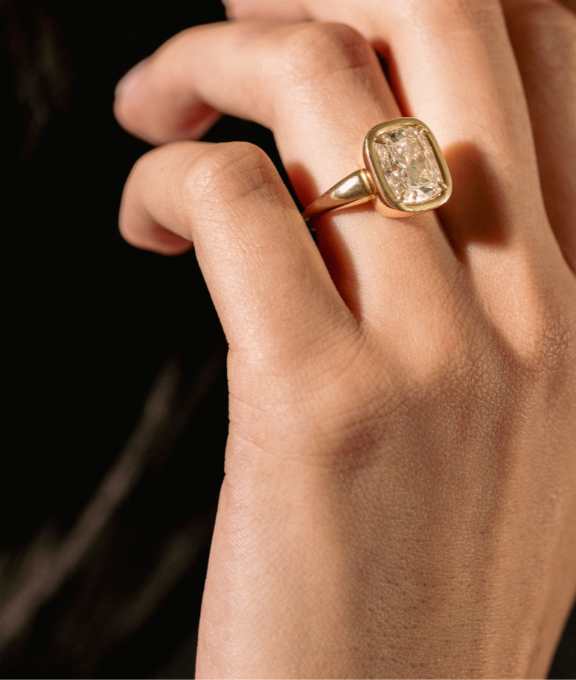
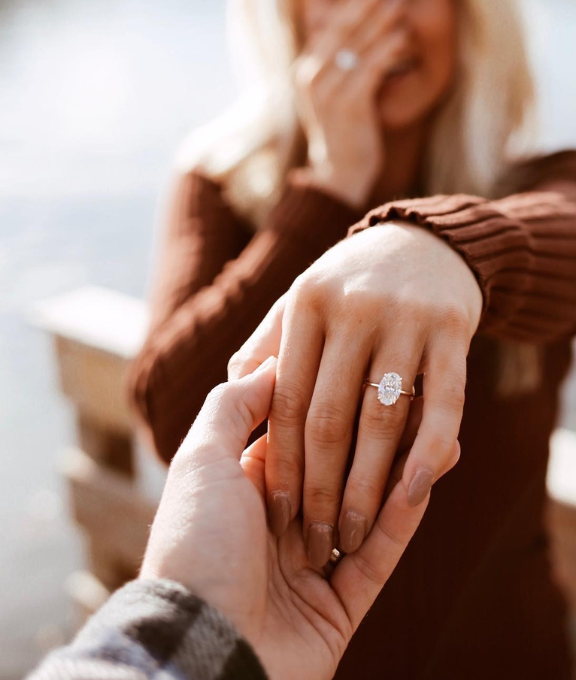


A solitaire ring puts all the focus on a single stone, and there’s something quietly powerful in that. Explore our collection and let us help you find a ring that feels right.
Can't find the perfect diamond?
talk to an expert


Amazing experience, we couldn’t be happier with the engagement ring. This company is great and I will definitely go back to them for any other jewelry!

A solitaire diamond ring is the most classic of all engagement rings, with just a single, central gemstone. Unlike other styles, solitaires are characterized by their simplicity, with no additional diamonds or gemstones anywhere on the band. This style, which dates back to ancient Roman jewelry, emphasizes the importance of the central stone as the ultimate focal point. While the solitaire itself exudes a timeless elegance, some couples opt for a matching simple wedding band, or a more bold chunky ring that complements the diamond engagement ring.
This setting holds a single center diamond on a plain band, with no side stones or accents. That one stone carries the whole design, so all of the light and attention stay on it. It is the most chosen engagement ring style, and it suits almost any wedding band.
They stay popular because a single stone on a clean band suits every diamond shape and every finger, and the look does not date the way trend-driven designs can. About 35 to 40% of engagement rings use one. The simple setting also keeps the focus on the center diamond rather than on accent stones.
Most use one of three settings. A prong setting lifts the diamond on thin metal prongs so light enters from every side, giving the most sparkle. A bezel wraps a thin rim of metal around the girdle, which guards the edges and can make the stone look a little larger. A tension setting holds the diamond between the two ends of the band, so it appears to float, though it is harder to resize later.
The trade-off is exposure against security. Four prongs show a little more of the diamond and give a cleaner, more modern outline. Six prongs cover slightly more of the stone, hold it more securely, and give round diamonds a fuller circular look. Six is the safer pick for an active hand or a larger stone.
A solitaire shows the center diamond on its own, while a halo encircles that diamond with small accent stones that make it look up to half a carat larger. A hidden halo tucks those accents under the center stone, so the ring looks plain from above and shows the extra sparkle only from the side. The bare setting is the cleaner look, and a halo adds size and shine while asking less of the budget than a bigger center stone would.
The real question is how much width you want across the finger. A solitaire keeps one diamond and a simple line. A three-stone ring adds two side stones, usually 30 to 50% of the center’s size, for more width and sparkle, and the stones can stand for past, present, and future. With no side stones, the whole cost rests on the single diamond.
Choose a solitaire if you want a smooth band and the easiest upkeep, and a pavé band if you want extra sparkle running along the finger. A pavé shank lines the metal with tiny accent diamonds that run down the shank, which can make the center look larger. Those small stones need occasional checks, and a plain band is simpler to resize.
An east-west setting turns the center diamond on its side so it lies across the finger. The look is modern, and an elongated shape like an oval or emerald can appear a little longer set this way. It still holds a single stone, so only the orientation changes.
A solitaire holds one diamond, a cluster gathers several smaller stones into one shape, and a toi et moi sets two stones side by side. Cluster and toi et moi rings give a more personal, less expected look, and they can cost less for the same face-up size. The single stone is the simplest and most classic of the three.
The setting usually costs less than a halo, pavé, or three-stone design because it has no accent stones. The center diamond still accounts for most of the price, so a larger or higher-grade stone can make the ring more expensive even without accents. With no accent stones, more of the budget goes into the diamond itself.
Every diamond shape works in this setting. Round brilliants give the most sparkle and suit four- or six-prong settings equally well. Elongated shapes like oval, emerald, and pear stretch the finger and often look larger for their weight. A bezel flatters shapes with points or corners, wrapping a metal rim that guards those edges.
It pairs cleanly with almost any wedding band because the single stone leaves room on both sides. A plain or pavé straight band rests snug beside a low mount, and a taller setting lets a straight band tuck underneath without leaving a gap. You only need a contoured band when the center stone is set very low or turned east-west.
It suits everyday wear well, especially in a low-profile or bezel setting that guards the diamond’s edges and rests close to the finger. A tall prong setting rides higher and snags more readily on clothing and gloves, which is why a lower mount is the calmer choice for busy hands. GOODSTONE offers half-bezel and low-profile options with resizing and prong checks whenever the ring needs them.
This ring is about the easiest to keep bright, since it has no accent stones or hidden grooves to trap grime. Every couple of weeks, fill a small bowl with warm water and a drop of mild dish soap, work gently over the stone with a soft toothbrush, then rinse it and buff it dry with a lint-free cloth. Once a year, have a jeweler give it a proper cleaning and confirm the single-prong setting still holds the diamond firmly.
It shows the diamond at its true size. Nothing surrounds the stone or hides any of it, and without a halo or a pavé shank borrowing brightness from around the edges, what you see is the stone alone. For anyone who wants the diamond judged on its own terms, that is the whole point of the setting.
Get in touch with our concierge team to book a one-on-one call with us to discuss about your Engagement Ring. We will walk through the process from diamond sourcing to choosing the perfect setting.


