






Engagement Ring Styles: A Complete Guide
A ring on a jeweler’s site might be listed as a cathedral solitaire with a pavé band and a hidden halo. All four terms describe the same ring, but each tells you something different about its design.
Solitaire tells you the ring is built around a single center stone, while pavé describes how the smaller stones along the band are set. Cathedral refers to the metalwork, with arches that rise on either side to meet the setting. A hidden halo is a circle of small stones tucked beneath the center stone, out of sight from above.
Strung together in a product name, those distinctions can be easy to miss.


What “Style” Refers To
Four terms can appear on one ring without contradicting each other because each answers a different question about it. Solitaire and hidden halo are both about the stones, one saying there is a single stone at the center and the other adding a circle of small ones underneath. Pavé is answering something else entirely, how the small stones in the band are secured.
Cathedral is about the metal underneath, the arches that rise from the band to support the setting. Those arches also set the center stone higher above the finger. Vintage and Art Deco work differently, describing the look a ring is going for without committing to a particular construction. A solitaire can be prong-set or bezel-set, and either can be made in a vintage or modern style.
Stone Arrangements
A solitaire is a ring built around a single center stone. The band below can be plain or set with small stones, since solitaire refers to the center stone and leaves the band as a separate decision.


The other arrangements describe what happens when stones are added, and where those stones go is what changes the name. Put a circle of small stones around the center, and the ring has a halo. The circle makes the center stone look larger and widens the top of the ring.
A hidden halo puts that circle underneath the center stone, which a top-down photo will not show. Those small stones usually go into the head, below the center stone, though some designs place them lower on the ring.
Stones set beside the center make a different arrangement. A three-stone ring names a count, one center stone with a companion on each side. The three do not have to be the same cut. One pairing uses tapered baguettes beside an oval center. Side-stone is a looser description, covering accent stones set along the shoulders without specifying how many.
Two arrangements give up the single center altogether. A Toi et Moi ring sets two stones side by side, French for you and me, and the two do not have to match. GOODSTONE’s Toi et Moi Series pairs a pear with a radiant or a pear with an emerald cut on one band. A cluster groups several small stones close together so they look like one larger form.
East-west describes how the center stone is oriented, turned so an elongated cut like an oval or an emerald runs across the finger. It says nothing about how many stones the ring has, and a solitaire and a three-stone ring can both be east-west.


How the Stone Is Fastened
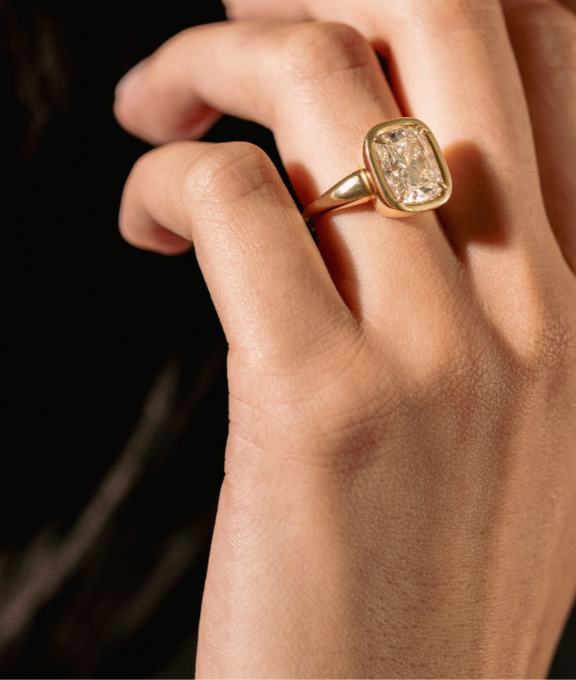
Prongs and a bezel differ mainly in how much metal touches the stone. Prongs grip it at a few points and leave the rest of the edge open. A bezel runs a rim all the way around that edge, so more of the stone is protected, and a little less of it shows from the top.
Because that rim has to follow the outline exactly, it is made for one stone, and putting a different cut in later means a new rim. A half bezel falls between the two, with metal on two sides and the other two left open.
Rows of small stones are a different problem. There, the question is what goes between them. In a channel, nothing does. The stones run inside a groove with metal walls on the outside, so the line looks unbroken.
A bar setting puts a strip of metal between each stone, gripping it on two sides and leaving the outer two open. Pavé sets the stones close together with small beads of metal, so barely any metal shows between them.
Tension is the outlier. Nothing wraps around the stone at all. The two ends of the band press against it, and some makers add a concealed bezel underneath for strength. That pressure is built for one stone at one size, so a tension ring is hard to resize and needs a stone hard enough to take the load.
One ring can use more than one of these. A prong-set center stone above a pavé band uses two, and a listing will mention both.
Design Styles
Design labels describe a ring’s overall look, and what gives each one away is usually the detailing worked into the metal.
Vintage is the label worth a follow-up question, since it gets used for two different situations. Antique has a settled meaning in the trade, a piece at least a hundred years old, which in 2026 means roughly 1926 and earlier. Vintage is looser, and sellers do not agree on where it starts.


A new ring described as vintage or vintage-inspired is telling you about its design. A genuinely old ring is one particular piece that already exists, so you take it as it comes. You can order a newly made vintage-inspired ring in the metal and size you want.
The era names are easier to tell apart than they sound, because they look different. Edwardian rings are lacy and curved, built around filigree, fine metal wire twisted into openwork patterns. Metalwork that looks like lace points to that period.
Art Deco, from roughly the 1920s into the 1930s, is built on straight lines and symmetry, with milgrain running along the edges, a row of tiny metal beads. Step cuts like the emerald and the Asscher belong to that look, so a rectangular stone with stepped facets is a common sign.
Nature-inspired rings give themselves away through their forms, leaves and vines worked into the band, sometimes with the metal textured to suggest bark. Modern designs keep the lines cleaner and the ornament lighter, so what you notice is the outline and the stone.
Classic is the one to be careful with. It names no period and no motif. It usually means a plain solitaire on a simple band, but the meaning varies from seller to seller, so it is worth checking what a particular listing means by it.


Stone Shape
Round, oval, emerald, pear, cushion, princess, marquise, Asscher, and radiant name the outline of the stone. Shape is a choice of its own. The same oval can be a solitaire or the center stone of a three-stone ring, and either version can be bezel-set or prong-set.
Round, princess, and Asscher are close to as wide as they are long. Oval, marquise, and pear run longer than they are wide, which is the proportion east-west orientation works with. Emerald, radiant, and cushion come in both squarer and longer versions, so one shape name can arrive in different proportions.
Faceting is a separate matter from the outline. Emerald and Asscher are conventionally step cut, with broad flat facets in parallel rows. Brilliant faceting, which most of the other shapes use, has many small facets radiating from the center. Step cuts sparkle less than brilliant faceting does, and inclusions and body color are easier to see in them.
Shape does not fix the faceting. Cushions vary a good deal in how they are faceted, and step-cut versions of other shapes exist, so a shape name on a listing describes the outline and leaves the faceting to be checked.
Comparing Two Listings
With two rings side by side, the arrangement terms tell you which has stones beyond the center one, though not how many. A halo, a hidden halo, a pavé band, and side stones all mean small stones somewhere in the design, while a solitaire on a plain band has one.


When a listing quotes a carat figure, check which figure it is. Look for “ct tw,” which means total weight across every stone in the ring. A halo ring quoted that way can have a smaller center stone than a solitaire at the same number.
A few of the securing terms also warn you about later changes, and they are worth spotting on a listing. A tension setting has its pressure built for one stone at one size. A bezel rim is cut to one stone’s outline, so a different cut can mean rebuilding the rim. A bar setting that runs the whole way around the band is harder to resize than one that stops short of the bottom.
The kind of term that changes tells you how the rings differ. Vintage versus modern is a difference in detailing, and two rings labeled that way can be built the same underneath. Prong versus bezel is a difference in what touches the stone.


Where the Terms Combine
Take “vintage-inspired halo with a pavé band,” for example. Vintage-inspired is the look, and halo says there are small stones around the center. Pavé covers how the small stones in the band are fastened.
The listing does not say how the center stone is secured. Nothing there names prongs or a bezel, so that stays unknown.
A short listing may describe a plain ring, or it may briefly describe a detailed one. What a listing leaves out is worth asking about before you buy.
Common Questions About These Terms


Do these terms mean the same thing at every jeweler?
Not consistently. A term tied to something visible on the ring leaves less room for interpretation, since you can look at a bezel and see the metal wrapping the stone's edge. A label like classic or modern names no particular feature, so it means what a seller wants it to. Looseness is not limited to design labels. Side-stone names an arrangement without specifying how many stones, and cushion names an outline without settling the faceting. If a term does not name a specific feature, ask the seller what they mean.
What should I ask about a ring I have only seen online?
Start with what secures the center stone, since a listing can name the pavé on the band and leave the head unmentioned. If the only carat figure given is a total, ask what the center stone weighs on its own. On a cushion, or any shape where faceting varies, ask how the stone is cut. It is also worth asking for a side view, since details like a hidden halo and cathedral arches are easier to see in profile.
Why are two rings described with the same words priced differently?
Style terms describe how a ring is designed and built, and they stop there. Nothing in them reports the grade of the center stone or how well the ring was made. Two listings can match term for term and still describe rings that differ on both counts. Reading the terms tells you what kind of ring you are looking at, and the rest comes down to the stone and the workmanship.
Does any of this apply to lab-grown diamonds?
Yes. Arrangement, securing method, and design style all relate to the ring itself. Shape describes the stone’s outline, while faceting describes how it was cut. None of those terms tell you how a diamond was made, so its origin is identified separately, usually as the words laboratory-grown or laboratory-created in the stone’s description.