






What a Diamond Grading Report Tells You & What It Doesn’t
Every diamond worth buying comes with a grading report, and most buyers read it like a nutrition label, checking that the numbers look respectable before moving on.
The document repays closer attention. GIA weighs a stone to five decimal places and publishes two, then plots every inclusion large enough to draw. How the stone looks across a restaurant table is not on it, and neither is what it would have scored at a different laboratory.
It is the only document in the transaction written by someone who is not selling you the stone.
Where Shape Fits
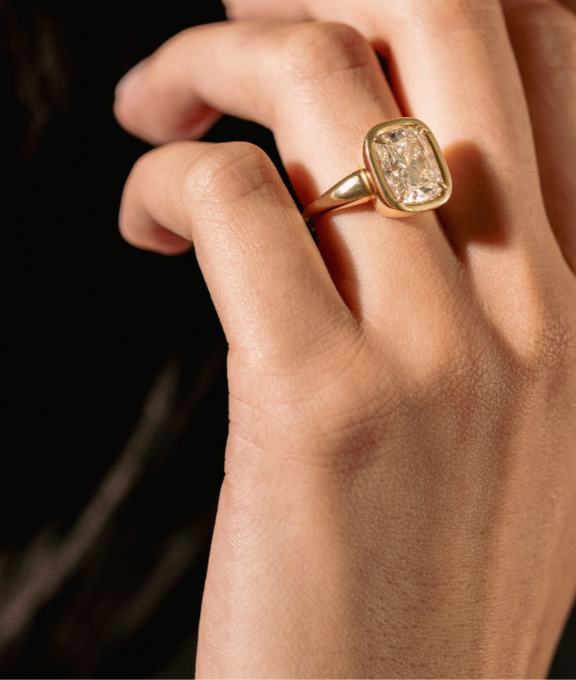
Shape is usually the first decision a buyer makes. The outline governs how much of your finger a stone covers at a given weight, and how much of its own body color reaches your eye when you look straight down at it. A corner or a point is thinner than a curve, so the setting has more work to do on some outlines than on others.


Cut Past the Grade
Cut is the only one of the four that grades human work, and on a GIA report the overall grade appears on round brilliants only.
The grade is a composite of seven things. Brightness, fire, and scintillation describe how the stone handles light. The remaining four are matters of workmanship, being weight against diameter, girdle thickness, facet symmetry, and the quality of the polish. An optical scanner takes 400 contour images and rebuilds them into a three-dimensional model to derive the proportions. A grader assesses the polish, the symmetry, and the girdle by eye.
Excellent covers more ground than the word suggests. Stones with different proportions arrive at the same cut grade, and two Excellents side by side will often differ visibly. GIA built the system from tens of thousands of observations in which viewers picked the stones they found most visually appealing, so the grade records what most people preferred. You may prefer one graded lower.
Polish and symmetry are graded separately and printed separately, each on its own Excellent-to-Poor scale. Polish takes in the condition of the facet surfaces, including blemishes left by the polishing wheel or picked up during wear. Symmetry measures the exactness of the outline and how precisely the facets align. A stone rated Excellent on all three is what the trade calls triple Ex.
For any outline other than a round brilliant, GIA grades only polish and symmetry. The report still prints measurements and a girdle description, ungraded.


Clarity & What Eye-Clean Means
GIA’s clarity scale has 11 grades across six categories, from Flawless down to I3, and it assigns each grade under 10x magnification. A grade comes from the number, size, nature, position, and relief of a stone’s inclusions and blemishes. Relief is how strongly a characteristic contrasts with the diamond around it. Inclusions are internal or reach the surface, while blemishes stay on the surface. Most stones in a jewelry store fall between VS and SI.
Where the Term Comes From
Eye-clean is the trade’s term for a stone whose inclusions cannot be seen without magnification. GIA does not use it. No laboratory assigns it, and no standard defines it.
The one quantified definition in circulation sets the test at 6 to 12 inches from the eye, face-up, in daylight-equivalent or fluorescent light, with 20/20 vision. IGI publishes that wording while stating that IGI and other laboratories do not make the judgment. It began as a consensus among gemologists polled on a consumer forum, so treat it as a working rule with no standards body behind it.
The standards themselves make no promise. CIBJO requires inclusions in an I1 stone to be visible face-up to the naked eye, then adds that inclusions may also be visible face-up in higher grades. GIA attaches the unaided eye to the I grades alone and hedges even that with “often.” AGS says SI inclusions are sometimes visible without magnification. No grade on the scale guarantees anything.
Inside the Plotting Diagram
A GIA report for a D-to-Z stone carries a plotting diagram, a map of the clarity characteristics drawn to scale in their approximate shape and position as a grader sees them at 10x. It gives two views, the crown from above and the pavilion from below. No two stones plot alike, so the plot doubles as identification.
The key lists characteristics in a fixed order. Laser drill-holes come first, for disclosure. Grade-setting inclusions come next, which tell you which characteristic the grade turned on. Other inclusions, naturals, and extra facets follow. Red indicates most inclusions, green marks naturals, black marks extra facets, and red with green together covers cavities, knots, etch channels, indented naturals, and laser drill-holes.
Characteristics that are faint or widespread may go unplotted, though they can appear under Comments. The GIA Diamond Dossier and the eReport include no plot at all, instead listing up to four characteristics that support the grade.
Treated Stones
Treatments do one of two jobs, improving clarity or altering color. GIA grades stones with stable ones, so laser drilling, HPHT processing, irradiation, and annealing all appear on reports. Drill holes are plotted as clarity characteristics, and a color-treated stone gets an asterisk beside its color grade plus an inscription on the girdle.


Fracture filling and coating are neither permanent nor stable, and GIA issues no grading report for a stone that has had either. A filled stone therefore comes to you without the document that would grade it. Filling cannot take a jeweler’s torch. GIA’s own bench testing sweated the filler out during prong retipping, and boiling in acid and repolishing damaged it too. The FTC requires disclosure of any treatment that is impermanent, requires special care, or materially affects value. Fracture filling triggers all three.


Color & Where the Eye Breaks
The D-to-Z scale measures color absence. Each letter covers a range of tone and saturation, and GIA assigns one by viewing the stone table-down under controlled lighting against a set of master stones, each of which is itself a diamond fixed to a letter.
The letters group into five bands, and GIA’s description of each says more about naked-eye visibility than the grade alone does. D through F is colorless. Across G to J, near-colorless, coloration often goes unseen except by trained graders. K through M is faint, which GIA still calls difficult for an untrained eye to see. Only at N through R does color become visible to an untrained eye, and then only in larger stones. By S through Z, it shows at many sizes.
Every GIA report carries a fluorescence evaluation of how a stone reacts to long-wave ultraviolet light. Between 25 and 35% of diamonds submitted to GIA show some fluorescence, and about 10% of those show enough to affect appearance. More than 95% of the time, the reaction is blue. A strongly fluorescent stone may show more contrast. Fewer than 0.2% of fluorescent stones look hazy or oily.
Reading the Report
A grading report is an opinion formed under controlled conditions, and some parts of it are firmer than others.
Each letter on the color scale covers a defined range of appearance, so two stones graded H can differ in color. GIA’s own research puts a skilled grader’s repeatability at slightly less than one-fifth of a grade at best, which is the tolerance within which two experts can disagree.


Across laboratories, the spread widens. Reports issued to different standards can produce different results for the same stone. GIA has written that using the same color grading terms does not amount to applying the GIA system, since the conditions and the methodology are part of it. A stone near a boundary can fall on either side depending on who looked.
Report, Certificate & Appraisal
GIA does not certify diamonds. Its own wording is that a GIA-certified diamond is a misnomer, since the laboratory grades stones and describes them without guaranteeing anything about them. The document is a report.
An appraisal is a different instrument, an opinion of value written for insurance. GIA does not provide one and does not name appraisers. A report confirms the characteristics that determine value without stating a value.
The report number is laser-inscribed on the girdle of many graded stones. That inscription ties one document to one stone. GOODSTONE verifies each diamond’s identity against the inscribed number.
What Changed for Lab-Grown
On October 1, 2025, GIA stopped applying 4C grades to laboratory-grown diamonds. A submitted stone now receives a Quality Assessment reading Premium or Standard.
Premium requires D color, VVS clarity or better, Excellent polish and symmetry, and an Excellent cut grade for round brilliants. Standard sets minimums of E to J color, VS clarity, Very Good polish and symmetry, with Good symmetry allowed on fancy outlines, and a Very Good cut grade on rounds. A stone that meets neither gets no assessment.
The fee is $15 per carat with a $15 minimum, and the minimum submission is 0.15 carats. Every assessed stone has its girdle inscribed with the term Laboratory-Grown and the assessment number. Natural diamonds are unaffected and receive full 4C reports as before.


Carat, Points & the Price Steps
One carat is 200 milligrams. It divides into 100 points, so a half-carat stone is a 50-pointer. GIA weighs on an electronic micro-balance to five decimal places and publishes two. The rounding is deliberately asymmetric. A weight rounds up to the next hundredth only when a nine occupies the thousandth place. That sends 1.769 to 1.77 and leaves 1.768 at 1.76.
Price does not climb smoothly with weight. It steps at 0.25, 0.50, 0.75, and 1.00 carats, where demand concentrates. The 1-carat step is the steepest. A 0.96 and a 1.02 differ by 6 points, close to invisible on the hand, and the 1.02 can cost as much as 20% more. A stone bought deliberately below a mark costs less at close to the same visible size.
Total carat weight is a different number again. A ring set with many small stones adding to 2.15 tcw costs considerably less than one set with a single 2.15 carat diamond. Rarity rises with the size of the individual stone. Where a piece mixes diamonds with other gems, the combined figure is called total gem weight.