





How to Find Your Ring Size & Get It Right the First Time
One full US ring size is 0.8mm of inside diameter, and half a size is 0.4mm. Sizes that close leave little room for measuring error. A string wrapped too tightly, or a printable size chart the printer shrank to fit the page, can produce the wrong number. Fingers also change with temperature and throughout the day. Measure more than once, on separate days, before ordering.


Diameter, Circumference & the US Scale
A ring size describes the opening in the middle of the band, given either as the diameter straight across it or as the circumference around it. US size 7 has an inside diameter of 17.3mm and an inside circumference of 54.4mm. The US scale is divided into quarter steps of about 0.2mm of diameter.
The international ISO 8653 standard, used across continental Europe, defines ring size as the inside circumference in millimeters. A French 54 measures 54mm around the inside and corresponds to a US 7. Record the measurement in millimeters alongside the size whenever a jeweler or chart provides both.
Measuring at Home and Where It Goes Wrong
At a jeweler, you try on graduated metal rings from a sizer set until one fits. That ring is stamped with its size, removing the need to take a separate measurement or make a conversion. Plastic sizer belts do the same job in one piece, threading through a buckle and tightening to a reading. Tighten it until the band stays at the base of the finger without slipping, then check that it still comes back over the knuckle without force.


A printable chart has to come out of the printer at actual size, so set the scaling option to none and check any reference line on the sheet with a ruler before using the circles. String and paper strips have no scale to check against, and wrapping one tight enough to compress the finger gives a reading smaller than the true size. That reading is also a circumference. If the chart you are using lists diameter, divide that measurement by 3.14.
Ring size is specific to the finger, so a ring you already own has to come from the finger you are sizing. You can then measure it accurately against a chart or with calipers. The dominant hand can be slightly larger, so a ring from one hand may not give the correct size for the corresponding finger on the other.
One full US size is about 2.5mm of circumference. In a string measurement, 2mm of error is nearly a full US size.


If Your Ruler Is Marked in Inches
US ring size charts publish inside diameter in inches alongside millimeters. A size 7 is 0.682 inches across, and a size 9 is 0.746 inches. One full size is 0.032 inches of diameter.
That figure is finer than the markings on a household ruler. A sixteenth of an inch is 0.0625 inches, close to two full ring sizes, so a diameter read off a ruler marked in sixteenths cannot separate one size from the next. Circumference gives more room, since a full size is about a tenth of an inch there, though a sixteenth still covers more than half a size.
To convert a figure you already have, multiply inches by 25.4. Millimeters are the finer unit for this.
Sizing Around a Prominent Knuckle
A knuckle wider than the base of the finger gives you two measurements and one number to choose. Take both readings with the same tool, one at the widest part of the knuckle and one at the base. Matching the size to the knuckle leaves extra room at the base. The ring should go over the knuckle without force and be snug once it reaches the base. If you have to force it over the knuckle, the size is too small even when it fits lower down. Choose a size between the two readings. Give a jeweler both measurements when you order.


When the two readings are far enough apart that no single size satisfies both, the band itself has to change. A hinged shank opens at the bottom, so the ring is placed on the finger without passing over the knuckle. Inside the band, a spring bar flexes as the ring goes on and closes again underneath.
A ring sized to pass the knuckle can still turn once it is on. The flat underside of a euro shank keeps a heavy top upright better than a round band does. Ring guards clip on underneath and come off again. Ask a jeweler before fitting one, since a metal guard can mark the band.


When Fingers Are at Their Largest
Fingers shrink when cold and expand when warm. They also fluctuate throughout the day, reaching their largest toward the middle or end. That is the most reliable time to measure. Cold hands measure small. Avoid taking a reading straight after a hot shower or a workout.
Finger size can vary slightly from day to day, so a second reading may be different. If a measurement falls between two sizes, take the larger one.
Why a Size Stops Fitting
Not every change to a finger reverses by the next day. Weight gain or loss alters finger size, and the shape of a finger changes with age. Neither shows up in a measurement taken today. A size that was correct when the ring was ordered may no longer be correct later. Pregnancy also swells the hands. That swelling recedes afterward.


Wider Bands and Comfort-Fit Interiors
Wide bands fit more tightly than narrow ones of the same size. Published guidance on when to size up for width ranges from bands over 4mm to bands over 10mm. Check what the jeweler or the product page says about the band you are buying.
The inside shape of the band also changes the number. A comfort-fit band is domed on the inside, so less of its surface touches the finger. Compared with a standard-fit band of the same size, it slides over the knuckle more easily and fits more loosely once on. Advice on how far to size down for it ranges from none to half a size, so sizing on a comfort-fit gauge gives the more reliable number.
Reading a Size From Another Country
British and Australian sizes use letters, with half sizes between them. Japan uses whole numbers, and its scale has no linear relationship to circumference or diameter.


| US | UK | European | Circumference |
|---|---|---|---|
| 5 | J½ | 49 | 49.3mm |
| 6 | L½ | 52 | 51.9 |
| 7 | N½ | 54 | 54.4mm |
| 8 | P½ | 57 | 57.0mm |
| 9 | R½ | 59 | 59.5mm |


Ring Sizes for a Surprise Proposal
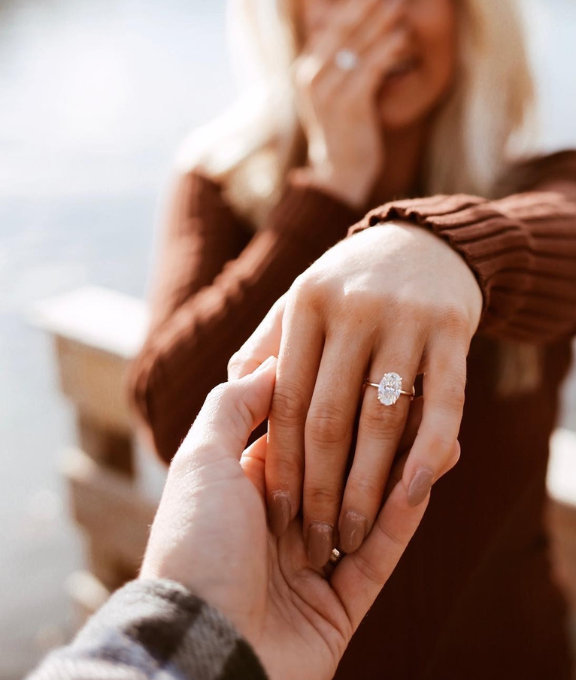
When the finger cannot be measured directly, the number comes from a borrowed ring or someone who already knows the size. GOODSTONE books design appointments by video and in person, so you can ask a designer about sizing before you place the order. Find out how long the ring will take before you fix the proposal date.
A Starting Range for a Guess
With nothing to measure, a guess has to start from a range. For women, that range is 5 to 7, and for men, it is 8 to 10. Those ranges span two full sizes each, or about 5mm of circumference. A number chosen this way is a placeholder for a measurement.


If the Size Turns Out Wrong
Resizing and exchange are separate remedies with terms that can differ. A resize alters the ring you bought, and an exchange replaces it with another. Read both sets of terms.
Some designs cannot be resized at all. Ask about the specific ring and get it in writing before ordering.