

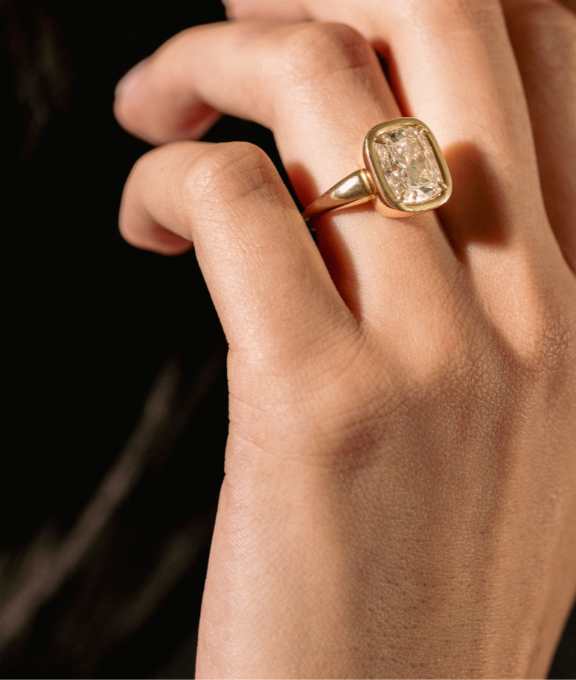
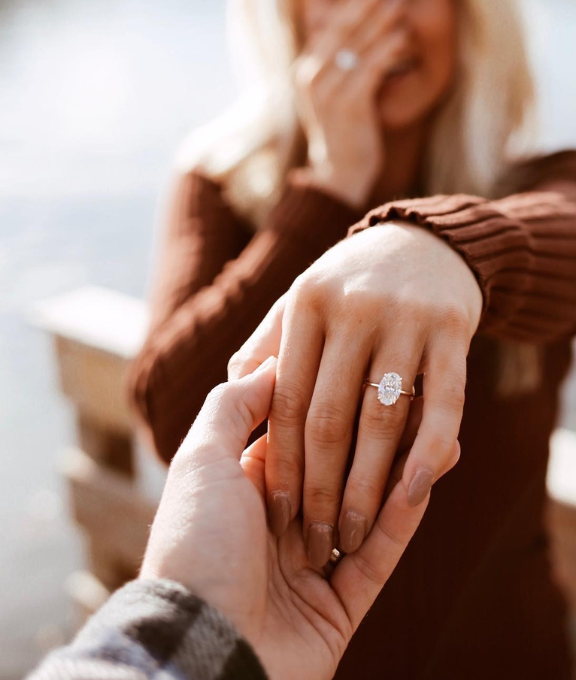


If you want a setting that protects without hiding, a half bezel might be what you’re looking for. Our styles are sleek and made to last. Browse the collection and find the one that’s meant for you.
Can't find the perfect diamond?
talk to an expert


I could not have asked for a better experience from Goodstone. From the very beginning, Monica was incredibly polite, helpful, and knowledgeable as we designed my custom engagement ring together. The finished ring is absolutely beautiful and was even completed ahead of schedule! I couldn’t be happier with both the ring and my experience at every step of the process. Huge thanks to Monica, Amanda, and the entire Goodstone team!

The Half Bezel setting is designed to cradle the center stone securely along its sides while leaving the top and bottom exposed, creating a striking balance between protection and brilliance. This unique design highlights the beauty of the gemstone while offering a modern, minimalist aesthetic that stands out from traditional settings.
The Bezel setting is one of the oldest techniques in jewelry making, with origins tracing back to ancient civilizations such as Egypt and Rome. The Half Bezel, a modern adaptation, combines the security of a full bezel with the openness of a prong setting, allowing more light to interact with the gemstone while maintaining a sleek and contemporary aesthetic. Our collection features meticulously crafted rings that blend historical craftsmanship with modern design principles to create a truly timeless piece.
A half bezel setting wraps a metal rim around only two opposing sides of the diamond, holding it firmly while leaving the other two edges open to the air and light. This gives you some of the protection of a bezel with a more open look, so the stone stays visible from the sides.
A half bezel covers two opposing sides of the diamond and leaves the other edges open, while a full bezel wraps metal all the way around the rim. It exposes more of the stone to light and reveals more of its outline, while the full version provides more coverage and protection for every edge.
Held on two sides, the diamond stays secure, though a full bezel offers a bit more coverage by surrounding the entire girdle. With two metal walls gripping opposing sides, the stone stays stable for daily wear, and the open edges hold up as long as you avoid hard knocks against exposed corners.
For an active life, the low rims cover the sides most likely to catch, keeping the ring smooth against hands and clothing. Two edges stay open, so a wearer can turn those toward the palm, where knocks are less likely. It provides less coverage than a full bezel, yet still snags far less than raised prongs do.
With two sides left open rather than covered in metal, more light reaches the diamond than a full bezel allows. Light enters through those open edges, so the stone keeps more of its brightness than it would inside a full rim while still gaining protection on the two wrapped sides.
Two opposing edges of the diamond stay open, so those sides have less metal shielding than they would with a full rim. The two wrapped sides stay well protected. Positioning the open edges away from the most exposed points helps, and the diamond remains hard, so everyday contact rarely causes harm.
Two smooth metal walls wrap opposing sides of the diamond, where a prong solitaire holds it with small raised claws. The bezel rides lower and catches less on clothing, while the prong version lifts the stone higher and opens more of it to light from every angle.
An elongated stone gains the most here, since the two walls grip its long sides and leave the tips bare, so the open ends carry the eye down its length. Oval and emerald cuts show this off best, and marquise or pear stones do the same. Round and cushion diamonds work too, held snug between the walls with their curved edges on view.
Resizing goes smoothly, since the open band below the setting gives a jeweler room to work without disturbing the metal around the stone. This makes it easier to resize than a full bezel, where more of the metal connects to the shank, though the range still depends on the band and the alloy.
The diamond looks slightly larger because the two wrapped rims press close to the stone and pick up where its edges end, adding a little apparent width. The effect is gentler than a full bezel, since two sides stay open, so you still see most of the diamond’s true outline.
A plain or thin pave wedding band pairs well with the solitaire, and because the setting rests fairly low, a straight band usually meets it closely. With the two open sides leaving nothing raised in the way, a flat band meets it cleanly, and no shaped cut is required.
This ring is simple to clean, since its smooth metal walls have fewer tight corners than prongs where grime gathers. The spot to watch is behind the two wrapped rims, where a little residue can hide, so a soft brush and warm soapy water work along those edges to lift it out. Rinse and dry the ring, and a professional cleaning now and then reaches what the brush misses.
Expect a price close to that of a plain prong solitaire, sometimes a little higher because shaping the two metal walls requires extra work. Where it runs higher, that reflects the labor of shaping the two walls rather than extra material, so the change to the total is slight.
Because only two sides are wrapped, a half bezel gives up very little sparkle. Light still pours in through the two open edges, so the diamond keeps most of the brightness a full rim would trim. What you notice is a lively stone with a softer line where the metal meets it.
Get in touch with our concierge team to book a one-on-one call with us to discuss about your Engagement Ring. We will walk through the process from diamond sourcing to choosing the perfect setting.


