

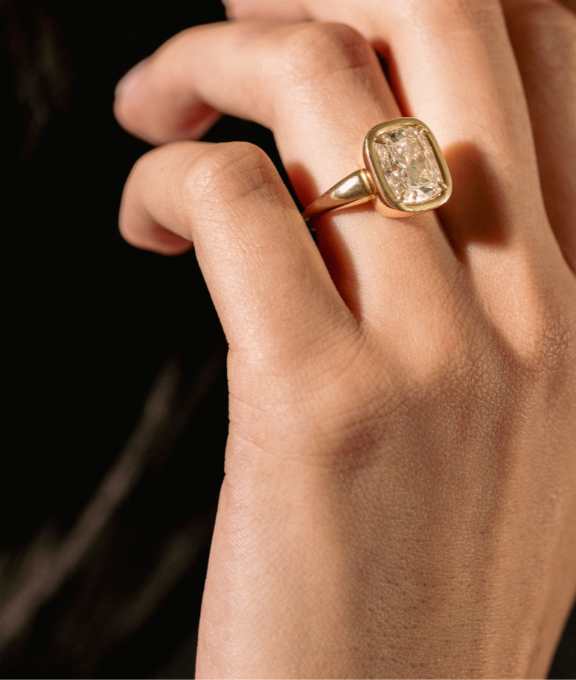
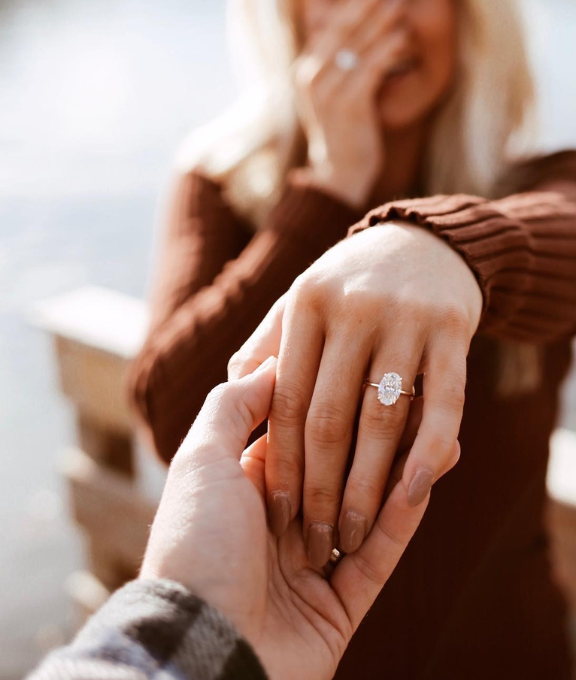


East-West rings set the diamond horizontally for a clean, contemporary feel. Browse our entire collection and see how one of these pieces could become part of your story.
Can't find the perfect diamond?
talk to an expert


Impeccable customer service from start to finish! I also love my rings. I literally can’t stop looking at them and smiling. I would recommend them over and over again.

An East West diamond engagement ring reimagines the traditional solitaire by setting the center stone horizontally across the finger rather than in the classic vertical orientation. This placement creates a clean, modern silhouette while still highlighting a single, central diamond as the focal point. The result is a design that feels both architectural and timeless — minimal in structure, yet bold in presence.
Elongated diamond silhouettes are especially striking in East West settings, including emerald, oval, marquise, radiant, and elongated cushion cuts. Set horizontally, these refined shapes glide elegantly across the finger, creating a graceful sense of length and a more expansive presence on the hand.
Designed with both beauty and wearability in mind, East West engagement rings transition effortlessly into everyday life. Some styles rest seamlessly alongside a straight wedding band, while others are complemented by a softly contoured band for a tailored fit. Paired with a minimalist band or a more sculptural design, the East West setting offers a sophisticated, modern interpretation of the classic solitaire.
An east-west setting places the center stone sideways, so it lies across the finger instead of pointing up toward the fingertip. Most rings are set north-south, and this horizontal turn gives a contemporary, less expected look. The style suits longer, elongated cuts, which show their length across the finger.
It describes the direction the stone faces. The diamond is rotated about 90 degrees from the usual upright position, and its long axis runs across the finger rather than along it. Nothing else about the stone changes, only its orientation in the setting.
The ring symbolizes unity and balance for many wearers, with the stone set evenly across the finger. Some connect the sideways set to equal partnership, and others like that it signals a modern, independent style. The meaning is personal and open to your own reading.
The difference is the direction the stone points. A traditional north-south setting sets the diamond upright, running from the base of the finger to the fingertip. An east-west setting turns it on its side so it runs across the finger. The sideways turn looks less expected and can make an elongated stone look wider on the hand.
Elongated shapes work best here, since turning them sideways shows off their length across the finger. Oval, emerald, marquise, pear, and elongated radiant or cushion cuts all suit the sideways set. Round and princess cuts look the same from every angle, and they gain little from the rotation.
The setting can make an elongated diamond look larger. Its longest edge spans the width of the finger, so the stone covers more of the hand without added carat weight. The effect is strongest with long shapes like oval and emerald, where the horizontal edge reaches almost from one side of the finger to the other.
You can, though it gains little from the turn. A round looks the same from every direction, so it has no distinct long axis for the sideways set to draw out. The horizontal effect depends on the long axis, which a circle lacks.
Any solitaire can be turned this way, since the orientation is a setting choice rather than a property of the stone. The visual payoff, though, tracks the long axis of the diamond. A solitaire with real length shows a distinct change once it is turned. A round or square stone looks much the same in either direction.
The setting is having a strong moment, and it draws on an idea that has appeared in jewelry for decades. Sideways settings are not new, so the look has staying power beyond the current wave of interest. How long it lasts comes down to personal taste rather than fashion.
Because the stone lies across the finger, a band shaped to follow that line usually rests best against the ring. A curved band can hug the base of the stone, and an open band leaves a small gap so the horizontal stone nests inside. A straight band can still work when the setting is high enough to rise above it.
The ring holds up to everyday wear, since the sideways stone settles lower and flatter against the finger than an upright setting. That lower profile catches less on clothing and rides comfortably through a busy day. A secure bezel or sturdy prongs keep an elongated stone protected.
They are not usually more expensive than a comparable upright ring. The stone and metal drive the price, not the diamond’s orientation. A custom or more unusual setting can add a little to the cost, though the sideways orientation itself does not affect the diamond’s value.
It cleans up the same way any ring does. Mix a little mild dish soap into warm water, run a soft toothbrush along the sides of the setting where the horizontal stone meets the band, then rinse it thoroughly and dry it with a soft cloth. The stone rests low and sideways, so a yearly jeweler visit to check that the horizontal seat still holds firm is worth the trip.
Both the oval and the emerald cut look excellent set this way, in slightly different ways. An oval turned sideways softens the hand and looks wide and full, while an emerald cut shows its long, straight lines running across the finger. The choice depends on your own taste for soft curves or straight edges.
Get in touch with our concierge team to book a one-on-one call with us to discuss about your Engagement Ring. We will walk through the process from diamond sourcing to choosing the perfect setting.


