

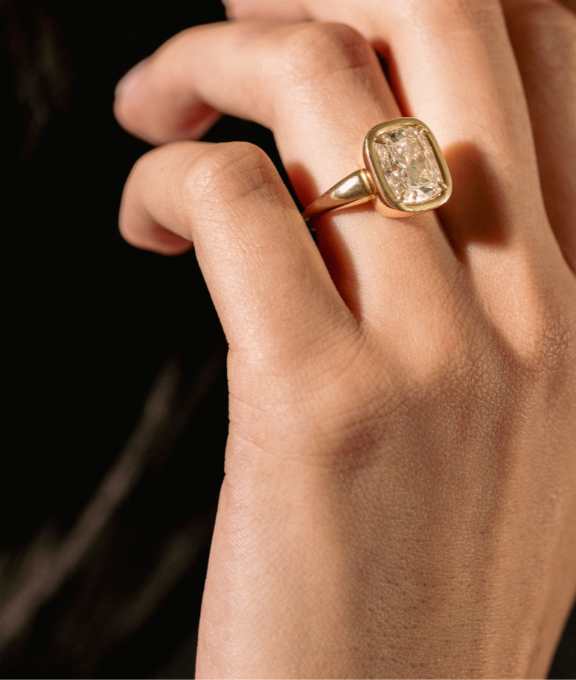



A cathedral setting raises your stone and lets light pour in from all sides. Our Signature collection pairs that look with double claw prongs. Browse and see what draws you in.
Can't find the perfect diamond?
talk to an expert


I had an amazing experience with Kayla at Goodstone. The team took the time really listen and understand our vision, and I came out of the whole process feeling confident that I was buying real quality. They were transparent about pricing and customization, and the whole process felt very easy. Everything turned out beautifully and my fiancée couldn’t be happier.

A cathedral engagement ring is a celebration of timeless elegance and architectural beauty. Inspired by the sweeping arches of classic cathedrals, this design elevates the center stone with graceful curves that rise from the band, showcasing its brilliance from every angle. The minimalistic band is perfectly complemented by double claw prongs, a detail that enhances the center stone's presence while providing optimal security.
This versatile design accommodates various stone shapes, allowing you to personalize your ring to reflect your unique style. The Signature Cathedral is more than just a ring—it’s a statement of refined sophistication, blending modern minimalism with traditional craftsmanship to create a piece that will never go out of style.
A cathedral setting has arched metal shoulders that rise from the band and sweep up to meet and support the center stone. The name comes from the graceful arches you see in cathedral architecture. The stone stays prong-held, and the arches lift it above the finger for a raised, framed look.
The Signature Cathedral is GOODSTONE’s premium version of the cathedral setting, so the arched shoulders and prong-held center follow the same core structure you find in any cathedral ring. The differences lie in the finishing, the proportions, and the metalwork of that arch, which vary from one ring to the next.
A cathedral solitaire adds arched metal shoulders that rise to cradle the center stone, while a plain prong solitaire leaves the stone above an unadorned band with nothing bridging the gap. The arches add height and side detail and lend extra support to the head.
The setting can catch on clothing and hair because the arched shoulders and raised head create more contours than a low, plain band. The prongs and the lifted stone give the fabric something to grab. Keeping the ring clean and having the prongs checked helps, and many wearers gradually adjust to the profile.
The arched design lifts the diamond higher on the finger, which can give the stone more presence from the side. The arches draw the eye upward toward the center and frame it, making the diamond appear slightly more prominent. That extra height comes from the setting rather than any change to the stone itself.
The raised shoulders add some metal alongside the head, which can help shield the diamond’s prongs and girdle from side knocks. The stone still rests up in prongs rather than inside a full frame, so the protection is partial. A bezel setting guards the edges more completely.
For everyday wear, a cathedral setting holds up fine, though the raised head and arched shoulders ride higher than a flat solitaire and offer more places to catch. For hands-on work, you might remove it, and the prongs benefit from periodic checks. Many wearers find the height comfortable once the ring settles into daily habit.
The sweep of the arches gives an elongated stone somewhere to rise, so oval and emerald cuts draw a graceful line up through the setting. Round, cushion, and princess diamonds also fit well, each held above the finger where the shoulders lift and frame it. How a given stone pairs with the arches comes down to its outline and size, which are easiest to judge with the stone in the setting.
A cathedral solitaire can be resized in most cases, since resizing happens at the bottom of the band away from the arched shoulders and the head. A jeweler adds or removes metal at the base, leaving the arches untouched. The workable range depends on the metal and the width of the arch above.
A cathedral setting collects more dirt because the arched shoulders and the space beneath the raised stone create crevices where lotion, soap, and dust gather. Reaching a soft brush under the arches and around the prongs with warm, soapy water clears those hollows that a rinse cannot. A jeweler’s cleaning once or twice a year gets at what the brush leaves and keeps the metalwork open to the light.
A straight band is the simplest pairing, and it suits the look when you want the two rings to form one line. The catch is that the arches can hold the shoulders slightly away from a straight band, so it does not always meet the ring at the center. A notched band, cut to seat against the base of each arch, tucks in more closely and is the safer choice when a tight pairing matters most. GOODSTONE can fit a band to a specific cathedral profile.
It usually costs a little more than a plain prong solitaire because the arched shoulders take extra metal and more detailed fabrication. How much more you pay turns on the metal, the width of the arches, and the stone. A jeweler can give you a side-by-side figure against a plain solitaire.
The higher profile can take a short adjustment, since the stone and arches rest above the finger rather than close to it. Many wearers find the ring comfortable once it settles in, and the raised head keeps the diamond off surfaces. Trying the profile in person helps you gauge the fit.
The gap comes from the arches themselves. As the shoulders rise toward the stone, they curve away from a straight band, so a small opening can appear where the two rings meet near the center. A band curved to follow that same rise closes the space and seats against the ring.
Get in touch with our concierge team to book a one-on-one call with us to discuss about your Engagement Ring. We will walk through the process from diamond sourcing to choosing the perfect setting.


