

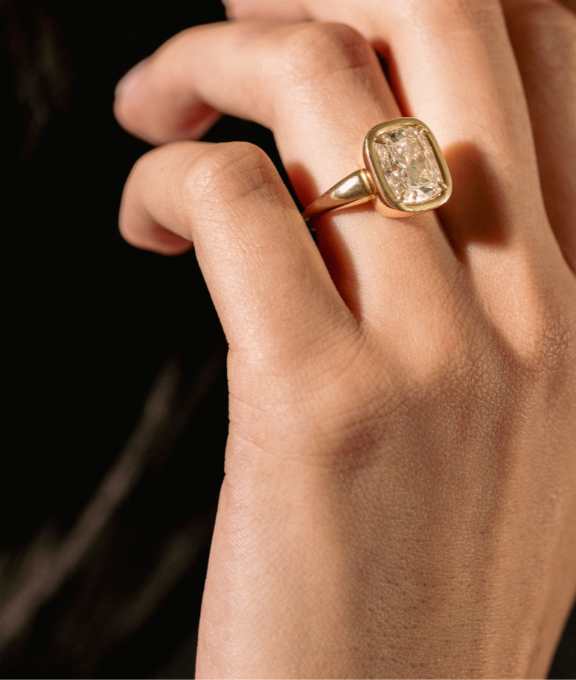
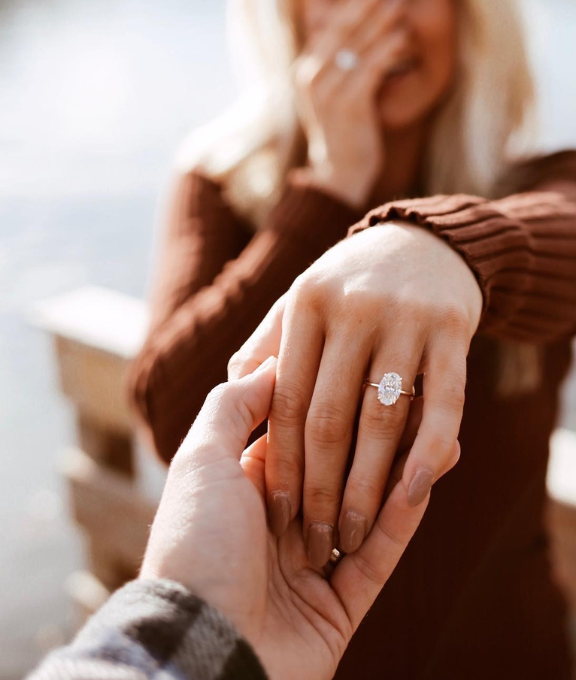


Emerald-cut diamonds feature bold step lines and a refined, confident look that honors your love story with elegance. Find a piece that feels quietly powerful and composed.
Can't find the perfect diamond?
talk to an expert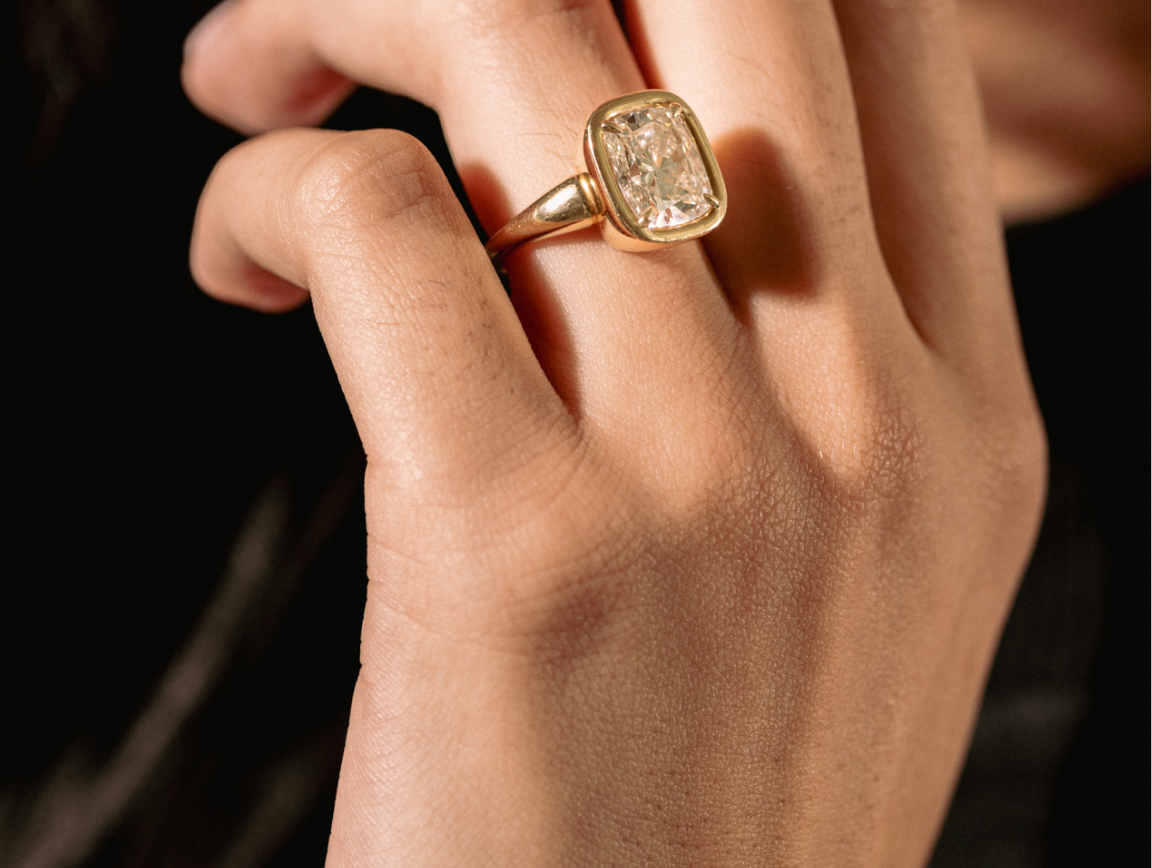
Get a bespoke design from
GOODSTONE that'll last a lifetime.


This place has the best products but I will say that the reason you want to go through them is the customer service/people. When you order something you can work with one of the sales reps and they are cool, insightful people who make the process less frustrating. They answer emails or you can reach out to them directly. Really makes a difference. They do a lot of the annoying work for you. I worked with Kayla and doe so shout out to them.

Step-cut emeralds reveal inclusions through the open table. Every emerald in this collection is reviewed internally before setting.
The emerald collection starts with a thin solitaire at $1,925 and includes three-stone, east-west, half-bezel, and pavé designs in yellow, white, and rose gold.
Each emerald is reviewed, set, and finished by hand at our Los Angeles workshop using recycled gold. Finished rings are shipped overnight in a sealed package, fully insured and requiring a signature upon delivery.
Every emerald ring includes free 30-day returns and lifetime care services, including polishing, resizing, prong tightening, and accent-stone replacement.

Both cuts use step facets and place a strong emphasis on clarity. The emerald cut relies on a rectangular outline that creates a longer visual line, while the Asscher uses a square shape with cropped corners. Although they share a similar facet structure, the two cuts produce noticeably different proportions and appearances.
The emerald and cushion cuts differ in both shape and faceting. The emerald uses a rectangular outline and step facets, creating broad reflections and a longer visual line across the finger. The cushion relies on brilliant faceting and rounded corners, producing a more scattered sparkle pattern. Although both remain popular engagement-ring choices, they create very different visual effects.
Length is a defining characteristic of both the emerald and marquise cuts. The emerald features a rectangular outline and step facets, while the marquise features an elongated silhouette with pointed ends and brilliant faceting. The emerald emphasizes broad reflections and symmetry, and the marquise produces a more scintillating sparkle pattern.
The emerald and old European cuts produce very different light patterns. The emerald features step facets and a rectangular silhouette, producing broad reflections and emphasizing clarity. The old European is a round brilliant cut with a high crown and a visible culet, producing a softer antique-style sparkle. Although both have historical roots, they create distinctly different appearances on the hand.
Shape is one of the clearest differences between these two cuts. Old mine diamonds use rounded corners and brilliant faceting, creating a softer appearance and a broader sparkle pattern. Emerald cuts rely on straight edges and step facets that emphasize clarity and broad reflections. Although both have historical roots, they produce distinctly different visual effects.
The emerald elongates through proportion. The pear elongates through silhouette. Because the emerald has no point and no exposed tip, it sits flush against cuffs and tucks under gloves without snagging, which matters more in daily wear than most shoppers expect. It suits a wearer who reads Architectural Digest before Vogue, and who would rather a ring look considered from across a table than dramatic in a close-up.
Each cut adds length to the finger through a different design. The emerald relies on rectangular proportions and step facets, while the pear combines a rounded end with a pointed tip and brilliant faceting. Because the emerald has no exposed point, it is less likely to catch on clothing and other everyday items. The two cuts also produce distinct light patterns, with the emerald emphasizing broad reflections and the pear producing more scintillation.
Cropped corners are one of the few traits these cuts share. The emerald relies on step facets that create broad reflections, while the radiant uses brilliant faceting that produces a more scintillating sparkle pattern. Although the shapes can appear similar at a glance, their light performance is noticeably different.
Round and emerald cuts differ most in their faceting. The round uses brilliant facets that maximize sparkle, while the emerald relies on step facets that emphasize clarity and broad reflections. The round’s circular shape also contrasts with the emerald's rectangular proportions, creating two distinctly different appearances.

"We don't believe in one right answer when it comes to diamonds. Lab-grown or natural stone to finished pieces, what matters is that you walk away with something exceptional. That's always been our standard."
- Blake Asaad, founder
An emerald cut diamond is a rectangular step cut with cropped corners that create an elongated octagonal shape. Its facets run in parallel rows, producing a different light pattern than the triangular facets used in brilliant cuts. A standard emerald cut has 57 facets. Step-cut faceting dates back to the 1500s, while the emerald cut became widely associated with diamonds during the Art Deco period of the 1920s and 1930s.
A round brilliant uses triangular and kite-shaped facets that maximize light return and create rapid scintillation. An emerald cut features long, parallel step facets that reflect light across larger sections of the stone. Emerald cuts produce broader flashes and the hall-of-mirrors effect rather than the constant sparkle associated with round brilliants.
VS1 is typically the minimum clarity grade for an eye-clean emerald-cut diamond. The step facets and large open table make inclusions easier to see than in a brilliant cut. VVS2 or higher is often recommended above 1.5 carats, where imperfections become more noticeable. VS2 still works in smaller stones when inclusions are located near the girdle or corners, where prongs may help conceal them.
Both, depending on the setting. The emerald cut reached peak popularity during the Art Deco period of the 1920s and 1930s, making it a natural fit for vintage-inspired designs with milgrain or filigree details. The same cut can also suit modern settings such as solitaires, bezels, and east-west designs, where its proportions complement a more modern aesthetic.
Yes. An emerald cut diamond typically has a larger face-up footprint than a round brilliant of the same carat weight, often by about 5%. More elongated emerald cuts can further increase that difference. A 1-carat emerald measures roughly 6.5 by 4.5 millimeters, while a 1-carat round measures about 6.5 millimeters in diameter. Those proportions spread more surface area across the finger.
The classic length-to-width ratio for an emerald-cut diamond falls between 1.30 and 1.50, with 1.40 often considered the traditional benchmark. Ratios from 1.30 to 1.35 create a squarer appearance, while ratios between 1.45 and 1.50 produce a more elongated shape. Beyond 1.55, emerald cuts become narrower and resemble baguettes more than traditional emerald cuts. Comparing ratios side by side is often the easiest way to determine a preference.
All three work well with an emerald cut. A solitaire keeps the focus on the center stone. A three-stone setting with trapezoids continues the step-facet geometry of the emerald and is associated with Art Deco designs. An east-west setting rotates the stone horizontally across the finger, creating a different visual profile. Bezel and half-bezel settings also pair well with emerald cuts because their straight metal edges complement the stone's cropped corners.
Yes. The large open table and step facets of an emerald cut make the stone more transparent than a brilliant cut, allowing skin tone, prongs, and basket metal to be more visible through the diamond. For that reason, the metal choice can have a greater influence on the appearance of an emerald-cut ring than on many brilliant-cut designs.
An emerald-cut diamond typically costs 20 to 30% less per carat than a round brilliant of the same color and clarity. Demand for round diamonds remains significantly higher, contributing to their higher prices. Emerald cuts also retain more of the original rough during cutting, while round brilliants require greater material loss to achieve their shape.
Both pair well with an emerald-cut center stone because they share the same step-cut faceting. Tapered baguettes create a slimmer, more elongated appearance along the finger, while trapezoids provide a broader frame around the center stone. Both maintain the visual continuity that makes step-cut three-stone rings so distinctive.
Yes. Lab-grown emerald-cut diamonds make high clarity grades more affordable than their natural counterparts. The controlled growth process typically produces fewer inclusions, making VVS and VS grades available at a significantly lower cost. A lab-grown VVS2 emerald cut often costs 60 to 85% less than a natural diamond of comparable quality. Because emerald cuts reveal inclusions more readily than many brilliant cuts, higher clarity grades are often preferred.
Target D through G for a colorless emerald-cut diamond in platinum or white gold, as step facets reveal color more readily than brilliant cuts. H is often considered the practical lower limit in white metals and can also work well in yellow or rose gold settings, where slight warmth complements the metal. J and lower color grades typically show noticeable warmth. Larger emerald cuts often benefit from G or higher to maintain a consistent appearance across the table.
Platinum and white gold are popular choices for emerald cuts because they preserve a colorless appearance in D-G stones. Yellow gold complements warmer color grades, particularly in the G-I range, and has long been associated with vintage-inspired designs. Rose gold introduces additional warmth and pairs well with I and J color grades. Because emerald cuts reveal more of the basket beneath the stone, the metal beneath the table can also influence the diamond's appearance.
Yes. Emerald cuts are a popular choice for east-west engagement rings. The center stone is rotated horizontally so its long axis runs across the finger rather than toward the fingertip. This orientation creates a wider visual footprint without increasing carat weight. East-west emerald cuts work particularly well as solitaires, with baguette side stones, or in low-profile bezel settings. They also pair cleanly with straight wedding bands.
The 1- to 2-carat range works well for most emerald-cut engagement rings. Many buyers prefer 1.5 to 2 carats because the elongated proportions of an emerald cut create a larger face-up appearance than its carat weight might suggest. Smaller stones in the 0.75- to 1-carat range can also look balanced because the rectangular shape provides strong visual coverage. Finger size remains a vital consideration, with a size 6 finger typically accommodating 1.5 to 2 carats comfortably.
GIA does not assign an overall cut grade to emerald-cut diamonds, so evaluation relies on visual inspection and proportions. Look for extinction across the table first. Dark or muddy areas within the step facets can indicate weaker light performance, while crisp, parallel reflections suggest a stronger cut. As a guideline, target a depth of 60 to 70%, a table of 60 to 70%, a length-to-width ratio between 1.30 and 1.50, and polish and symmetry grades of Excellent or Very Good.
Emerald-cut engagement rings most often pair with a straight wedding band because their cropped corners create a flat edge that sits flush against the band. A contoured band is typically only needed when the engagement ring has a low basket or bezel setting that brings the stone close to the finger.
Round brilliants generally retain value better than emerald cuts because they benefit from broader demand and a more active secondary market. Emerald cuts typically hold their value better than many niche fancy shapes, but resale demand remains lower than for rounds. They may take longer to sell and often command lower resale prices.
Get in touch with our concierge team to book a one-on-one call with us to discuss about your Engagement Ring. We will walk through the process from diamond sourcing to choosing the perfect setting.


