





Anillos de compromiso con talla Asscher
Los anillos de compromiso Asscher Cut son una opción hermosa y atemporal. Elaborados con estilo y elegancia, estos anillos de diamantes brillarán y brillarán toda la vida.
Anillos de compromiso con talla Asscher (63)
style setting


- $1,500+
- $1-$500
- $501-$1,500
- Alianza de boda baguette
- Alianza de boda con corte Asscher
- Alianza de boda con corte de mina antigua
- Alianza de boda con diamantes de colores
- Alianza de boda de corte trilliant
- Alianza de boda de talla esmeralda
- Alianza de boda en forma de corazón
- Alianza de boda en forma de pera
- Alianzas de boda
- Alianzas de boda anchas
- Alianzas de boda antiguas con corte europeo
- Alianzas de boda con corte cojín
- Alianzas de boda con diamantes amarillo canario
- Alianzas de boda con esmeralda verde
- Alianzas de boda con piedras preciosas de colores
- Alianzas de boda con zafiro
- Alianzas de boda con zafiro rosa
- Alianzas de boda de aguamarina
- Alianzas de boda de corte marquesa
- Alianzas de boda de corte ovalado
- Alianzas de boda de corte radiante
- Alianzas de boda de corte redondo
- Alianzas de boda de metal
- Alianzas de boda de rubí rojo
- Alianzas de boda finas y apilables
- Alianzas de boda gruesas y atrevidas
- Alianzas de boda y anillos de compromiso negros
- Alianzas de boda únicas
- Anillo de compromiso cultivado en laboratorio con talla esmeralda
- Anillo de compromiso de diamantes cultivados en laboratorio
- Anillo de compromiso de diamantes cultivados en laboratorio ovalados
- Anillo de diamantes cultivados en laboratorio de tres piedras
- Anillo de diamantes cultivados en laboratorio en forma de pera
- Anillo de diamantes radiantes cultivados en laboratorio
- Anillo de eternidad cultivado en laboratorio
- Anillo solitario de diamantes cultivados en laboratorio
- Anillos con inicial del club
- Anillos de compromiso
- Anillos de compromiso antiguos con talla europea
- Anillos de compromiso bruñidos
- Anillos de compromiso con corte de mina antigua
- Anillos de compromiso con esmeralda verde
- Anillos de compromiso con halo
- Anillos de compromiso con lazo
- Anillos de compromiso con solitario brújula
- Anillos de compromiso con talla Asscher
- Anillos de compromiso con talla cojín
- Anillos de compromiso con talla de pera
- Anillos de compromiso cruzados
- Anillos de compromiso de canal grueso
- Anillos de compromiso de diamantes amarillos
- Anillos de compromiso de doble vuelta
- Anillos de compromiso de talla esmeralda
- Anillos de compromiso de talla marquesa
- Anillos de compromiso de talla ovalada
- Anillos de compromiso de talla princesa
- Anillos de compromiso de talla radiante
- Anillos de compromiso de talla radiante cuadrados
- Anillos de compromiso de talla redonda
- Anillos de compromiso de tendencia
- Anillos de compromiso de tres piedras
- Anillos de compromiso de tres piedras con piedras laterales de escudo
- Anillos de compromiso de zafiro
- Anillos de compromiso en racimo de zafiro azul
- Anillos de compromiso horizontales Este Oeste
- Anillos de compromiso listos para enviar
- Anillos de fuego estelar
- Anillos de hombre
- Anillos de racimo exclusivos
- Anillos fundidos
- Anillos gruesos
- Anillos meñique
- Anillos Solitarios
- Apiladores y juegos
- Archivo de anillos de compromiso a medida
- Archivo de joyería a medida
- Aretes de diamantes
- banda de diamantes
- Bandas de cigarros de acordeón
- Bandas de diamantes de múltiples formas
- Bandas de eternidad con piedras preciosas de colores
- Bandas de piedras preciosas
- Bandas de puntas compartidas
- Best Diamond Earrings
- Best Engagement Rings
- Best Necklaces
- Best Wedding Bands
- BIENES
- Big Stud Energy
- Boleto alto
- Button Back Studs
- Cadena + colgante de diamantes acoplable
- Cadenas de oro
- Carolyn Bessette Edit
- Catedral de la firma
- Cathedral Engagement Rings
- Chunky & Bold Engagement Rings
- Chunky Signet Ring
- Cigar Rings
- Cinco anillos de piedra
- cita nocturna
- Club contorneado
- Clásicos de otoño
- Colección de botones en la espalda
- Colección de clubes
- Colección de microgarras
- Colección fundida
- Colección Lazo
- Colgante clásico de diamantes acoplable
- Colgante de diamantes acoplable con doble bisel
- Colgantes con botones en la parte posterior
- Colgantes de diamantes acoplables
- Colgantes de diamantes acoplables al club
- Collares con colgante de diamantes
- Collares con colgante de diamantes de medio bisel
- Collares con colgante de diamantes en bisel
- Collares de diamantes
- Collares de diamantes cultivados en laboratorio
- Collares de tenis
- Collares de tenis cultivados en laboratorio
- Colored Gems
- Compass Tapered Butter Knife Solitaire Engagement Ring Series
- Compass-Set Eternity Band Collection
- Compass-Set Tapered Wedding Band
- Conjunto de bisel
- Conjunto de bisel Alianzas de boda
- Conjunto de bisel Pavé Filo con filo cuchillo Colgantes de diamantes acoplables
- Conjunto de bisel Penumbra Anillos de compromiso
- Conjunto de bisel Serie Halo
- Conjunto de canales
- Conjunto de canales Alianzas de boda
- Conjunto de canales Anillos de compromiso
- Contoured Pavé Wrap Engagement Ring Series
- Contoured Wedding Bands
- diamantes
- Domed Solitaire Engagement
- Double Row Penumbra Bezel
- Double Row Solitaire Collection
- Dual Lasso
- Easter Collection
- Ecléctico
- El mejor anillo de compromiso con solitario acanalado
- El mejor anillo de compromiso cónico
- El mejor solitario de medio bisel
- Engagement Rings
- Entrantes
- Esenciales cotidianos
- Espectaculares
- Estilos de anillos de compromiso exclusivos
- Estilos de verano
- Exclusivo del Black Friday 2025
- Favoritos de Insta
- Fine Jewelry - Featured
- Finest Engagement Rings Full Collection
- Floating Huggie Collection
- For Him
- Gargantillas de diamantes
- Gold Bands
- Halo de vástago dividido
- Huggie & Hoop Earrings
- Inspiración vintage.
- Joyería fina con diamantes en forma de corazón
- Joyería grabada y personalizada
- Knife Edge Drop Earrings
- Lasso Drop Earrings
- Lasso Huggies
- Lazo clásico
- Lazo grueso
- Listo para enviar - Joyería fina
- Los mejores anillos de compromiso con banda para puros
- Los mejores anillos de compromiso con brújula
- Los mejores anillos de compromiso con solitario
- Los mejores solitarios con bisel cónico
- Los mejores solitarios con juego de bisel
- Los más vendidos
- Low Profile Wedding Bands
- Medio bisel
- Medio bisel de doble fila
- Menos de $1,500
- Menos de $1000
- Menos de $3500
- Menos de $800
- Molten Bezel Stud Collection
- Mom Who Does It All
- Mother's Day Collection
- New Engagement Ring - Featured
- Nueva joyería fina
- Nuevos anillos de compromiso
- Oro Amarillo
- Oro Blanco + Platino
- Oro rosa
- Pavé de firma
- Pendientes
- Pendientes colgantes
- Pendientes con botón trasero
- Pendientes de club
- Pendientes de diamantes
- Pendientes de diamantes cultivados en laboratorio
- Pendientes fundidos
- Pendientes Huggie
- Pendientes Lazo
- Pequeño lazo
- Piedras de colores
- Piezas exclusivas
- Piezas llamativas
- Piezas únicas
- Pila destacada
- Pila destacada
- Pila destacada
- Pila destacada
- Pila No. 6
- Pila No. 7
- Pila No. 8
- Pila número 1
- Pila número 2
- Pila número 3
- Pila número 4
- Pulsera del club
- Pulsera Lazo
- Pulseras de cadena
- Pulseras de diamantes
- Pulseras de tenis
- Pulseras de tenis cultivadas en laboratorio
- Puños de oreja
- Ready To Ship
- Regalos de aniversario para ella
- Regalos de cumpleaños para ella
- Regalos de graduación para ella
- Regalos de San Valentín para ella
- Regalos para ella
- Regalos para él
- Ridged Band Knot Engagement Ring Collection
- salida nocturna
- Serie apilable
- Serie Aurora Pavé
- Serie Cenit
- Serie de bandas de eternidad
- Serie de garras
- Serie de solitario de vástago dividido
- Serie de solitario delgada y simple
- Serie de vástago de cresta vintage
- Serie Laurel
- Serie Loto
- Serie Nova
- Serie Pavé con espacio de doble hilera
- Serie Pavé de Triple Fila
- Serie Pila No. 5
- Serie Solitario Creciente
- Serie Toi y Moi
- Serie translunar
- Serie tríada
- Show de baúles 11/02/2026
- Single Club Bracelet
- Single Stone Bracelets
- Solitario Bisel Catedral
- Solitario con botón trasero
- Solitario contorneado
- Solitario ondulado
- Solitarios con cuchillo de mantequilla
- Solitarios de anillo de club
- Solitarios de medio bisel
- Solitarios Iris
- Split Shank Bezel Engagement Ring Series
- Split Shank Engagement Ring
- Split Shank Half Bezel Engagement Ring Series
- Tendencia
- The Classics
- The Cool Mom
- The Floating Engagement Ring Collection
- The Generational Gift
- The Sentimentalist
- The Tennis Series
- The Upgrade
- Three Stone Engagement Ring with Kite Side Stones
- To Me, From Me
- Toda la joyería fina
- Todas las bandas de metal
- Todas las pulseras
- Todo personalizado
- Todos los anillos
- Todos los collares
- Todos los estilos
- Toi y Moi
- Tres piedras con piedras laterales de pera
- Tulip Cathedral Solitaire Rings
- Vacaciones
- Vástago triple de doble halo
- Wedding Bands for Marquise Engagement Ring
Can't find the perfect diamond?
talk to an expert


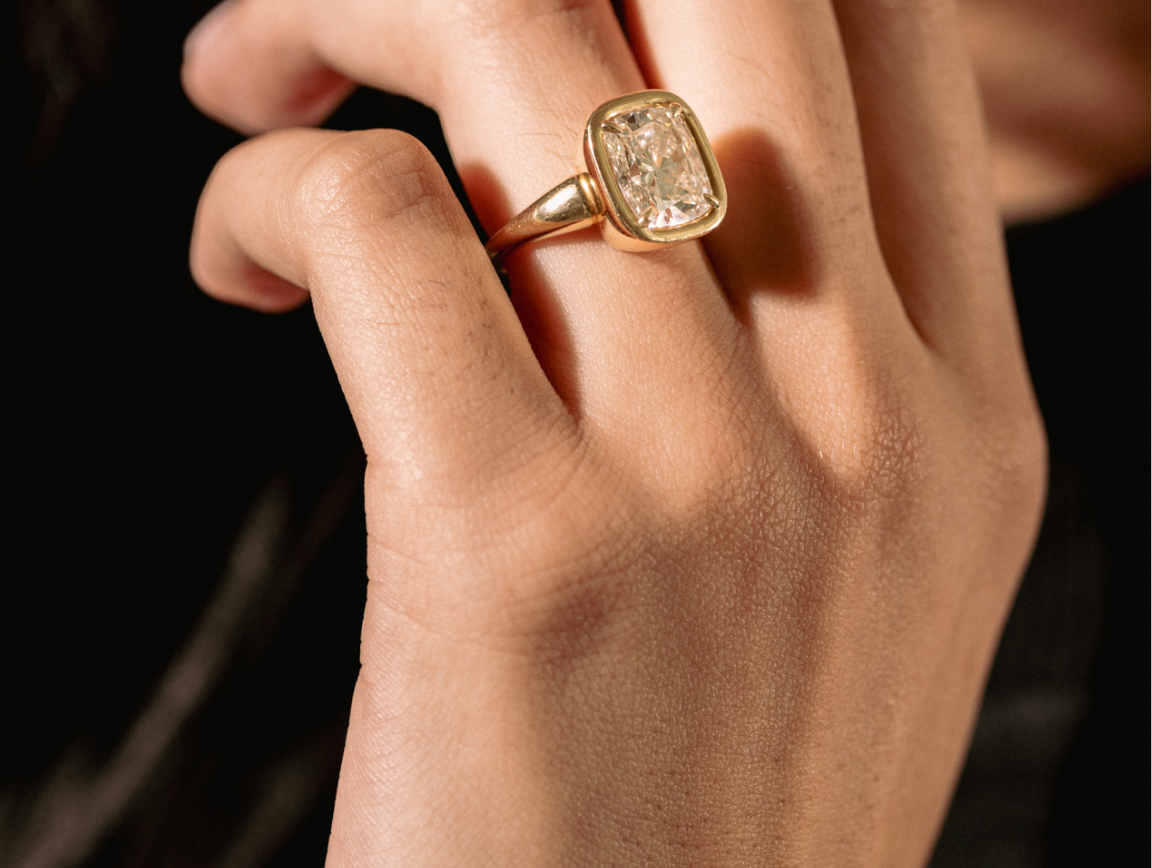
Get a bespoke design from
GOODSTONE that'll last a lifetime.


AS SEEN ON YOU


By far the best and easiest experience. Kayla was able to pull the exact diamond my fiancé wanted and worked quickly to get renders. She was even able to get the ring in time to me so l could ask my future in laws for permission before asking my now fiancé. Wouldn't go with another jeweler again

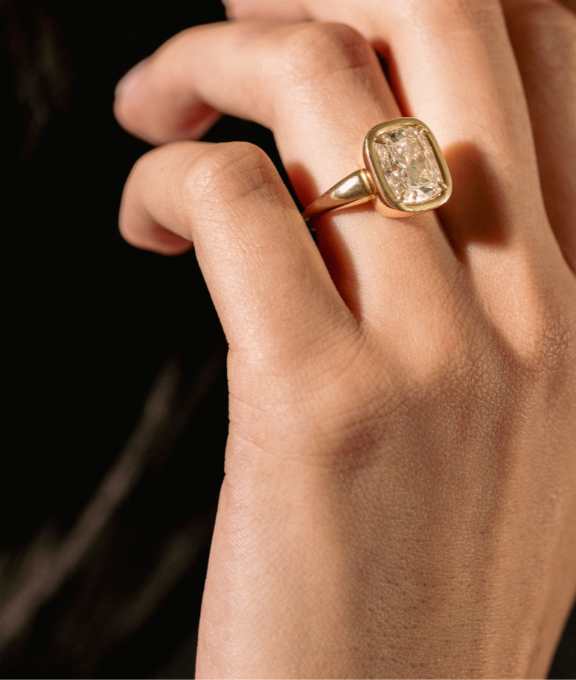
Anillo de compromiso con solitario de medio bisel este-oeste de doble fila con diamante de talla Asscher
SHOP NOW


Why Choose GOODSTONE for an Asscher Cut Engagement Ring?
Step Facets Calibrated for the Hall of Mirrors Effect
Every Asscher is evaluated internally for even step-facet alignment, a square outline, and a small table that produces the hall-of-mirrors effect.
Asscher Settings from Thin Solitaire to Pavé
The Asscher lineup ranges from a thin solitaire at $2,225 to bezel, half-bezel, three-stone, halo, and pavé settings in gold and platinum. There are truly no limits to your options.
Handmade in Los Angeles with Recycled Gold
Each ring is handmade at our Los Angeles workshop using recycled gold. The finished ring is packed in a plain FedEx box and shipped overnight, fully insured and requiring a signature upon delivery.
Free 30-Day Returns and a Lifetime Warranty
All ready-to-ship Asscher rings include free returns within 30 days and a lifetime warranty covering resizing, polishing, prong inspections, and replacement of small stones.


Compare the Asscher Cut to Other Engagement Ring Cuts
Asscher Cut vs. Cushion Cut Engagement Ring
The Asscher is a square step cut introduced in 1902 and known for its geometric appearance. Where a cushion softens its corners and scatters light through brilliant faceting, the Asscher maintains straight lines and produces long parallel flashes of light. The result is a choice between a softer design and a more structured one, with the Asscher also requiring more frequent cleaning to maintain its look.
Asscher Cut vs. Emerald Cut Engagement Ring
Both stones are step cuts, trading sparkle for broad flashes of light. The Asscher is square and draws the eye inward through its concentric facets, while the emerald uses a longer rectangular outline. Clarity matters for both because the open facet patterns make inclusions and smudges easier to see.
Asscher Cut vs. Marquise Cut Engagement Ring
Few diamond cuts look less alike than the Asscher and marquise. The Asscher is a square step, while the marquise combines brilliant faceting with a shape defined by two pointed ends. The marquise can create a large face-up appearance and requires protection at its tips, while the Asscher emphasizes clarity and symmetry.
Asscher Cut vs. Old European Cut Engagement Ring
Both cuts have historical roots, but they produce different visual effects. The Asscher dates back to 1902 and uses step faceting and a square outline, while the old European is rounded with a high crown and visible culet. Their facet patterns differ despite their shared history.
Asscher Cut vs. Old Mine Cut Engagement Ring
Similar proportions make these cuts easy to confuse at first glance. The old mine cut uses broader facets and the less uniform appearance typical of early hand-cut diamonds, while the Asscher follows a more precise square pattern built around step faceting.
Asscher Cut vs. Pear Cut Engagement Ring
Symmetry immediately separates these two cuts. The Asscher features a square outline and step faceting, while the pear combines a rounded end with a single point. The pear requires protection at its tip, and the Asscher’s broad facets make fingerprints and smudges more visible.
Asscher Cut vs. Princess Cut Engagement Ring
Despite their similar square design, the princess uses sharp corners while the Asscher trims them away. The princess became popular for combining a square shape with strong sparkle, while the Asscher emphasizes precision and symmetry.
Asscher Cut vs. Radiant Cut Engagement Ring
Cropped corners visually link these two cuts, but the similarity ends there. The radiant emphasizes fire and sparkle, while the Asscher is more restrained. Their appearances differ despite sharing a similar outline.
Asscher Cut vs. Round Cut Engagement Ring
The round brilliant is the most popular engagement-ring shape because of its broad appeal and familiar appearance. The Asscher’s square design and Art Deco origins set it apart from the standard round profile.


"We don't believe in one right answer when it comes to diamonds. Lab-grown or natural stone to finished pieces, what matters is that you walk away with something exceptional. That's always been our standard."
- Blake Asaad, founder
Frequently Asked Questions
What is an Asscher cut diamond?
An Asscher is a square step cut with cropped corners that produces a soft octagonal outline, small table, high crown, and deep pavilion. Joseph Asscher patented the cut in Amsterdam in 1902, making it the first diamond cut to receive a patent. A standard Asscher has 58 facets arranged in parallel rows around the stone, and most have a length-to-width ratio between 1.00 and 1.05.
Why do Asscher-cut diamonds show inclusions more clearly, and what clarity grade should I buy?
Step cuts use large open facets that provide a clearer view into the diamond than most brilliant cuts. Because inclusions are easier to see through the table, clarity matters more in an Asscher than in many other shapes. VS1 is often considered a strong starting point for an eye-clean Asscher, while VVS2 becomes more attractive above 1.5 carats, when inclusions are easier to detect. VS2 can also work in smaller stones when inclusions are confined to the diamond’s outer portions.
Is the hall-of-mirrors effect in an Asscher cut diamond always visible?
Yes. The pavilion and crown structure of an Asscher diamond reflects light in a receding series of squares, often compared to standing between two parallel mirrors. The effect typically appears as the X or windmill pattern visible through the table and is also visible under normal household lighting and jewelry-store spotlights. Unlike the rapid sparkle of a round brilliant, the Asscher produces larger, more orderly reflections.
Is an Asscher-cut engagement ring Art Deco, vintage, or contemporary?
Both. The Asscher cut reached peak popularity during the Art Deco era of the 1920s and 1930s, and many vintage-inspired settings emphasize that heritage through details such as milgrain. The cut's square shape and clean lines also pair naturally with modern solitaire and bezel settings, allowing it to look equally at home in contemporary designs.
Does an Asscher-cut diamond look smaller face-up than a round diamond of the same carat weight?
Yes. An Asscher places more of its weight in the crown and pavilion, which reduces its face-up size compared with a round diamond of similar carat weight. A 1-carat Asscher typically measures about 5.5 millimeters across, while a 1-carat round measures about 6.5 millimeters. The size difference is noticeable on the hand. When comparing shapes, millimeter measurements are often more useful than carat weight alone.
Why are Asscher-cut diamonds usually cheaper per carat than round diamonds?
Compared with round brilliants, Asscher diamonds typically cost 15 to 35% less per carat at the same color and clarity grades. Its square shape preserves more of the original rough diamond during cutting, while round diamonds require greater material loss. Asscher diamonds also attract less demand than rounds, which contributes to the price difference. However, the higher grades often recommended for step cuts can reduce some of the savings.
What is the best setting for an Asscher cut engagement ring: solitaire, halo, bezel, or three stone?
No single setting is the best for an Asscher cut. Bezel settings are a popular choice because the metal frame complements the diamond’s cropped corners. A solitaire keeps the focus on the center stone, while a halo can make the diamond appear larger. Three-stone designs often pair Asschers with baguette or trapezoid side stones that complement the cut’s clean lines.
Will an Asscher-cut diamond’s cropped corners chip during daily wear?
No. The cropped corners are more durable than the sharp 90-degree corners found on cuts like the princess. Removing those points reduces the areas most vulnerable to chipping and helps distribute impact around the stone’s edge. Asscher and emerald cuts are more resistant to corner damage than other square or rectangular shapes. Rounded prongs provide adequate protection, while a bezel offers even greater coverage.
Is an Asscher cut engagement ring suitable for an active lifestyle?
Yes. The cropped corners reduce chip risk to well below that of a princess cut, and the step facets on a thicker crown provide the stone with structural stability. A full bezel wraps around each corner in metal and offers the highest level of protection, making it the standard recommendation for hands-on work and athletic routines. A half bezel covers two corners and reads sleek. A low-profile solitaire with sturdy prongs strikes a middle ground for buyers who want everyday wearability without bulk.
What is the difference between a standard Asscher cut and a royal Asscher cut diamond?
A standard Asscher has 58 step-cut facets and follows Joseph Asscher’s original 1902 patent. The Royal Asscher cut adds 16 pavilion facets for a total of 74 and was redesigned in 2001 by Edward and Joop Asscher to increase dispersion and reduce darker areas within the stone. The Royal Asscher is a trademarked cut produced exclusively by the Royal Asscher Diamond Company and typically commands a higher per-carat price.
What color grade is safe in an Asscher cut diamond (G, H, I)?
G and H are usually considered the safest color grades for an Asscher cut, particularly in platinum or white-gold settings. Because step cuts make body color easier to see than brilliant cuts, faint tint becomes more noticeable through the large open facets. I-color diamonds can still work well in yellow- or rose-gold settings, where the warm metal masks color. Above 2 carats, many buyers prefer G to minimize visible warmth across the table.
Which metal suits an Asscher-cut engagement ring best?
Platinum and 18k white gold are the most common metals for Asscher-cut engagement rings because they maintain a bright appearance around the diamond. Yellow gold pairs well with diamonds in the I-J color range and has strong ties to Art Deco jewelry. Rose gold adds warmth, while two-tone designs combine a white-metal head with a yellow- or rose-gold band.
Are Asscher-cut diamonds available as lab-grown above 2 carats?
Yes. Lab-grown Asscher-cut diamonds are commonly sold in sizes above 2 carats, with 2- and 3-carat stones regularly appearing in retailers’ inventories. Lab-grown Asschers share the same chemical composition, optical properties, and grading standards as natural Asschers of comparable quality. Their lower cost allows buyers to consider larger sizes than might be practical with a natural diamond.
Which side stones suit an Asscher-cut three-stone engagement ring?
Tapered baguettes are the traditional choice for an Asscher-cut three-stone ring because their shape complements the center stone. Trapezoid side stones are another established pairing and occupy more space along the band. Half moons introduce softer curves, while trillions and pears appear in more contemporary designs. Round and oval side stones create greater contrast because they do not share the angular appearance of the Asscher.
How does an Asscher cut engagement ring pair with a wedding band: straight or contoured?
A straight wedding band sits flush against most Asscher-cut engagement rings because the stone’s shape allows a clean connection between the two rings. A contoured band is only necessary when a wide basket, halo, or cathedral setting prevents the rings from sitting together. Step-cut eternity bands and baguette bands are also popular pairings because they complement the center stone’s appearance.
What carat weight does an Asscher-cut diamond need to look proportional?
Because Asscher-cut diamonds have a smaller face-up appearance than rounds of the same weight, 1.5 carats is often considered a balanced starting point. Smaller stones can look compact on the hand, while larger Asschers make the cut's distinctive features easier to see.
How do I evaluate the cut quality of an Asscher-cut diamond without a GIA Excellent grade?
GIA does not assign a cut grade to Asscher diamonds, so buyers must rely on proportions, polish, and symmetry instead. Look for a depth between 60 and 68%, a table between 60 and 68%, and a length-to-width ratio between 1.00 and 1.05. Polish and symmetry should be rated Excellent or Very Good, with symmetry carrying particular importance in a step cut. A clear X or windmill pattern visible through the table is often a positive sign.
Does an Asscher-cut diamond hold its value compared to a round or emerald cut?
Round brilliants generally retain value better than any other diamond shape because they benefit from the strongest resale demand. Asscher diamonds typically follow resale patterns similar to emerald cuts, with both step-cut shapes trading below rounds on the secondary market. Lab-grown Asschers retain less value than natural diamonds due to the larger supply in that category.
Get in touch with our concierge team to book a one-on-one call with us to discuss about your Engagement Ring. We will walk through the process from diamond sourcing to choosing the perfect setting.