





How Do I Recreate a Celebrity Engagement Ring as a Custom Piece?
When people fall for Zendaya’s east-west cushion or Taylor Swift’s bezel-set old mine cut, they usually love one feature, not the whole multimillion-dollar design. A custom jeweler can recreate that look, and the realistic goal is to capture a ring’s signature rather than clone it part for part. Name the element that caught your eye, hand a designer a reference photo, and choose lab-grown if you want the carat without the price tag. The result looks like the celebrity ring, while in the details it becomes your own.

The most successful custom designs capture the signature details you love while creating something uniquely your own.
Decoding a Celebrity Ring’s Signature
A celebrity ring you love is rarely a single feature. There are usually several choices, and one or two of them are the ones your eye notices first. The skill in recreating it lies in pulling that signature out of the photo and leaving the rest open, because that’s where a designer makes the ring yours.
Naming the Signature Element
Before anything else, look at the reference photo and identify what you respond to. With a celebrity ring, it usually comes down to a few parts:
-
The stone cut, like an oval, cushion, emerald, pear, or marquise.
-
The orientation, since a stone set the long way across the finger (east-west) looks different from one set upright.
-
The setting family, which includes solitaire, halo, three-stone, bezel, or toi et moi.
-
The band, thin and delicate or thick and architectural, plain or set with pavé.
Most people find their must-have is one of these rather than all of them. Once you can say it out loud, a thin yellow gold band with a bezel-set oval, you have given a designer the one thing they cannot guess.
Reading the Famous Examples
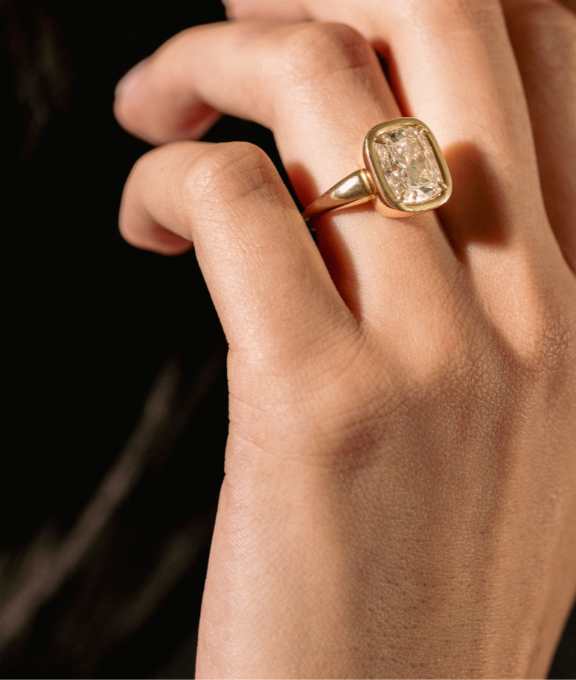
It helps to see how a few well-known rings break down. Zendaya’s ring is an elongated cushion set east-west in an antique button-back mounting, so the signature there is the horizontal orientation and the vintage detail, not the 4 or 5 carats. Taylor Swift’s is a hand-cut old mine cushion bezel-set on an engraved yellow gold band, where the antique cut and the warm engraved gold define it.
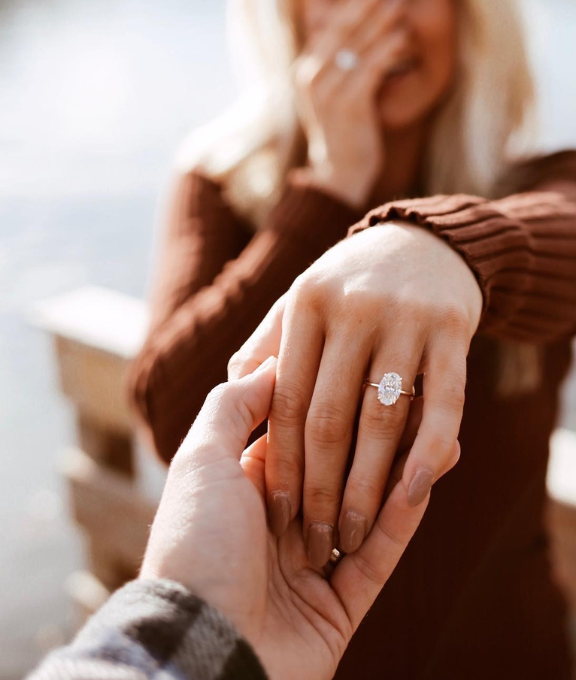
Megan Fox’s toi et moi pairs two pear-cut stones, an emerald beside a diamond, and the whole identity is that two-stone silhouette. Lady Gaga’s oval is set on an unusually thick band, and the band is the point as much as the stone. In each case, the recognizable part is a feature or two you can ask for at any carat weight and budget.

Celebrity engagement rings are memorable because of one or two defining features rather than their overall price.
The Line Between Inspired-By and Copy
There is a real difference between recreating a look and copying a protected design, and it is worth knowing where the line sits. The good news is that the individual pieces of most rings, like an oval stone, a bezel, or a plain gold band, are ordinary elements that no one owns. Recreating a familiar silhouette out of those parts is the normal, legal path that custom jewelers follow every day.
The line gets crossed in two places. One is asking for an exact copy of a specific designer’s signature piece, especially one that holds a design patent, since a design patent can be infringed even by an independently created design. The other is selling or describing the ring using the original brand’s name. A trademark and its signature presentation are protected even when the underlying setting style is unremarkable, whereas a plain setting style is not.
The practical guidance is short. Capture the silhouette, adjust some details so the ring stands as its own piece, and present it as an original design rather than a named replica. A reputable jeweler can recreate a look without difficulty. They will decline to stamp someone else’s brand on it, and that caution protects you as much as them.

The goal of custom jewelry is inspiration, not imitation. A well-designed ring captures the feeling of the original while establishing its own identity.
From Photo to Finished Ring
Once you know the look you want, the build follows a fairly predictable path, and most of it happens before any metal exists.
The CAD Review
You start by sharing your reference photos, a budget, and your metal and stone preferences. From that, a designer builds a 3D model and sends back photorealistic renderings from several angles, usually within about two weeks, along with a quote.
This is the stage where you ask for changes. A thinner band, a different prong style, a tweak to the profile, and revisions within the original scope generally do not move the price. GOODSTONE’s custom process works similarly, with the client signing off on the render before anything is cast.
One thing first-timers should know is that a magnified render runs heavier and blockier than the real piece, since prongs and pavé are refined by hand after casting. A preview that looks a little clunky often becomes a finer ring than the screen suggested, so judge a jeweler by photos of finished work, not the polish of the render.
Casting and Hand-Finishing
After you approve the design, the file becomes a wax or resin model, sometimes a 3D-printed version you can try on, and then the piece is cast in metal and finished by hand. From approved design to delivery usually takes about 4 to 8 weeks, longer if a rare stone has to be sourced or the handwork is elaborate. Starting 8 to 12 weeks before a proposal gives the process room to breathe, avoiding a last-minute rush. The detail that makes a recreation finally look like the celebrity ring often shows up only here, in the hand-finishing, which is the part no preview can show you.
Hitting the Look Within a Budget
What pushes celebrity rings out of reach is almost always the stone, and a lab-grown center is the way around it. A lab-grown diamond is chemically and optically identical to a mined one, so the look on the finger does not change while the price drops sharply. The average price for a 1-carat lab-grown is roughly $1,000, compared with about $4,200 for natural, and the gap widens as carat weight climbs.
At statement sizes, it turns dramatic. A 3-carat lab-grown diamond is usually priced between $7,000 and $13,000, while a 3-carat natural diamond usually starts near $30,000. More than half of couples chose a lab-grown center in 2025, and many put the savings toward a larger stone.
There are smaller moves too. Keeping accent stones modest, using 14k gold, or swapping a sapphire or spinel in for a colored-stone celebrity look all bring the number down without losing the silhouette.
This kind of project is our specialty. A client brings a single photo or a whole stack of inspiration images and pulls them into a single design with a designer, choosing lab-grown or natural for the center depending on the look and the number to hit. When a full custom build does not fit the timeline, a ready-to-ship piece can come close to the look instead, which keeps a tight proposal date from forcing the whole idea aside.

The overall appearance of a celebrity-inspired ring can often be achieved without matching the celebrity price tag. Strategic choices make the biggest difference.
Bringing Your Inspiration to a Designer
The first real step is the easiest one to do today. Collect the photos that keep catching your eye, even if there are 20 of them, because most people find their dream ring is a blend of several they loved rather than any single image. Look at the collection and identify the one or two features that recur. The cut, the orientation, the band. That short list is what a designer turns into a ring.
When you bring those photos in, ask to see finished work rather than only renders, and let the designer adjust a detail so the piece becomes yours rather than a copy. The celebrity ring is the inspiration, and the ring you walk away with is built around the part you loved most.

Sharing inspiration photos gives a designer a clear understanding of what draws your eye. From there, the conversation shifts from copying a ring to creating one that feels distinctly yours.
Frequently Asked Questions
Can you recreate a celebrity engagement ring?
Yes. Custom jewelers routinely recreate celebrity rings by matching the stone cut, setting style, and band, working from reference photos rather than copying the exact original. Changing a detail or two keeps the inspiration while making the ring your own piece.
Is it legal to copy a celebrity engagement ring?
Recreating a familiar silhouette is generally legal because individual elements, like an oval stone or a bezel, are not protectable on their own. An exact copy of a brand’s distinctive, patented, or trademarked signature design can infringe, and using the original brand’s name to describe your ring is at your own risk. The safe path is an original inspired-by design.
How much does it cost to recreate a celebrity engagement ring?
Custom engagement rings in 2026 average roughly $5,000 to $15,000 depending mostly on the stone, with a wider real-world range from about $2,500 to well past $50,000. Choosing lab-grown is the single biggest cost lever. The custom process itself adds less than most people expect.
Can a jeweler make a ring from a photo?
Yes. You can send photos of rings you like, and a designer turns your ideas into a final design and provides a quote. Exact measurements are not required up front, because the design conversation develops them during the CAD stage.
How do you get a celebrity look engagement ring on a budget?
Choose a lab-grown center, drop slightly below whole-carat marks since a 0.90 carat looks like a 1.00 carat, keep accent stones small, and use 14k gold. For a colored-stone celebrity look, a sapphire or spinel matches the color for far less. Each of these holds the silhouette while lowering the bill.
How long does it take to make a custom engagement ring?
Plan on about 4 to 8 weeks from approved design to a finished ring, with rare stones or heavy handwork pushing the longer end. Begin the conversation eight to twelve weeks before a proposal, leaving time for CAD revisions and sourcing, so nothing has to be rushed at the close.
Does the CAD render look exactly like the finished ring?
No, and it should not. Viewed at screen scale, a preview appears bulkier than the ring on a finger, and the milgrain and pavé only take their final crispness at the bench. What returns is the more delicate of the two, so weigh a jeweler on photos of completed work rather than the preview.
Are lab-grown diamonds cheaper than natural diamonds?
Far cheaper, and the gap only opens up as the stone grows. At 1 carat, a lab-grown center averages near $1,000, while the mined version costs around four times that, and by statement sizes the spread climbs into tens of thousands. That is why lab-grown is the usual route to a celebrity look without the matching bill.
Do lab-grown diamonds look the same as real diamonds?
Yes. A lab-grown diamond shares the same chemistry and optics as a mined one, so they look alike on the finger. With most couples choosing a lab-grown center in 2025, the choice now looks ordinary rather than like a budget concession.
What is the difference between a replica and an inspired-by ring?
A replica matches a specific ring point-for-point, which is where the legal exposure is highest. An inspired-by piece borrows the overall look but stands as its own design, the route reputable jewelers default to. For a celebrity ring, that second path is almost always the one you want.
Can you recreate a celebrity ring with a colored gemstone?
Yes. For colored-stone celebrity rings, sapphires, spinel, and other durable gemstones offer an affordable way to match the color and overall look. A designer can pair the colored center with the setting style and band that define the original.



Deja un comentario (todos los campos son obligatorios)