


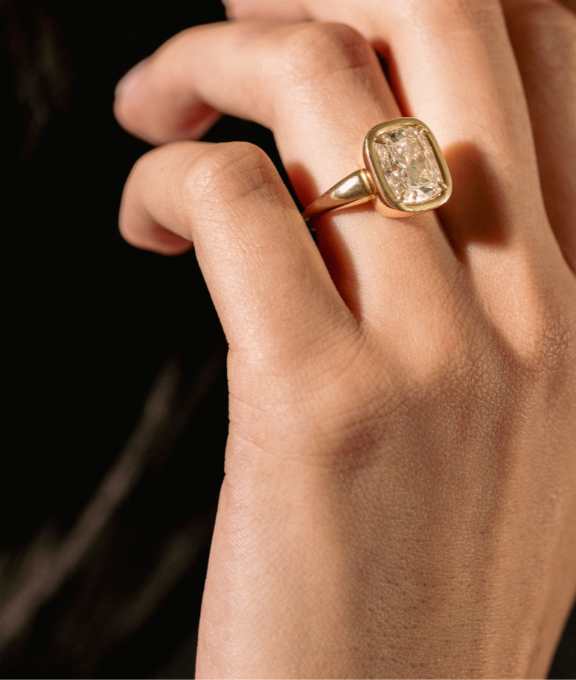




Which Diamond Shapes Hide Inclusions Best?
Two diamonds can have the identical SI1 grade and look nothing alike to the eye. A round brilliant of that grade often looks perfectly clean, while a princess shows a crystal lodged under its table. The difference lies in how each cut handles light. Brilliant faceting scatters light and buries a small inclusion inside the sparkle. A step cut opens the center of the stone to plain view, and the shape a buyer picks sets how low a clarity grade they can safely go.

Not all diamond shapes hide inclusions equally. Brilliant cuts scatter light and disguise small flaws, while open step cuts reveal far more of what sits inside the stone.
Where the Round Brilliant Buries a Flaw
The round brilliant is the most forgiving cut a buyer can choose, and its 58 facets are the reason. They are cut to send back as much light as possible, and that busy return never lets the eye fix on any one spot inside it. A small crystal or a wisp of cloud gets lost in the motion. This is the cut where a buyer can drop the clarity grade the furthest and still hold something that looks clean at arm’s length.
Under 1 carat, an SI1 or even an SI2 round is usually eye-clean, and a VS2 almost always is. The margin is wide enough that a messy-looking grading plot can still produce a stone with nothing visible to the naked eye. An F SI1 round can carry a scatter of marks on its grading plot and still show nothing to find in the hand. An SI1 grade often braces a buyer for visible flaws that then take a loupe to locate at all. The faceting did the work the certificate could not describe.

The round brilliant is one of the most forgiving shapes for clarity. Its dense faceting and constant light return help small inclusions disappear into the sparkle.
Other Forgiving Brilliant Cuts
Below the round, a group of brilliant cuts hides inclusions almost as well, each with its own soft spot where a flaw usually disappears. The faceting is still busy enough to scatter light and blur small marks. SI1 and SI2 remain workable under 1 carat before a buyer needs to step up to VS as carat weight climbs.
-
Oval: The stretched brilliant faceting softens a flaw so well that even a 2-carat oval often hides an SI1 or SI2 without a hint of it.
-
Cushion: Its rounded, pillow-like facets give an inclusion a gentle blur, and SI1 to SI2 looks clean in most stones.
-
Radiant: A dense, sparkly facet pattern hides inclusions and disperses color at once, and an SI1 radiant frequently comes back eye-clean.
-
Princess: The sharp pointed corners are strong hiding spots, and a flaw tucked into a corner lets a buyer drop toward the lower grades without paying for it in looks.
-
Marquise: Brilliant faceting throws light down the length of the stone, and the two pointed ends give small inclusions somewhere to rest unnoticed.
-
Pear: The rounded end and the single point create several soft zones, with a flaw near the tip usually the hardest to see.
None of these matches the round for sheer margin, and all of them let a buyer trade clarity for size or color and still keep a stone that looks flawless to anyone not holding a loupe.

Oval, cushion, radiant, princess, marquise, and pear cuts all offer more flexibility in clarity than step cuts.
The Step-Cut Exposure Problem
At the other end are the step cuts, the emerald and the Asscher. They use long, straight facets that run in parallel steps toward the center, cut to show clean planes of white light instead of fire. That openness lays the middle of the stone open to view through the wide, flat table, and no scattered light is there to bury anything positioned under it.
A step cut reveals what a brilliant would have hidden. A crystal or a feather that would vanish in a round shows plainly through an emerald table, and the effect can grow worse than a single mark suggests.
In one SI1 emerald, a lone inclusion repeated itself across the parallel facets until it looked like three, enough to drive a shopper to distraction. In another, a feather under the table showed only in direct daylight, then faded in softer indoor light, so the same stone looked different from one hour to the next.
This is why the community rule for step cuts is to aim higher on clarity, with VS2 as the floor and VS1 once the stone grows. The stone itself needs to be checked by eye. Its grade alone cannot be trusted because emerald and Asscher cuts do not travel well sight unseen. GOODSTONE follows that rule, pairing the diamond search with a designer who reviews an open-table stone for an eye-clean appearance before it is set.

Emerald and Asscher cuts are admired for their open, architectural facets, but that transparency leaves inclusions with nowhere to hide.
Placement, Setting, and Size Effects
Cut sets the odds, and where an inclusion is placed and how the stone is mounted decide the rest. Two flaws of the same size can look completely different depending on where they fall inside the stone.
Under the Crown and Near the Girdle
The kindest places for an inclusion are under the crown facets and out near the girdle edge, where the faceting folds light over the flaw. A small white crystal tucked under the crown or along the girdle is the safest case a buyer can hope for.
The hardest case is the opposite address, a dark crystal resting dead center under the table, because there is no brilliance in that spot to bury it. A black or central crystal shows in almost any cut, and under an open step-cut table it has nowhere left to go.

Inclusions near the edge of a diamond are often far easier to disguise than those sitting directly beneath the table. Placement can matter just as much as the clarity grade itself.
Concealment by the Setting
The setting can finish what the faceting starts. A bezel wrapped around the girdle or a well-placed prong can completely cover an edge inclusion, and a flaw that shows in the loose stone can vanish once the diamond is mounted. A set stone can hide its inclusion so completely that a loupe and both eyes fail to find it, the mark locatable only in macro photographs after a prong has swallowed it.
A bezel can do the same, covering marks that were barely visible even when the stone was loose. This is worth planning around because a girdle-edge flaw, combined with the right mount, can turn a lower-grade stone into one that looks flawless.

The right setting can hide more than most buyers realize. A well-placed prong or bezel can cover an edge inclusion and make a lower-clarity stone look beautifully clean once set.
The Carat Size Multiplier
Size magnifies every one of these effects. Bigger facets act like a magnifying glass. A flaw invisible at 1 carat can surface at 3, and a grade that was safe on a small stone stops being safe on a large one. A 1-carat VS2 can look flawless while a 3-carat VS2 of the same cut shows a mark under the table.
The effect matters most for step cuts. An emerald that would pass under 1 carat becomes risky at 2 or 3 carats, the size where a plain VS2 can let an inclusion through, and the reason bigger step cuts steer buyers toward VS1 and a personal look.

As carat weight increases, inclusions become easier to see. Larger facets reveal more detail, which is why bigger diamonds often benefit from stepping up in clarity.
Recommended Clarity Grades by Shape
Put the odds and the placement together and a working target emerges for each cut. These give a starting point for an eye-clean stone at typical sizes. A single inclusion in the wrong spot can still betray any grade.
-
Round brilliant: SI1 to SI2 under 1 carat, easing toward VS2 as you move past 2 carats.
-
Oval, cushion, radiant, princess, marquise and pear: SI1 to SI2 under 1 carat, stepping up to VS1 or VS2 as the stone grows.
-
Emerald and Asscher: VS2 at a minimum, VS1 for anything approaching or past 2 carats, and always confirmed by eye before buying.
The busier the faceting, the lower the grade a buyer can take and still get a clean look. The more open the cut, the more that same buyer pays in clarity for the same result. A brilliant cut lets the budget go toward size or color. A step cut sends that same budget into clarity, and it rewards the buyer who slows down for a close look before setting the stone.
Frequently Asked Questions
Which diamond shape hides inclusions the best?
The round brilliant hides inclusions best. Its 58 facets are engineered for maximum light return, and that brilliance masks small flaws so well that many SI1 and even SI2 rounds read eye-clean under 1 carat.
Which diamond cuts show inclusions the most?
Step cuts, the emerald and Asscher, reveal inclusions most. Their wide, open facets put the whole interior on view with no scattered light to hide a flaw, so marks that vanish in a brilliant cut show plainly.
Do brilliant cut diamonds hide inclusions?
Brilliant cuts do hide inclusions. Their many small facets scatter light and blur small marks, so inclusions are camouflaged rather than framed. Round, oval, cushion, radiant, princess, marquise and pear all work this way.
What clarity should I get for an emerald cut diamond?
VS2 is the floor, and VS1 once the stone passes 2 carats. The emerald’s open table hides nothing, so the SI grades that pass in a round get risky here unless you inspect the individual stone. Its cousin, the Asscher, targets the same.
What clarity is eye-clean for a round diamond?
For 2 carats and under, VS2 and SI1 round brilliants are almost always eye-clean, and an SI2 round sometimes is. Larger rounds are safer at VS2 or above.
What clarity should an Asscher cut be?
Treat an Asscher like an emerald and aim for VS2 or higher, since its step-cut facets reveal a flaw the same way. Have the stone confirmed eye-clean before you buy, since the grade alone can mislead here.
Does diamond shape affect clarity?
Shape does not change the clarity grade, but it strongly affects how visible an inclusion is. A brilliant cut hides flaws, and a step cut reveals them, so the clarity you should target moves with the cut.
What does eye-clean mean for a diamond?
Eye-clean is a stone that shows no inclusions to the unaided eye, whatever a loupe turns up. Because it describes a look and not a grade, the same grade can read eye-clean in a brilliant cut and betray a flaw in a step cut.
Is SI1 clarity always eye-clean?
No. If an SI1 reads eye-clean, that depends on the size and location of its inclusions, which makes SI1 less predictable than VS grades. Brilliant cuts forgive an SI1 far more reliably than step cuts do.
Where do inclusions hide in a diamond?
The most forgiving spots are under the crown facets and near the girdle edge, where faceting and the setting help mask a flaw. Inclusions off to the side, near the pavilion, or under a prong often go unnoticed.
Does carat size affect how visible inclusions are?
Carat size does affect it. Larger diamonds show inclusions more readily because bigger facets act like magnifying glasses. A 1-carat VS2 may look flawless, while a 3-carat VS2 of the same cut can show a flaw under the table.




Deja un comentario (todos los campos son obligatorios)