





Fire vs. Brilliance: Why Some Diamonds Sparkle and Others Look Glassy
The diamond that scattered color across the jeweler’s showroom can look flat and lifeless an hour later, when you glance down at it under the panel lights above your desk. Sparkle comes from how a stone was cut. The material matters far less, and a glassy look almost always means the cut is letting light escape the bottom or sides instead of returning it to your eye. This is true for brilliant cuts like rounds and step cuts like emeralds.
Color and clarity grades rarely explain the problem, and the light around you governs how much of that sparkle you get to see at all.

Understanding the difference between fire, brilliance, and cut helps explain why some stones come alive in the light while others appear surprisingly flat.
Fire, Brilliance, and Scintillation
When people say a diamond sparkles, they are usually describing three separate effects that happen to arrive together. Telling them apart is what lets you work out why a stone looks flat. It helps to slow down and name each one.
Brilliance is the bright white shine, the steady flash you notice before any color appears. Light enters through the top of the stone, bounces off the angled facets inside, and comes back up toward your eye. Diamond bends light sharply because of its high refractive index, measured at 2.417, which is part of why a well-cut stone can look so bright next to other colorless gems.
Fire is the colored part, the darts of red, blue, and green that scatter when you tilt the ring. White light is a blend of every color, and as it passes through the stone, each color bends by a slightly different amount, and they separate, traveling along their own paths. The amount of this splitting is fixed. Every diamond, cheap or fine, has the same dispersion value of 0.044, so the material’s capacity for fire is constant, and only the amount that reaches your eye differs.
Scintillation is the pattern of bright and dark flashes that appears when the diamond moves, the light moves, or you do. A stone sitting still on a table shows you brilliance and maybe some fire, but scintillation only appears once something starts to move.

The sparkle you see is actually a combination of three distinct effects. Together, they create the light performance that gives every well-cut diamond its unmistakable beauty.
Causes of a Glassy or Dull Diamond
A diamond returns light only if that light strikes its inner facets at a steep enough angle to bounce back up. Cutters form the bottom of the stone, the pavilion, to hold that angle across every facet. When the proportions drift too far in either direction, light slips through the stone, and the eye sees a washed-out, glass-like patch where sparkle should be.
This is why a high color or clarity grade cannot rescue a dull stone, since those grades describe the diamond’s body and not the angles that send light back to you.
Shallow Cuts, Windowing, and Fisheye
A stone cut too shallow, too flat from top to bottom, lets light in through the top and then meets the pavilion facets at too gentle an angle. Below roughly 24.4 degrees, a facet stops bouncing light back and lets it pass straight through the bottom. That leak shows up as windowing, a see-through zone in the center where you can almost read print through the stone. The core goes transparent, a hole where the bright center should be.
A very shallow stone can also show a fisheye, a gray circular ring you see through the table when you look at the stone face-up. It is the reflection of the stone’s girdle, the rim around its widest point, and it gives away a pavilion cut too shallow.

A shallow cut allows light to escape instead of reflecting back through the top of the diamond. The result is a transparent, glass-like appearance that no amount of clarity can overcome.
Deep Cuts and the Dark Center
A stone cut too deep, too tall from top to bottom, has the opposite problem. Light comes in, bounces off one pavilion facet, then hits the far facet at an angle that sends it out the side, and the center under the table goes dark. Jewelers call a round brilliant with this fault a nailhead, named for the dark head that shows under the table in almost any light.
The giveaway is that the dark center never moves. Normal scintillation flickers between bright and dark as you tilt the ring, but a nailhead’s shadow stays fixed no matter how you turn it.

A diamond that's cut too deep can develop a permanently dark center where light never returns to the eye. Proper proportions are what create the lively sparkle buyers expect.
Dirt and Inclusion Haze
Not every dull stone is a cutting fault, and this is the part worth checking first, because the fix is sometimes free. A film of hand lotion, soap and skin oil builds up on a ring worn every day, and it dims the stone so gradually that you stop noticing until a quick clean brings the flash back.
A dense scatter of tiny inclusions can also diffuse light and give a milky, cloudy look, different from the see-through glassiness of leakage. Dirt washes off, but inclusion haze and poor proportions stay, and those are the ones to catch before you buy.

Everyday buildup can temporarily mute a stone's brilliance, while heavy inclusions create a softer, cloudy appearance that cleaning cannot fix.
Fire and Brilliance in Different Cuts
Part of the confusion around glassy stones comes from cuts that were never meant to glitter in the first place. The way a diamond is faceted sets the character of its sparkle, and two families of cuts aim at completely different looks.
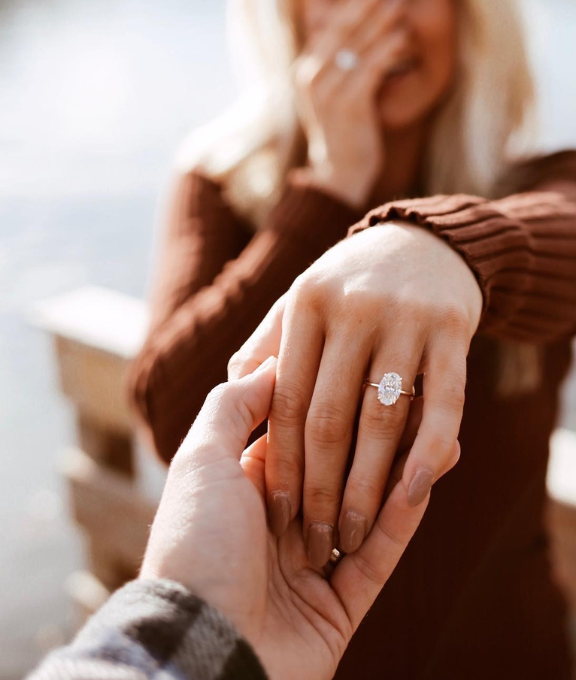
Brilliant cuts, which include the round, oval, cushion, princess and radiant, pack dozens of small facets angled to send light back fast. The round brilliant has many small facets, engineered for the most light return of any shape, which is why it glitters with fine, rapid sparkle.
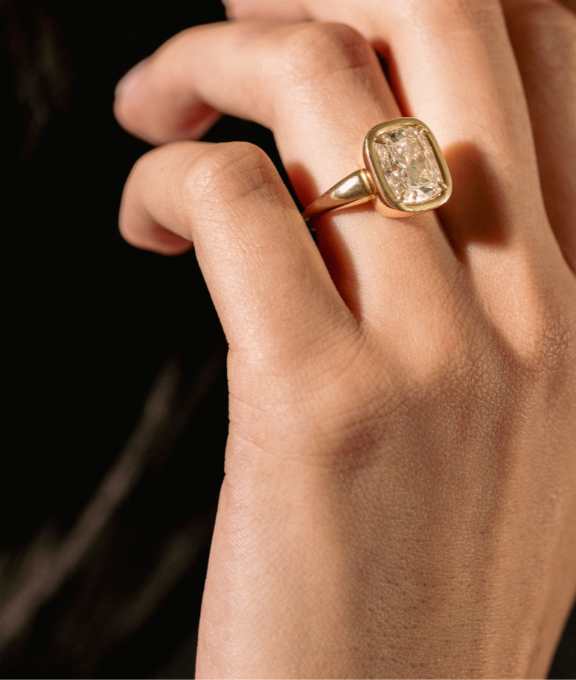
Step cuts take the other path. Emerald, Asscher and baguette stones use fewer, larger facets set in parallel rows running down from the edge. Light travels across those long facets and returns slowly, in long, sweeping flashes down the open surfaces. These cuts show off a stone’s transparency and reward eye-clean diamonds, and their calmer flash is intentional. A well-cut emerald is doing exactly what it was cut to do, even though it will never sparkle like a round.
Because the cut sets a stone’s sparkle, watching it move in the light tells you what a grading report cannot. GOODSTONE keeps well-cut stones across the range, from round brilliant through step cuts like emerald and Asscher, and a designer can show how each shape behaves in the light before anything is decided.

Every diamond shape is designed to interact with light differently. Brilliant cuts maximize sparkle, while step cuts embrace broad flashes of light.
Lighting’s Effect on Sparkle
The same diamond can look like two different stones depending on where you are standing. The light source determines which of the three effects you end up seeing, and it explains why your ring can look flat at your desk and bright over dinner.
Fire needs a concentrated point of light, direct sun or a single spotlight, bright enough to split into separate colors as it passes through the stone. Diffuse light does the opposite. Cloudy daylight and the flat panels overhead in most offices evenly illuminate the diamond from every direction.
The result is a steady white brilliance but washes out the colored flashes and crisp motion. A stone that goes muted under flat office panels and brightens under a restaurant spotlight is behaving exactly as it should.
This is also the test that separates a good cut from a bad one. A well-cut diamond changes character across lighting, brighter here and more colorful there, but it should never go fully dead. A poorly cut stone has no light return to fall back on in soft, even light, so it looks like plain glass.
Fire also has an upper limit that is easy to misread. Moissanite splits light more than twice as hard as diamond, with a dispersion of 0.104 against diamond’s 0.044, and it scatters far more color, often a rainbow, disco-ball effect in sunlight. That rainbow appeals to plenty of buyers, though it can also give away that the stone is not a diamond at all, a useful tell before you decide more fire is what you want.

Natural sunlight, candlelight, and office lighting each reveal a different side of the stone's personality.
Sparkle in Lab-Grown Diamonds
A lab-grown diamond sparkles exactly like a mined one, because it is the same material, carbon in the same crystal structure, with the same 2.417 refractive index and the same 0.044 dispersion. Fire, brilliance and scintillation all depend on the material and the cut, and the origin of the crystal changes neither.
What that means for a buyer is that the choice between lab-grown and natural comes down to budget and preference, while the sparkle question comes back to cut every time. GOODSTONE offers both lab-grown and natural stones and lets a client sit with a designer to compare cut quality directly, the part that determines how a finished ring behaves in light.

Lab-grown and natural diamonds share the same optical properties. When cut to the same standard, both display identical fire, brilliance, and scintillation, making cut quality the true measure of sparkle.
Frequently Asked Questions
What is the difference between fire and brilliance in a diamond?
Brilliance is the white light a diamond sends back to your eye, the steady bright shine you notice first. Fire is dispersion, the same light split into flashes of spectral color like red, blue, and green. Brilliance is a white effect, and fire is a colored one, and a well-cut stone gives you both.
What is scintillation in a diamond?
Scintillation is the flashing pattern of light and dark you see when the diamond, the light source, or you move. It is separate from steady brilliance and colored fire because it appears only with motion. A lively play of bright and dark flashes as you tilt the ring is a sign of good scintillation.
What makes a diamond sparkle?
Sparkle is three optical effects arriving together. The white light of brilliance, the colored flashes of fire, and the moving glints of scintillation. All three depend mainly on how precisely the stone was cut, since the cut angles govern how much light returns to your eye and how much leaks away.
Why does my diamond look like glass?
A glassy look almost always means the cut is letting light leak out through the bottom or sides of the stone before it can come back to you. It happens when a stone is cut too shallow or too deep, and the light misses the angle it needs to bounce back. Color and clarity grades rarely cause it, and a dirty stone can look glassy too, which a cleaning will fix.
Why does my diamond look dull and lifeless?
Cut quality is almost always the cause, because poor proportions leak light and leave little sparkle to come back. A high color or clarity grade will not rescue a poorly cut, lifeless stone. Before you assume the worst, clean the ring first. A film of oil and lotion can dull a well-cut diamond until it is washed off.
What is diamond windowing?
Windowing is a see-through zone in the middle of a stone where light passes straight through the stone and leaks out the bottom. It comes from pavilion facets meeting light within the critical angle of about 24.4 degrees, so the light escapes rather than bouncing back. The center looks transparent, almost like plain glass, where a bright core should be.
What is a nailhead diamond?
A nailhead is a dark center under the table caused by a pavilion cut too deep. The steep bottom sends light out the sides of the stone instead of back up through the top, and the middle stays dark in almost any lighting. The giveaway is that the shadow does not move as you tilt the ring.
Why does my diamond only sparkle sometimes?
Lighting sets which effect you see. Fire and crisp scintillation need a concentrated light source like sunlight or a spotlight, while the flat, diffuse light in many offices floods the stone evenly and leaves mostly steady brilliance. The same ring can look muted under flat office light and much brighter under sunlight or a spotlight.
Do emerald cut diamonds sparkle less than round diamonds?
They sparkle differently, not less. An emerald cut is a step cut, giving long, sweeping flashes where a round brilliant gives fast, fine glitter. Its calmer flash is a design choice, and it shows off a stone’s transparency in a way a round does not.
Do lab-grown diamonds sparkle the same as natural diamonds?
Yes. A lab-grown diamond is the same material as a mined one, with the same 2.417 refractive index and 0.044 dispersion, so its brilliance, fire, and scintillation potential match. Only cut quality determines how much of that sparkle comes back, not the crystal’s origin.
Does moissanite sparkle more than a diamond?
Moissanite has higher dispersion than diamond, 0.104 against 0.044, so it scatters noticeably more colored fire, often a rainbow effect in bright sun. The extra color looks beautiful to one buyer and obviously synthetic to the next, and more fire is not automatically what you want on a classic-looking ring.




Deja un comentario (todos los campos son obligatorios)