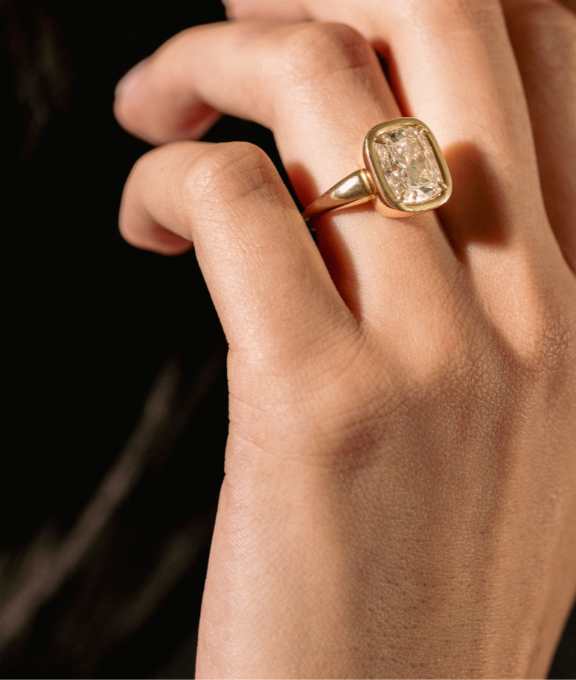
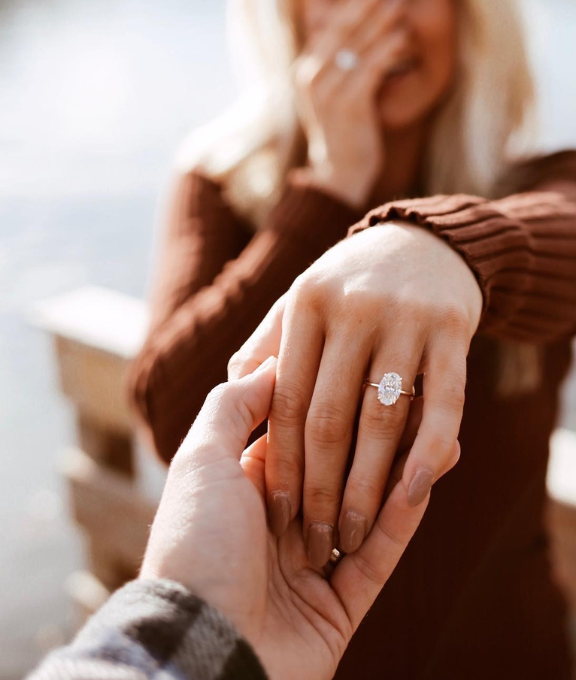
A modern expression of the classic bezel solitaire, this engagement ring features a sleek split shank that gently tapers toward a low-set center diamond.
Great experience all around. Really good service and the craftsmanship was solid. Thanks to the Goodstone team Amanda, Savanna and Kayla were awesome!
The Split Shank Engagement Ring Collection epitomizes timeless sophistication and architectural elegance. Featuring a band that gracefully divides into two before converging at the center stone, this design creates a mesmerizing frame that highlights the brilliance of the diamond. The split shank not only enhances the visual impact of the ring but also lends a sense of balance and symmetry, making it an exceptional choice for those seeking a unique yet classic look.
Historically, split shank rings have been favored for their ability to amplify a diamond's presence, providing a regal and dramatic aesthetic. Crafted with precision and attention to detail, each ring in this collection is designed to exude brilliance from every angle.
A split shank engagement ring has a band that divides into two strands near the center stone, creating a space between them before they meet the setting. The two strands frame the diamond with negative space, drawing the eye inward. A single-strand band, by contrast, stays solid all the way around.
The band divides into two strands near the top of the ring, while a plain solitaire stays one continuous strip from base to setting. The split adds side detail and open space around the center stone. A plain band maintains a smooth, unbroken line that puts all the focus on the diamond.
The design can make the center diamond look larger, since the two strands widen the ring near the stone and set it inside a pocket of open space. That negative space between the strands isolates the diamond and lends it greater presence. The carat is unchanged, but the stone holds the eye more than it would on a solid band.
The two strands can add a little support by meeting the setting at two points on each side rather than one, which spreads where the band connects to the head. The main security still comes from the prongs holding the stone. The split contributes more to the framing and presence than to structural strength.
The band holds up well for everyday wear, since each strand is solid metal and the two join firmly at the setting and the base. The open space between them can gather dust, so occasional cleaning helps. As with any ring, having the prongs and joins checked keeps the setting sound.
It can usually be resized, though the work is a little more involved than on a plain band because the split changes the geometry near the top. A jeweler resizes at the bottom of the shank where the metal is single, and the range depends on how the strands are set near the top.
The open space between the strands echoes a long outline, so pear and oval stones settle well where the two arms widen around them. Round and cushion diamonds pair nicely, too. Centered in the frame, the split opens up around them. A larger center stone gains the most, since it fills that framing where a small one might leave the strands looking bare.
The band can catch on clothing at the open space where the strands divide, since the gap and the edges give fabric something to grab. The effect is usually mild and depends on how wide the split is. Keeping the strands smooth and the setting clean reduces the chance of snagging on knits.
A wedding band that follows the line of the split pairs more closely, since a straight band can leave a gap where the strands rise and part. A band shaped to the curve of the strands tucks into that opening and meets the ring evenly. GOODSTONE can match a band to a specific split shank so the two pair cleanly.
A specially fitted band is not always required. Where the strands curve and widen, a band contoured to nestle between them fills the opening and keeps the pairing snug. A plain straight band can still suit the ring when the strands run closer together or the split starts higher up, so the choice depends on how the two strands are built.
Cleaning takes a little more care than a plain band, since the open space between the strands and the extra edges near the setting collect lotion and dust. Guide a soft brush down between the strands and around the prongs in warm soapy water, then rinse so nothing stays trapped in the gap. Having a jeweler clean it periodically keeps the strands and the setting looking their best.
Expect somewhat more than a standard solitaire, since dividing the band into two strands uses extra metal and more detailed fabrication. How much more depends on the metal, the width of the strands, and the stone. GOODSTONE can work out the added cost of a given split shank next to a plain band.
The two strands can overwhelm a smaller center diamond if they are wide and the stone is petite, since the framing may draw attention to the metal rather than the stone. Matching the width of the split to the diamond’s size keeps them balanced. A narrower split holds the eye on the stone.
Upkeep runs a little higher than a plain solitaire, mainly cleaning the open space between the strands where dust settles and having the joins and prongs checked. The extra edges and the split are the places to watch. Routine gentle care keeps both the framing and the setting in good order.
Get in touch with our concierge team to book a one-on-one call with us to discuss about your Engagement Ring. We will walk through the process from diamond sourcing to choosing the perfect setting.