

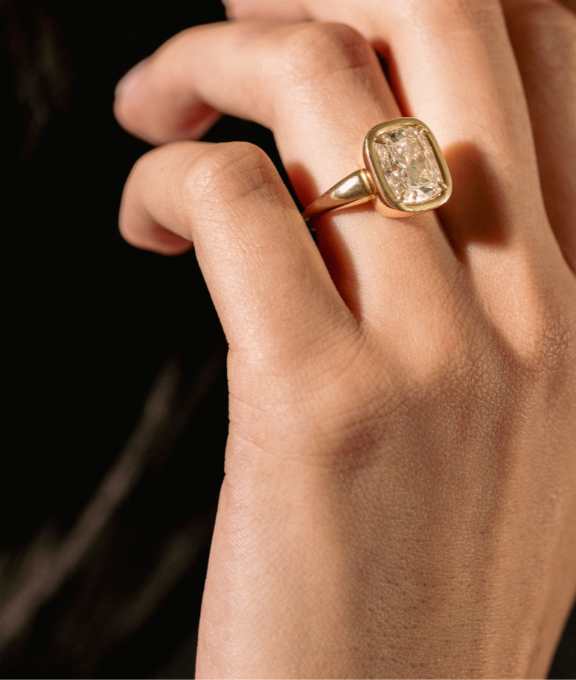
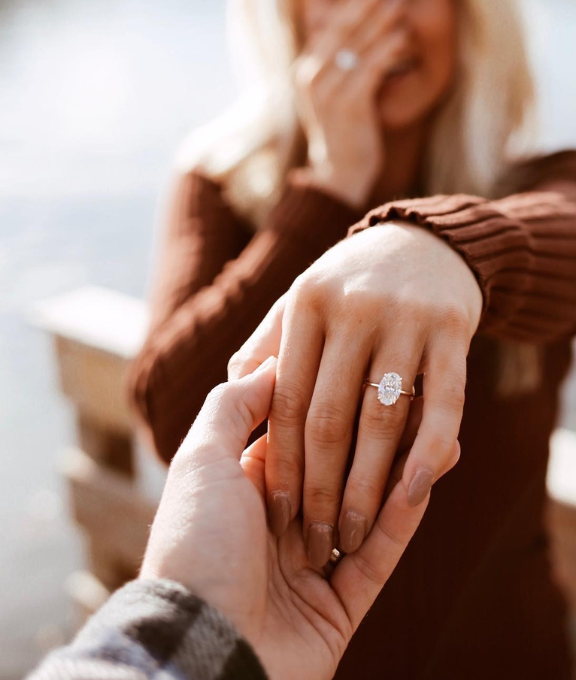


Sloped sides meet at a soft edge, giving these rings a smooth profile that feels easy to wear. Our Butter Knife solitaires pair that sleek band with your stone. See what moves you.
Can't find the perfect diamond?
talk to an expert


Amazing experience start to finsh designing my fiancee's custom engagement ring. We are so happy with the end result!

The Butter Knife Solitaire Engagement Ring Collection, offers a sleek and sophisticated design that beautifully blends timeless elegance with modern refinement. Just like our Butter Knife wedding band, this engagement ring features sloped sides that gracefully meet to create a delicately thin edge around the band. The knife edge design dates back to the early 20th century, with its roots in the Art Deco era, known for its bold lines and geometric shapes. This collection exemplifies the perfect balance of simplicity and sophistication, ideal for those who appreciate minimalist design with a luxurious touch.
A butter knife band, also called a knife-edge band, has two flat faces that taper up to a defined ridge running along the top, like the crest of a blade. The inside stays rounded for comfort. It is a band profile rather than a stone setting, so it pairs with a prong-held solitaire head.
The name comes from the crest, which resembles the tapered edge of a table knife, not from any sharpness in the ridge. The top comes to a defined line, but the metal is smooth and rounded enough to wear against the finger. What the name describes is the sleek blade-like profile, not something that cuts.
A knife-edge band rises to a defined ridge along its top, while a plain rounded band curves smoothly with no crest. The two flat faces catch light along the center line, giving the ring a sleeker, more angular look. A rounded band presents a soft, even surface all around.
This profile is comfortable for daily wear. The ridge rides on the outside, while the inside stays rounded against the finger. The crest gives the ring its sleek look without pressing into the skin. Many wearers find the low profile rests close and unobtrusive throughout the day.
The ridged band can look slimmer because the tapered faces narrow toward the crest, creating a lighter visual line than a flat band of the same width. Set against that narrower line, the center stone can read a little larger by contrast. Its carat is unchanged. The crest only slims the metal beside it, leaving the stone where it is.
The band is durable, though the raised ridge can pick up small scratches and softening along the crest where it meets surfaces. Harder metals like platinum hold the edge longer. The crispness can be restored with polishing, and normal wear rarely threatens the ring’s strength.
A knife-edge band can be resized, though the jeweler takes care to keep the ridge line even across the join so the crest stays continuous. Resizing happens at the bottom, where a skilled hand blends the seam so the taper looks unbroken. Since some metals hold that fine edge better than others, GOODSTONE can point you to the alloy best suited to keeping the ridge crisp after adjustment.
The band tapers to a crest and never touches the head, so its crisp line pairs cleanly with round, oval, and princess stones. Emerald and other step-cuts echo the ridge’s angular edge and suit it especially well. That independence leaves almost any outline you like room to lead.
It catches on clothing very little. The ridge rides low, and the band stays close to the finger, with no raised elements beyond the crest. The setting head can snag more than the band itself. The sleek line is one reason the style suits day-to-day wear.
A matching knife-edge wedding band pairs most naturally with a knife-edge solitaire, with the two crests lining up along the finger for a continuous look. A plain flat or rounded band also lies flush against the base because the ridge stays low. GOODSTONE can match a wedding band to the crest of the solitaire.
Work a soft brush along the crest and around the setting in a bowl of warm water with a little mild soap, which lifts the film that dulls the ridge, then dry the band with a lint-free cloth. Skip abrasive cleaners that wear down the crest. An occasional professional polish brings the line back if daily wear softens it.
Platinum holds the profile especially well. Dense and hard, it keeps a crisp ridge as it wears. White and yellow gold also hold the crest, with harder gold alloys keeping the line longer. Softer metals lose the edge sooner, so the metal you pick sets how long the ridge stays sharp.
A butter knife solitaire can cost a little more than a plain one, since shaping the tapered faces and the crest takes more precise fabrication than a simple rounded band. What you pay extra for is the labor, not the material, so it adds little next to what the metal and the stone cost.
The ridge can show wear a little sooner where it rubs against other rings or hard surfaces. As the highest point of the band, the crest meets contact first. The wear is cosmetic softening rather than damage. Polishing restores the crest, and a harder metal keeps the line crisp longer.
Get in touch with our concierge team to book a one-on-one call with us to discuss about your Engagement Ring. We will walk through the process from diamond sourcing to choosing the perfect setting.


