






The Best Settings to Protect a Princess Cut’s Corners
A princess cut can chip with a sound you can hear, a small ding as a corner torques against its prong and the point gives way. Those four sharp corners are the whole vulnerability of the stone, and the setting is what decides how well they survive daily wear. Protection here is a matter of corner coverage. A setting that cups each of the four points, through V-prongs or a bezel, guards the spots that chip, while prongs planted on the flat edges leave the corners bare and cause most of the damage.

The princess cut’s crisp, architectural corners are what make it so distinctive, and what make the right setting especially important.
The Princess Cut’s Corner Vulnerability
The body of a princess cut is as durable as any diamond. Its trouble is at the four corners, where the shape narrows to roughly 90-degree points that have very little metal around them and even less margin for error. A sharp point concentrates the force of any knock into one small spot, and those corners also lie close to a cleavage plane, the direction where a diamond’s carbon atoms bond less tightly. A hard tap near a corner can start a chip that spreads down the stone’s side from there.
Most of that damage comes from ordinary life. A hand catches the ring on a countertop or a doorframe, and the corner takes the hit. Setters who remove old princess cuts from their settings see the result often, and many stones show at least one nicked corner that no one noticed while it was mounted. The failure can even be audible. When a poorly held corner turns into its prong, it makes a faint ding, and that small sound is the point chipping.

A princess cut is remarkably durable through its center, but its four sharp corners require extra consideration.
Corner-Covering Settings by Type
Every setting worth considering answers the same question first. Does it cover the four corners? After that come the trade-offs a buyer notices daily, how much light the setting lets into the stone, how much upkeep it asks for, and how easily it snags on fabric. The options below run from the one most jewelers reach for to the ones that suit narrower situations.
The V-Prong Standard
A V-prong, also called a V-tip or chevron prong, is a prong bent into a V that fits over a corner and holds both edges of the point at once. It is the feature most often recommended for a princess cut, and the reason is in how it grips.
A setter drills a small void into the metal so that the corner rests inside a hollow, with the metal touching only the two flat edges beside the point, never the tip itself. The point that would otherwise chip is tucked into a pocket where nothing presses on it.
Reliable protection comes from four V-shaped prongs, eight prongs with two at each corner, or a bezel. What matters is that something covers every corner. A V-prong does that while leaving the rest of the stone exposed to light, which is why it is the default for shoppers who want protection without sacrificing much brilliance.
A V-prong protects against most ordinary knocks, but it cannot make the stone chip-proof. A hard enough blow to a corner can still chip a princess even in a good V-tip, and metal that presses onto the stone over years of wear can become its own stress point. The prong tips also need an occasional look from a jeweler.
The Bezel and Half-Bezel
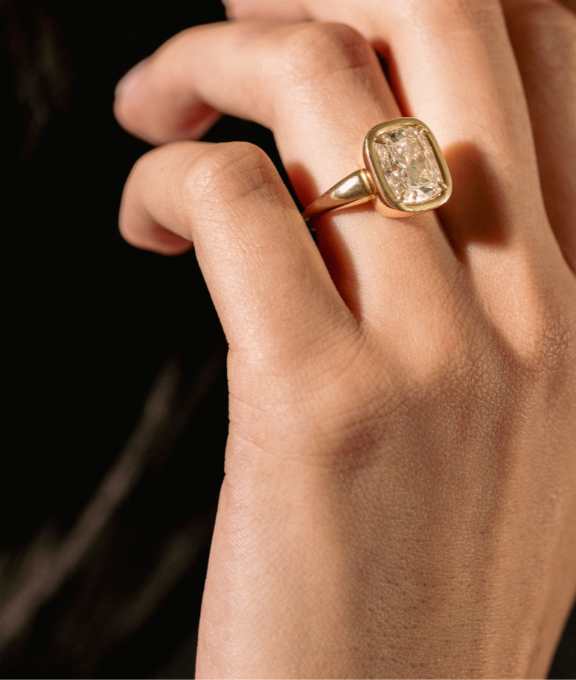
A full bezel takes a different route to the same goal. It wraps a continuous rim of metal around the whole girdle of the stone, corners and all, so the force of a knock spreads around that entire band. It is the most protective setting for stones with exposed corners and requires the least maintenance, with no prong tips to check or retip.
The trade-off is light. A metal collar around the girdle blocks some of the light that would enter and leave through the sides of the stone, so a bezel-set princess looks a little softer than the same stone held in open prongs. For a buyer who wants maximum security and does not mind that, it is a fair exchange.
A half-bezel is the middle path. Thin metal lips wrap the two most vulnerable corners while the other sides stay open, which keeps much of the bezel’s protection and lets more light back into the stone. It suits an active wearer who wants the corners guarded without trading away all the sparkle.
GOODSTONE builds this style into a dedicated princess cut half-bezel collection, and its custom work lets a buyer set how much metal covers each corner, the detail that decides how well the stone is protected.

Bezel settings offer exceptional security by wrapping protective metal around the diamond, while a half-bezel creates a more open interpretation, as you can see on our beautiful Penumbra Bezel Set Engagement Ring With Princess Cut.
The Halo Buffer
A halo surrounds the center stone, with a row of small diamonds set in their own metal frame, and the outer ring serves as a buffer. Bumps and snags meet the halo first. The everyday contact that would otherwise reach a bare corner catches the small stones and the frame. A double halo, with two rows, extends that cushion even further from the center.
A halo shields the corners without replacing them. A well-built halo still puts a V-prong or a small bezel on each of the four tips of the center stone. The halo is a second line of defense behind the corner coverage, not a substitute for it. A pretty halo with bare corners underneath still leaves the points at risk.

A halo creates an additional layer of protection around a princess-cut center while adding dimension and sparkle.
Double and Quad Prongs
Double prongs, sometimes called quad prongs when there are two at every corner, can protect a princess. Placement decides it. Two prongs set to either side of a corner can look secure while leaving the sharp tip exposed, which is the opposite of what the stone needs. Double-claw prongs arranged that way often provide less protection than a single V-tip would.
Some quad-prong designs do wrap each corner so the metal covers the point the way a princess needs. For any prong setting on a princess, look at the four corners and ask if the metal covers the tip or only sits beside it.
The Setting Mistake to Avoid
The setting that gets a princess into trouble is the one that treats it like a round diamond. Plain rounded or pointed claw prongs placed on the flat edges of the stone hold it firmly enough, but they leave the four corners exposed. On a round stone that is fine, because a round has no vulnerable point. On a princess, it puts the most fragile part of the diamond exactly where the next knock will find it.
Delicate single-line claw prongs are the version to watch for most, because they look their best in a photo. A thin claw cannot cradle a corner the way a drilled V-tip can, and guarding a sharp point with one is close to impossible. Corner coverage is what protects a princess, and side coverage cannot stand in for it. A setting that reverses that order looks fine on the day it is bought and chips the diamond later.

A princess cut should never be set as though it were a round diamond.
Setting Height and Snag Risk
Height is a separate question from coverage, and it is easy to conflate the two. A basket or a cathedral changes how high the stone rides and how much it catches on things. Neither changes how well the corners are held. A low basket keeps the diamond close to the finger with the same security as a taller mount, and its lower profile catches less on knitwear and hair.
A cathedral lifts the stone higher on metal arches, which looks graceful and gives clothing and hair more to snag on. A cathedral can still protect a princess well, as long as it is built with proper corner prongs.
The snag itself is a real part of daily wear. A raised prong or a high corner can hook a thread mid-getting-dressed and tug at a favorite sweater, both an annoyance and a sign the setting is riding high on the finger. Some protection comes from the cutter, in the faceting itself. A tiny flat facet, cut onto each corner during faceting, adds durability. It is usually too small to see without magnification, and many buyers never know their stone was finished that way.
No setting makes a princess fully chip-proof. That gap is what maintenance and insurance cover. Prong settings want a periodic jeweler check as the tips wear, bend, and loosen, and a bezel asks for less of that attention. Insuring the ring is the backstop the trade agrees on, since even the best corner coverage only lowers the odds of a chip.
A buyer who wants the height and the corner protection settled together can build both into a custom setting, working with a designer to match the basket profile to how the ring will be worn. GOODSTONE offers that kind of custom design alongside its ready-to-ship and half-bezel options, which keeps corner coverage from becoming an afterthought.

A secure setting should consider both protection and profile, like our Thin + Simple Solitaire Engagement Ring With Princess Cut Diamond.
Frequently Asked Questions
Do princess cut diamonds chip easily?
The flat body of a princess cut is as hard as any diamond, and the stone as a whole is durable. The weak spot is the set of four sharp corners, the likeliest place for a chip. Most corner damage comes from ordinary impacts, like knocking a hand against a countertop or a doorframe.
What is the best setting for a princess cut diamond?
The best settings are the ones that cover all four corners. That means V-prongs at each corner, a full bezel or a half bezel, or a halo with corner V-prongs underneath. Corner coverage is the priority for a princess-cut, and any setting that leaves the points bare is a weaker choice, no matter how secure it looks.
What is a V-prong setting?
A V-prong, also called a V-tip or chevron prong, is a prong bent into a V shape that fits over a corner of the stone and holds both edges of the point. It cradles the most fragile spot on a princess cut, and jewelers recommend it more than any other setting feature for the cut. The setter usually drills a small void so the corner rests inside the metal without the tip touching it.
Is a bezel setting better than prongs for a princess cut?
A bezel provides more protection, since it wraps metal around the entire girdle and all four corners, and it requires less maintenance than prongs. The trade-off is brilliance. The metal collar blocks some light from entering the sides of the stone. Prongs let in more light and sparkle more, but they need corner V-prongs and periodic checks to stay safe.
What is a half-bezel setting?
A half-bezel wraps metal lips around the two most vulnerable sides or corners of the stone while leaving the other sides open. It retains much of a full bezel’s protection while letting in more light for a brighter look. It suits an active wearer who wants the corners guarded without giving up all the sparkle of an open setting.
Does a halo protect a princess cut’s corners?
Yes, but indirectly. The ring of small diamonds and metal around the center stone acts as a buffer that takes bumps and snags before they reach the corners. The protection is only complete when the halo also has V-prongs or a small bezel on each corner of the center stone. Treat the halo as a second line of defense, with corner coverage still doing the main work.
How many prongs does a princess cut need?
Four corner prongs are the minimum, and each works best V-shaped so all four points are covered. Eight prongs, two at each corner, add security, and a bezel drops prongs altogether. What counts is a prong over each corner, not the total number on the ring.
Do double or quad prongs protect a princess cut?
Double and quad prongs help only if they are placed to cover each corner. Double claw prongs set to the sides of a corner leave the point itself exposed, which defeats the purpose. What protects the stone is a prong over each tip, and the number of prongs is secondary.
Can a chipped princess cut corner be fixed?
Small chips can sometimes be smoothed or lightly recut by a cutter, though this removes a little weight from the stone. Badly broken diamonds may need to be replaced, which is one of the main reasons jewelers recommend insuring the ring.
Is a cathedral setting safe for a princess cut?
A cathedral setting can protect a princess well, as long as it is built with proper corner prongs. Its main downside is height, since the raised profile can catch on clothing and hair for an active wearer. If you like the look, ask that the four corners be covered with V-prongs and consider a slightly lower profile.
Should you insure a princess cut engagement ring?
Yes. No setting makes a princess cut fully chip-proof, and insurance is the real protection against a broken corner or a lost stone. Jewelers and long-time collectors consistently treat it as a basic step for a princess cut.




Deja un comentario (todos los campos son obligatorios)