





The Best Settings for Emerald and Asscher (Step Cut) Diamonds
The settings that flatter an emerald or Asscher cut all do the same small job of getting out of the way. A four-prong solitaire, an east-west mount, a three-stone with step-cut sides, a halo, or a bezel serves the stone better than a busy pavé gallery. A step cut depends on transparency, and its open table works like a window straight into the diamond. The right setting keeps the long lines uncluttered and guards the cropped corners, while the wrong one crowds the geometry until that openness is lost.

Step-cut diamonds are defined by clean lines, open facets, and quiet flashes of light. The best settings complement that architectural beauty without competing with the stone itself.
The Optical Demands of a Step Cut
An emerald or Asscher cut gets its look from long parallel facets. Light comes back in even planes, bright corridors alternating with darker ones that move slowly as the hand turns. Light stacks down the stone’s stepped planes. The effect comes from transparency, and the open table is at the center of it. Hold an emerald cut over a line of text, and you can read through the stone. The setting frames that transparency.
An Asscher does the same thing, squared off, its cross-facet windmill snapping into view under a jewelry light and calming under a softer office one. A step cut rewards a look under multiple light sources before the buyer commits.
That openness sets the terms for everything a setting has to do. Because the facets are few and large, an inclusion that a round brilliant would swallow in its sparkle can show plainly, and body color shows more openly too. Both are on display through the table. The cropped corners are the other constant. They are the reason step cuts exist, and bevelling the points gave the fragile original crystal nothing to chip, and they are the part of the stone a setting most needs to guard.
This explains why the short list of step-cut settings is a spare one. Heavy pavé and ornate galleries busy up the clean lines and compete with the slow corridors of light. The mounts that suit these stones share a restraint. They hold the diamond securely and protect the corners while leaving the table and the long facets open to the eye.

Emerald and Asscher cuts reveal their beauty through broad, open facets rather than fast sparkle.
The Best Settings for Emerald and Asscher Cuts
Each of the mounts below steps back in its own way, and each keeps the geometry legible.
The Four-Prong Solitaire
The solitaire is the plainest way to frame a step cut, and for most stones it is the strongest. Four prongs grip the cropped corners, leaving the table and long facets fully open. Nothing stands between the eye and the open table. A thin band exaggerates the size of the stone because there is nothing beside it to shrink it by comparison, and a modest carat can look surprisingly large once the band stops competing with it.
It is also the mount that shows a stone honestly, with nowhere for a gallery to distract from an open table or a visible inclusion. It rewards a diamond that has already been vetted. Four prongs are the standard for security, and larger stones can take six or eight, where the added grip earns the extra metal.

A four-prong solitaire lets an emerald or Asscher cut speak for itself, just look at our Thin + Simple Solitaire Engagement Ring With Asscher Cut Diamond.
The East-West Setting
Turning an emerald cut horizontal across the finger is one of the newer options and one of the biggest engagement-ring trends of 2026. The stone reads long and linear laid on its side, and the orientation covers more of the finger. That extra coverage makes it look larger without added carat weight. It also rests lower than an upright mount and snags less on sweaters and hair throughout the day.
Emerald and marquise are the cuts cited most for the look, since their length is what makes the horizontal line work, and an Asscher stays square either way, leaving the trend mainly to the elongated emerald.

Turning an emerald cut east-west gives its classic geometry a distinctly modern perspective, as you can see on our Signature Cathedral Solitaire Engagement Ring With Emerald Cut Diamond (East West).
The Three-Stone With Step-Cut Sides
A three-stone setting suits a step cut best when the side stones are also step cuts. Tapered baguettes or trapezoids carry the same parallel-line geometry as the center and echo it rather than fight it, and their length draws the eye along the center stone to amplify its own presence. Trapezoids lie flush against the center’s straight sides and look almost like extensions of it, while tapered baguettes step down in a gentle line that lengthens the whole piece.
The structured silhouette still keeps the band restrained. Brilliant-cut side stones can work, but they introduce the fast sparkle the center deliberately avoids. The rhyme of step cut against step cut is the more considered choice.

Step-cut side stones create a natural extension of an emerald or Asscher center. Tapered baguettes and trapezoids echo its linear faceting, creating a three-stone ring that feels cohesive rather than overly embellished.
The Halo and Hidden Halo
A halo rings the center with small diamonds and does two things that a step cut alone cannot do. It adds the perimeter sparkle these cuts do not produce on their own, and it makes the center look larger than its carat weight. For a buyer who wants some brightness around a transparent center, it is the natural answer.
A hidden halo tucks that ring of stones beneath the diamond. The outline stays uncluttered from above while the profile still catches light from the side. The choice between them turns on how much brightness a buyer wants on the face of the ring, since an exposed halo announces itself while a hidden one keeps the step cut’s calm look intact.

A halo introduces brilliant sparkle around the quieter light of a step cut, while a hidden halo keeps that brightness tucked beneath the stone.
The Bezel and Half-Bezel
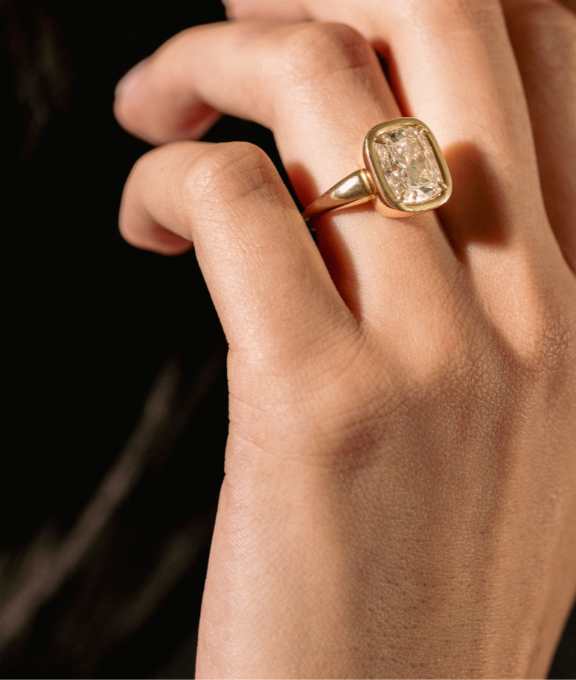
A bezel traces the stone’s outline with a metal rim, and the straight edges of that rim complement the cropped corners while protecting them. It is a sound pick for active hands. The tradeoff is light.
A full bezel blocks the side light the open facets would otherwise take in and can make the stone look slightly smaller. A half-bezel is the compromise many buyers reach for, wrapping only the vulnerable corners in metal while leaving the long sides open. The corners are guarded, and the table stays in view.

The crisp outline of a bezel feels naturally suited to the geometry of a step cut.
How to Protect Step-Cut Corners
The beveled corners are the reason an emerald or Asscher cut is more durable than a princess cut in the first place. A princess holds sharp exposed points that can chip against a doorframe, while a step cut has none and takes knocks more calmly day to day. That durability comes with a catch to be aware of before choosing a setting.
With no facet junction across a step cut’s corner to break up an impact, a chip that does happen shows plainly against the clean line, and no busy faceting hides it. This is why corner protection is at the practical center of the setting decision. Substantial corner prongs or a bezel that wraps the corners does the real work, while thin, ornamental claws look delicate and leave the most exposed part of the stone underheld.
It is worth asking a jeweler to show how the corners are held before the stone is set, because that single detail separates a ring that survives daily wear from one that stays at risk.

Emerald and Asscher cuts may have softened corners, but those edges still deserve thoughtful protection.
Choosing Metal and Stone Quality
The open table that makes these cuts beautiful also makes clarity and color part of the setting decision, because both are on show every time the hand turns. VS1 is the safe floor for a step cut, and VS2 is the value grade most buyers target, but any candidate should be checked for eye-cleanness on video before it is set.
The large facets can reveal a central inclusion that a printed grade will not warn you about. An SI1 can look eye-clean when its inclusions lie near the girdle where prongs will cover them. The specific stone matters more than the grade on the certificate.
Color follows the same logic. Step cuts reveal body color more openly than brilliants. Grades from D to F look cleanest set in white gold or platinum, where a cool metal keeps a high-color stone bright. A slightly warmer stone can be intentionally paired with yellow or rose gold, which masks a faint tint. Metal is chosen to match the stone in hand.
GOODSTONE stocks emerald and Asscher stones across solitaire, three-stone, east-west, and bezel collections, so that a step-cut can be set into whichever mount and metal best suits the particular diamond. Matching the setting to the stone is the point of the exercise.

The transparency of a step cut puts clarity, color, and metal choice on full display.
Frequently Asked Questions
Are emerald and Asscher cuts the same thing?
Both are step cuts with parallel facets, cropped corners, and the same slow, stacked flashes of light. The emerald is rectangular, and the Asscher is essentially its square sibling, with a more pronounced cross-facet windmill and a higher crown that gives it more depth into the stone.
What is the stacked light effect in a step cut diamond?
It is the step cut’s signature look. Light returned in long, even planes, bright corridors alternating with darker ones that move slowly as the hand turns. The look is slow, ruled flashes down the length of the stone rather than the fine, fast sparkle of a brilliant cut.
What clarity do you need for an emerald cut diamond?
VS1 is the safe floor, and VS2 the value grade, but any step cut should be verified eye-clean on video, because the large open facets show inclusions that a round brilliant would hide. The grade on paper is a starting point, not a guarantee for these cuts.
Can you use an SI1 for an emerald cut?
An SI1 can work when its inclusions sit near the girdle where they read eye-clean, while a VS2 with a central crystal can show, so the location and type of inclusion matter more than the grade alone. View the specific stone before committing.
What color grade is best for a step cut diamond?
Step cuts reveal body color more than brilliants, and D to F look cleanest in white metals. A slightly warmer stone can be paired with yellow or rose gold to mask a faint tint, so the color grade and the metal are chosen together.
How many prongs should an emerald cut have?
Four prongs gripping the cropped corners are the standard, and they need to be substantial. Thin decorative claws leave the corners underheld. Larger stones are safer with six or eight prongs, where the added grip earns the small amount of extra metal over the facets.
Does an east-west setting make a diamond look bigger?
Turning the stone horizontal increases finger coverage, so it looks larger without any added carat weight, and it sits lower than an upright mount, which means it snags less on clothing and hair.
What side stones go best with an emerald cut?
Tapered baguettes and trapezoids work best, because they are step cuts themselves and echo the center’s parallel-line geometry. The pairing gives a cohesive three-stone look, and the sides amplify the center stone’s length.
Is a bezel setting suitable for an emerald-cut diamond?
Yes. The straight edges of a bezel complement the cropped corners and protect them, giving activewear a sleek, modern look. The trade-off is that a full bezel blocks sidelight and can make the stone look slightly smaller, which a half bezel avoids.
Do emerald cut diamonds chip easily?
Less than princess cuts, because the beveled corners give no exposed points to break. A corner chip does show plainly on a step cut, though, with no facet junction to soften an impact, so corner protection in the setting still matters.
Should you avoid pavé settings for a step-cut diamond?
Pavé is not banned, but heavy pavé and ornate galleries compete with the clean parallel lines and busy up a stone meant to look spare. The usual guidance is to keep the band minimal so the geometry and its slow flashes stay the focus.
What carat size looks good for an Asscher cut?
Asscher faces are smaller than their weight suggests, and many buyers target around 2 carats for visual presence. Presence varies with the crown and the cut so that the same carat can read differently from one Asscher to the next.



Deja un comentario (todos los campos son obligatorios)