






Which Diamond Shapes Chip Most Easily in Daily Wear?
Some diamond shapes survive daily wear better than others, and the difference comes down to geometry. The thinnest, most exposed part of a stone gives way first, so a sharp point or a square corner is where a chip starts when a ring meets a countertop or a door frame. Shapes with those features chip most easily in daily wear, which puts the pointed marquise and pear near the bottom for durability, along with the square-cornered princess. Rounded outlines such as round, oval, or cushion take the same knocks with much less risk.

Rounded silhouettes naturally handle impact better, while sharp points and corners need a little more protection from the setting.
Hardness vs. Toughness in Diamonds
That top Mohs ranking describes hardness, not toughness, and the two are easy to confuse. Hardness resists scratching, while toughness resists chipping and fracture, and diamond has less of the second than its reputation suggests.
The crystal has four directions of perfect cleavage, planes that run parallel to its triangular faces where the carbon atoms bond less tightly. A hard strike at the right angle can split, chip, or cleave the stone along one of those planes, which is how the hardest natural material can still be brittle.
Most chips come from a single hard impact. The usual culprits are everyday ones, like a countertop edge, a door frame, or the next ring sitting in the same box. A mundane knock against the underside of a desk is enough if it finds a point, a corner, or a thin edge. Most wearers rarely see damage. A few weak spots create the risk, and the rest of the stone holds up. Knowing where those spots are is what separates a shape that handles daily wear from one that needs guarding.
|
Shape |
Chip Risk |
|
Lowest |
|
|
Low |
|
|
Low |
|
|
Low to moderate |
|
|
Low to moderate |
|
|
Low to moderate |
|
|
Heart |
Moderate |
|
Trillion |
Moderate |
|
High |
|
|
Highest |
|
|
Highest |
The Most Chip-Resistant Shapes
A hard knock needs a point or a corner to concentrate its force, and a curved outline denies it one. That is what puts the rounded shapes at the top for durability. A round brilliant has no corners at all, and its curved girdle spreads impact around the full edge, leaving no single point to absorb the force. Oval ranks close behind, with a smooth profile and no sharp extremities.
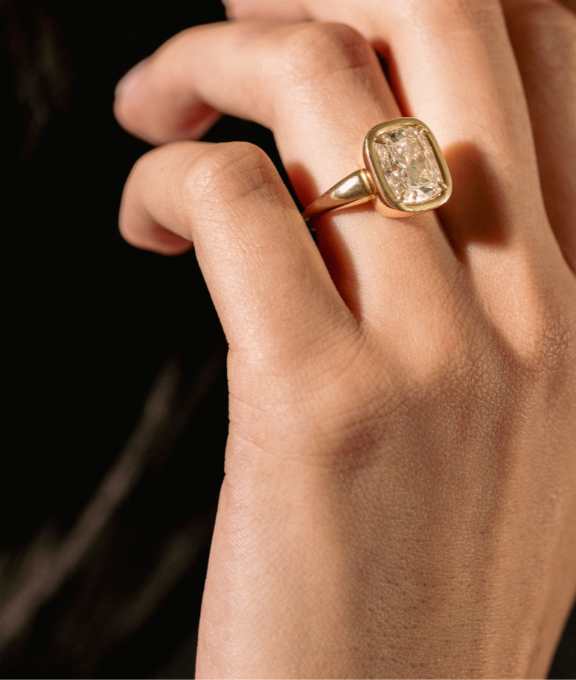
Cushion earns its place through softened corners and gently rounded edges that reduce the stress points where a chip would start. Many jewelers call it the most durable of the fancy stones. None of these stones are chip-proof. A thin girdle can still give way, and the first sign is a fingertip catching a tiny rough spot along the edge that the eye would miss. The rounded tier lowers the odds of a chip, and a hard hit meets a curved edge with no tip or squared corner to focus on.

Rounded shapes like round, oval, and cushion are among the most forgiving for daily wear.
Shapes with Moderate Chip Risk
Between the rounded forms and the pointed ones is a middle tier, where the corner has been blunted or the point set low and shielded by the design.
Emerald, Asscher, and Radiant Cuts
Emerald and Asscher cuts are step cuts with clipped, beveled corners instead of sharp 90-degree points. That single change moves the most vulnerable spot away from the fine tip, making them meaningfully more secure in daily wear than a princess cut. Radiant is a brilliant-faceted square or rectangle that also uses cut corners, and it shares the advantage.
These cuts can still chip at the clipped corner if a hit catches it wrong, and each one benefits from a prong or a bezel over that corner. The gap between a beveled corner and a sharp one is small to the eye, but it changes how the stone holds up.

Clipped corners give emerald, Asscher, and radiant cuts a durability advantage over sharper square shapes.
Heart and Trillion Shapes
A heart has a single point plus a small cleft at the top, and a trillion has three corners. Both share the risk that a point brings. What lowers the risk is placement. Jewelers usually set these points low in the mount or design them to shield them, keeping them out of the path of a direct knock. Even guarded, a point can go.
A single accident, as a ring dropped into a running sink disposal, can chip the points off a pair of flanking trillions at once, while the main stone cleaves where an inclusion lies. A trillion point left unguarded chips readily, and the mount matters as much as the silhouette here.
Shapes Most Prone to Chipping
The most fragile tier is defined by exposed geometry, a sharp corner or a fine point that is the first part of the stone to meet a knock.
The Princess Cut and Its Four Corners
The princess cut concentrates its risk at four sharp 90-degree corners. Each corner is both the most exposed part of the stone and a cleavage weak spot, where the carbon bonds are looser and a hard hit can start a chip. That combination makes a princess chip more readily than any rounded stone of the same size.
The damage often arrives slowly. In one case, a princess cut lost all four corners across 10 years of day-and-night wear, one corner at a time. The fragility is manageable, which is why jewelers routinely set a princess-cut with a V-prong that cradles each corner.

The princess cut's crisp geometry is part of its appeal, but those four sharp corners are also its most delicate feature. V-prongs help preserve the shape while keeping its bold, modern look intact.
Pear and Marquise Points
Pear and marquise place the weak point at a fine tip, the thinnest part of the whole stone. A pear has one exposed point, a marquise has two, and both catch on clothing and hard edges in a way a rounded girdle never does. The marquise adds a second problem. It is cut shallowly, leaving the girdle more exposed than on a deeper stone.
A marquise can have both points guarded in V-tips and still chip at the girdle, the damage often spotted only when a jeweler catches it at a routine cleaning. The fine point is the obvious hazard, and the thin girdle is the hidden one.

Pear and marquise diamonds owe their elegance to their tapered points. Those same details need extra protection, making thoughtful prong placement especially important for everyday wear.
Girdle Thickness and Surface Inclusions
Two weak points cut across every stone on the list, no matter where it falls in the tiers.
Girdle Thickness
The girdle is the thin band at the widest part of the stone, and its thickness changes the odds of a chip on any stone. An extremely thin or knife-edge girdle raises the risk. The crown and pavilion facets meet there at a fine edge, the weakest point in the structure.
A medium girdle balances durability against appearance. Modern cutting has mostly removed the old knife-edge problem, and a well-cut stone can hold a thin, elegant girdle without the fragility that name once implied.

A well-proportioned girdle gives the diamond edge strength without adding unnecessary weight. It is one of the quiet structural details that supports long-term wear.
Surface-Reaching Inclusions
An inclusion becomes a durability problem when it reaches the surface. A feather that touches the outside, crosses the girdle, or rests near a point is a built-in fault line, and a hard hit can chip there or split the stone along the feather. An SI2 diamond whose main inclusion is a surface-reaching feather can chip in exactly the spot the feather occupies after roughly a decade of wear.
Small feathers held well inside the stone pose little risk. The ones that reach an edge or a point pose the greatest risk, which matters when a lower clarity grade is due to a feather in a bad spot.

Not every inclusion affects durability, but those that reach the surface or sit near a point deserve closer attention. Their placement can matter just as much as their size.
Protective Settings for Points and Corners
The shape sets the risk, and the setting is where the wearer answers it. A V-prong bends metal into a V that caps a point or corner and shields the most vulnerable part of a pear, marquise, heart, or princess. Many jewelers treat a V-prong over a sharp point as standard practice.
A bezel goes further, wrapping a continuous metal rim around the stone and spreading the impact across a full 360 degrees, making it the strongest guard against both chipping and stone loss. A partial bezel can cover only the points or corners while letting more light into the stone. Channel settings protect the girdle by seating it flush in a groove.
Setting choice also rescues a damaged stone. A chip weakens the stone and can loosen a nearby prong, so jewelers often reset a girdle-chipped diamond into a bezel that hides the damage and shields the edge, or recut and repolish it at the cost of roughly 0.02 to 0.10 carats of weight for a minor chip.
The weak point of a shape is exactly what a designer should be building the setting around. GOODSTONE works in every diamond shape and setting and can cradle a marquise tip in a V-prong or wrap a pear point in a bezel, making the guard part of the ring from the first sketch.

The right setting can transform a delicate diamond shape into a confident everyday ring. V-prongs, bezels, and protective galleries help shield vulnerable points while preserving the design's character.
Frequently Asked Questions
Can a diamond chip or break?
Yes. Diamond is the hardest natural material, with a hardness of 10 on the Mohs scale, but it is not the toughest. It has four planes of perfect cleavage, and a hard impact at the wrong angle can chip or crack it along one of them.
Which diamond shape chips the most easily?
Marquise and pear chip most easily, because their sharp, exposed tips are the thinnest and most impact-prone parts of the stone. A tip catches on clothing and hard edges and takes the full force of a knock in one small spot.
Do princess cut diamonds chip easily?
More readily than rounded shapes. The four sharp 90-degree corners are the most exposed parts of the stone and lie on cleavage-weak spots. A V-prong over each corner greatly lowers the risk and is standard practice for the shape.
What is the most durable diamond shape for everyday wear?
Round brilliant, because it has no corners or points and its curved girdle spreads impact evenly around the edge. Oval and cushion follow closely, since both keep rounded profiles with no sharp extremities to catch a knock.
Why do diamonds chip if they are the hardest material?
Because hardness and toughness are different properties. Hardness resists scratching, while toughness resists chipping and fracture from a hard blow. Diamond’s cleavage planes are directions of weakness where a hard hit can split it, so the hardest material can still be brittle.
What are cleavage planes in a diamond?
They are the four directions of perfect cleavage that run parallel to the crystal’s triangular faces. Along these planes the carbon atoms bond less tightly, so the stone can split cleanly if it is struck at the right angle.
Where does a diamond usually chip?
Most often at the girdle, the thin outer edge at the widest part, and at the points or corners of fancy shapes such as the princess, marquise, or pear. These are the spots where an impact meets the least material.
Do emerald cut diamonds chip easily?
Emerald cuts hold up better than princess cuts, because their beveled, cropped corners replace the sharp 90-degree points that chip. A prong or bezel over the corner still adds protection.
Do pear and marquise diamonds need a special setting?
A V-prong or a bezel, partial or full, over the point is treated as a practical necessity rather than a style choice. The tip is the most fragile part of the stone, and wrapping metal around it shields the spot most likely to chip.
Does girdle thickness affect chipping?
It does. An extremely thin or knife-edge girdle raises chip risk on any shape, because the facets meet there at a fragile edge. A medium girdle balances durability with appearance, and modern cutting lets a stone stay elegantly thin without the old knife-edge weakness.
Can inclusions make a diamond more likely to chip?
They can. A feather inclusion that reaches the surface, crosses the girdle, or rests near a point creates a weak spot where a hard hit can chip or even cleave the stone. Small feathers held deep inside the stone pose far less concern.
Can a chipped diamond be fixed?
Often yes. A jeweler can recut or repolish the stone, which loses a little weight, or reset a girdle-chipped diamond into a bezel that hides the chip and protects the edge. A chip is a new weak point, so it is best assessed before the ring goes back into daily wear.




Deja un comentario (todos los campos son obligatorios)