



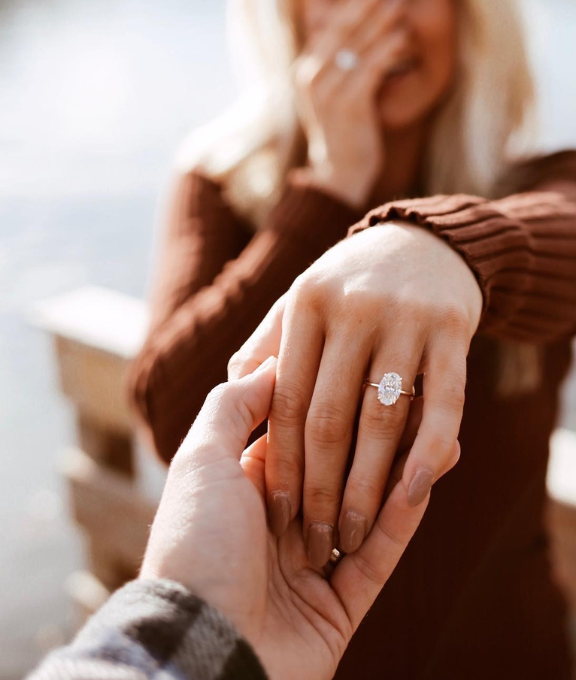


How to Buy an Engagement Ring in 5 Easy Steps
What does buying an engagement ring involve? Five decisions, made in a fixed order. What the partner wants comes first, because it constrains everything after it. The budget follows, then the stone and the setting, like an emerald solitaire or three stone oval. Paperwork and protection finish the sequence. Buyers who work out of order produce the regret stories that fill the jewelry forums. The average American spend in 2025 came to $6,504 by insurance-appraisal data. Survey figures put it nearer $5,200, and each step in the sequence has a defensible default.

Buying an engagement ring becomes much simpler when the decisions happen in the right order.
Step 1: What Does Your Partner Want?
The cheapest regret prevention in the entire purchase is preference research, and it costs nothing. Before any budget or stone enters the discussion, the buyer needs three observations about the partner. The metal color worn daily comes first. The cuts the partner gravitates toward come second, and the ring styles saved online finish the list.
Saved posts on social media are where buyers usually start. The jewelry already in rotation is better evidence, since it records what the person wears day after day instead of what they admire in photographs. A partner who has worn only yellow gold for a decade has already settled the choice of metal.
Friends form the second channel. A close friend can usually confirm a preferred cut without raising suspicion. The third option abandons secrecy altogether. A growing share of couples consult together before the purchase and keep the surprise in the timing of the proposal instead.
The cost of skipping this step is documented. One woman chose a platinum Tiffany solitaire because the setting was iconic, then spent the months after her wedding regretting that she had not asked for the rose gold version she wanted. Her store offered a reset or a stacking band as the fix. The mistake was a single afternoon's decision about metal, made without checking what she reached for every morning.
A second owner upgraded her setting to micro pave and found the result too dressy for her routine. Her own description of her style was jeans and t-shirts. The ring she had chosen belonged to a different wardrobe, and her conclusion afterward was that the plain solitaire and band would have served her better. More ring had meant less her, and the mismatch surfaced only after the wedding, when the ring had to coexist with ordinary clothes. The wardrobe check takes an afternoon and answers the metal and setting questions before any money is committed.

The best engagement ring should feel unmistakably like the person wearing it.
Step 2: How Much Should You Budget?
The two-months salary rule was never a tradition. De Beers introduced the one-month guideline in a 1930s advertising campaign and raised it to two and then three months in later decades. Current guides treat the formula as dead. Budgets now come from savings and from upcoming wedding or housing costs, with financing comfort setting whatever room remains.
Spending averages exist, though they disagree by method. An insurance-appraisal dataset placed the 2025 average at $6,504, while survey-based figures came in near $5,200 to $5,500. Appraisal values price replacement cost. Survey numbers record what buyers remember paying over the counter, so the first method runs higher. A buyer reading any single average should know which method produced it.
Lab-grown stones have changed what a given budget buys. Within colorless D-F purchases, the lab-grown share rose from 29% in 2020 to 76% in 2025. A budget that once covered a half-carat natural stone now covers a full carat in lab-grown at comparable grades. Couples who prefer natural stones still pay the natural premium. The premium is now large enough to count as a deliberate choice with an argument behind it, not a default anyone should inherit.
Financing follows the same discipline as the number itself. A 0% APR offer works when the balance is paid inside the promotional window. Rent-to-own arrangements run three to four times the ring's value and belong in no budget. Store credit cards with deferred-interest clauses fail that test as well. The emergency fund stays intact regardless of the number chosen.
Timing matters less than buyers expect. No sale season moves fine-jewelry pricing materially, so waiting for a holiday promotion saves little. Shopping off-peak buys more attention from staff, which has its own value in a purchase this size.

There is no universal formula for what an engagement ring should cost. The right budget is one that reflects your priorities comfortably while leaving room for the stone and design details that matter most to you.
What Moves the Price of an Engagement Ring?
Carat weight moves price non-linearly. Going from 1 carat to 2 multiplies the cost three to four times over, while dropping to a half carat roughly halves it. June 2026 pricing put a 1-carat natural round at about $6,900 per carat in D-F color with VS clarity. In G-H color that stone ran near $5,700. The lab-grown equivalent at G-H ran near $670. At the top of the clarity scale, a D-F stone with VVS1 clarity reached about $8,700 per carat natural, against roughly $1,078 for the lab-grown version.
A half-carat G-H natural stone in a plain solitaire setting totaled $3,300 to $4,500 as of June 2026. A 1-carat stone in a halo or pave setting ran $6,045 to $8,938 with a natural stone, or $1,650 to $2,780 lab-grown. These figures come from retailer price aggregation, not transaction records, so treat them as anchors for planning.

Carat weight, diamond origin, color, clarity, and setting all influence the final price differently.
Step 3: Which Center Stone Should You Choose?
How Should You Prioritize the 4Cs?
Cut ranks first because it governs how the stone handles light, and no other grade compensates for a poor one. Color comes next, where the value move is well established. A G-through-J stone faces up near-colorless once mounted, while D-through-F pricing assumes a difference most viewers cannot detect in wear. Clarity follows the identical logic. VS1 and VS2 grades, plus an eye-clean SI1, cover the range where inclusions stop being visible without magnification. Cut grades appear on reports for round brilliants, so buyers of other cuts judge light performance from video or in person. Color grading itself runs from D down through Z, and the near-colorless band begins at G.
Carat is where the budget flexes, as the price mechanics above show. Buyers who want presence per dollar have one further lever. Elongated cuts such as oval and pear present more surface area per carat than a round of equal weight. The stone looks larger on the hand for the same money.

The center stone sets the personality of the entire ring. Shape, size, light performance, and origin should work together to create a diamond that feels beautiful on the hand—not simply impressive on paper.
Should You Choose Natural or Lab-Grown?
The two stones share one crystal structure and one grading standard. No jeweler can separate them without specialized equipment, and grading reports disclose the origin. The difference is price and provenance. At 1 carat in G-H and VS grades, the gap in June 2026 was roughly $5,700 natural against $670 lab-grown. Resale cuts against both. A diamond returned to the market recovers perhaps half its retail value, and lab-grown stones retain less than that. The natural premium buys geological rarity and nothing else. A buyer who wants that rarity pays the premium knowingly, with the resale figures above in view.
Step 4: What Setting and Metal Should You Pick?
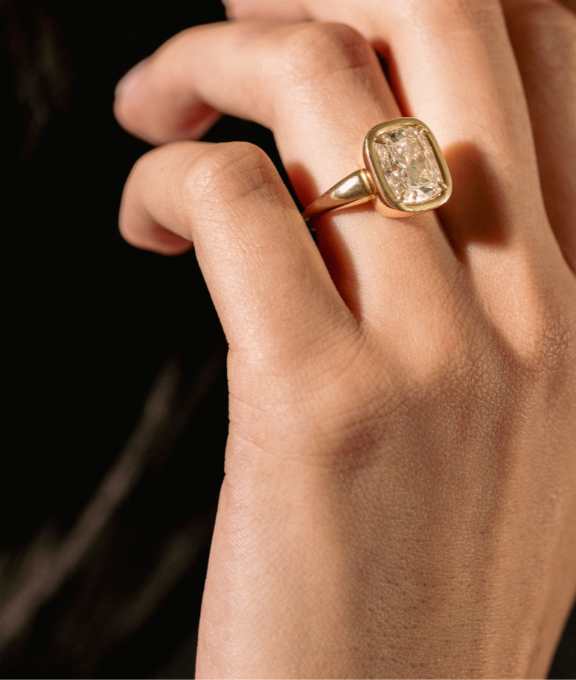
A setting secures the center stone and protects it from impact. Prong settings expose more of the stone to light, with four prongs showing more surface and six offering more protection. Bezel settings surround the girdle in metal entirely, which makes the bezel the protective default for active wearers and for cuts with exposed corners. Side stones add cost and complicate future resizing, which is worth knowing before committing to a pave band.
The lifestyle test from Step 1 applies here at full strength. The owner who regretted her micro pave had chosen a setting that photographed well and matched nothing she wore. A setting is worn on ordinary days, and the choice should be made for them, with the proposal photograph treated as one afternoon among thousands.
Metal choice interacts with the color grade bought in Step 3. Yellow gold masks slight warmth and can make a near-colorless stone present whiter. White metals flatter higher color grades. Platinum costs more and scratches into a patina over years of wear. White gold gives the identical color at a lower price. Rose gold reads warmer than either metal and suits buyers drawn to vintage detailing. Skin-tone matching gets overstated as advice, and the partner's existing collection remains the better evidence.
GOODSTONE builds engagement rings to order, with a dedicated designer assigned to the build and sketches reviewed before production begins. A sketch review would have surfaced the platinum-versus-rose-gold mismatch from Step 1 while it was still erasable. A custom build adds several weeks between design approval and the finished ring, so the process suits buyers who start early. The deposit after estimate approval is $500, credited to the final ring total, and the initial consultation carries no charge.

A setting should complement the center stone while fitting naturally into everyday life. From a classic solitaire to a protective bezel set design, the best choice balances personal style, durability, and the way the ring will actually be worn.
Step 5: How Do You Handle Sizing, Paperwork, and Insurance?
The reliable measurement happens at a jeweler with a ring sizer. Secret sizing stays approximate by nature. Post-proposal resizing is normal enough that most rings are built to move one to two sizes. Solitaires resize without difficulty, while pave bands present more trouble because the stones limit where metal can be removed.
Tapered fingers make sizing a two-variable problem. A ring sized to pass the knuckle can spin loose at the base. One owner discovered this when her ring nearly went down the washing machine drain before she resized from 7.25 to 6. Sized to the base, the same finger produces a pinch at the knuckle. Neither fit is wrong, and the choice comes down to which annoyance the wearer prefers. Some owners resolve the trade-off by season and wear a slightly larger size to accommodate summer humidity.
The paperwork is the step buyers skip. Insist on a grading report from a major laboratory. The letters on a certificate mean nothing without knowing which laboratory issued them, because some store brands grade in-house on proprietary scales that align with no independent standard. First-time buyers discover that gap only when they compare stones across stores. Get an itemized receipt and photographs of the finished ring. Ask for the return and warranty terms in writing before paying. Insurance comes last and should be bound before the ring leaves the house, because homeowners and renters policies rarely cover a ring's full value. A dedicated jewelry policy costs a small annual percentage of the appraised figure and requires the receipt or an appraisal to underwrite.

The final details are what make an engagement ring ready for a lifetime of wear. Proper sizing, independent grading, clear documentation, and insurance protect both the ring itself and the investment behind it.
What Should You Do If the Ring Is Wrong?
Regret arrives months after the wedding more than at the proposal, and the common fix is adjustment over replacement. A stacking band changes how the original ring reads on the hand. A reset moves the stone into a new setting, and fresh plating changes the metal color. Resale math explains why owners keep the original, since a returned diamond recovers only about half its retail value. Sentimental weight attaches to the first ring within months of wear, which is why the forum default favors modification. The repair path matters as much as the purchase path. One secondhand ring sized down an extreme number of sizes at a mall chain began losing stones, and the owner went through three returns and two months without the ring before the corporate office rebuilt it entirely.

A ring that doesn't feel quite right rarely means starting over. Resizing, resetting, or pairing it with a thoughtfully chosen wedding band can transform the way the original ring looks and feels while preserving its sentimental value.
Frequently Asked Questions
How much should you spend on an engagement ring?
One advisor framework sets the ceiling near 5% of annual income, which points a $60,000 salary toward roughly $3,000 and leaves emergency savings untouched.
What is the average cost of an engagement ring in 2025?
The appraisal-based average of $6,504 was down from $6,775 in 2024 and from a five-year peak of $9,025 in 2022.
Which of the 4Cs is most important?
Cut, because it controls light performance in every condition. A well-cut H-color stone with VS2 clarity outperforms a poorly cut D-color Flawless stone.
How do I find my partner's ring size without asking?
Borrow a ring they wear on the correct finger and trace its inner circle on paper. Sliding it onto your own finger and marking where it stops gives a jeweler the same estimate.
Should the engagement ring be a surprise?
It is a genuine split. The surprise route drives the secret-sizing and saved-post sleuthing, while joint consultations remove the style risk. One New York jeweler reports that many clients now bring the partner in for a consultation before any purchase, and treat the proposal itself as the surprise.
Natural vs lab-grown diamond, what is the price difference?
Lab-grown prices fell roughly 60% between 2020 and 2026, and the gap keeps widening.
What metal should I choose for the band?
Match the metal to the color grade and the wearer's existing jewelry. Note that white gold's rhodium plating needs renewal every one to two years under daily wear, an ongoing cost platinum does not carry.
Do I need a diamond grading report?
Every stone should come with one. For lab-grown stones the common issuing labs are IGI, GCAL, and GIA, while natural stones run through GIA or AGS.
Can an engagement ring be resized later?
Most rings resize one to two sizes in either direction, though full eternity bands with stones around the entire circumference generally cannot be resized at all.
How long does a custom engagement ring take?
Plan on several weeks from design approval to finished ring, covering sketch review and stone sourcing before production begins. Starting at least two months before the proposal date leaves room for one revision cycle.



Deja un comentario (todos los campos son obligatorios)