


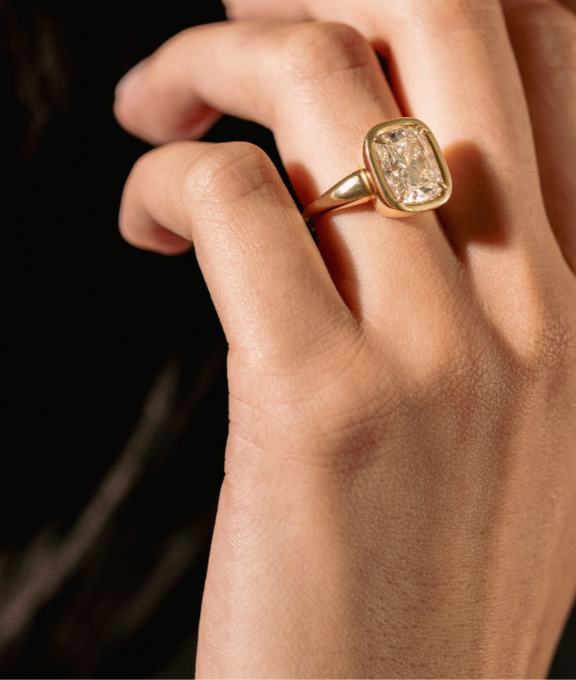


VS1 vs VS2: Can You See the Difference and Should You Pay for It?
A jeweler's loupe can tell the difference between a VS1 diamond from a VS2 diamond in seconds whether it's an emerald or an oval, and the unaided eye cannot. Both grades are eye-clean in normal viewing, and an eye-clean VS diamond looks identical to VVS or Flawless on the hand. The distinction exists at 10x magnification. At viewing distance there is nothing left to grade.
On the question of whether to pay, most buyers should not pay the VS1 premium, though two exceptions are specific enough to name.

Two diamonds can have different clarity grades and still look identical to the naked eye, whether it be a marquise or a cushion cut diamond.
What Do VS1 and VS2 Mean?
VS grades occupy the middle of the clarity scale, above SI and below VVS. Both denote minor inclusions such as small crystals, feathers, or distinct clouds. The number after the letters records how hard a grader had to work at 10x magnification. VS1 inclusions are difficult to find even for a trained grader. VS2 inclusions are somewhat easy to find at 10x, though not blatant. The written definitions omit the unaided eye entirely, because the scale was never built for it. Natural diamonds formed 1 to 3 billion years ago, and the minerals trapped during growth became the inclusions graders now catalog. Those inclusions also serve as identifying marks, since laboratories use them to distinguish one stone from another. A grader weighs inclusion location above all, with size and number behind it. Location determines most of what a wearer notices on the hand.

VS1 and VS2 diamonds both fall within the Very Slightly Included clarity category, where imperfections are typically difficult to detect without magnification.
Can You See the Difference Between VS1 and VS2?
Face-up at viewing distance, an eye-clean VS2 is indistinguishable from an eye-clean VS1. It is also indistinguishable from VVS and Flawless. Once no inclusion can be seen without magnification, nothing remains for the eye to grade. Buyers comparing two eye-clean stones are comparing lab paperwork, because the stones themselves match. Since normal viewing means social distance and mixed room light, no one examines a worn ring from 6 inches away under a lamp.
The grade letter compresses several judgments into two characters. A cloud or dark crystal under the center table facet is the most visible placement in any grade. The same inclusion near the edge or down in the pavilion can go unseen even by someone hunting for it. A VS2 with edge inclusions can look identical to a VS1 with centered ones, and for that reason two stones sharing a grade can differ in person.
In PriceScope threads, VS2 owners describe finding their inclusions only with effort, under magnification or at the right squinting angle, and several describe the mark becoming the way they know the stone is theirs.
The opposite mistake occurs more often. A buyer opens a 20x listing photo or the inclusion plot on a report and assumes the stone is flawed. The photo shows what a professional hunted for at 10x. On the hand, none of it registers. Enthusiast guides document the borderline cases, such as a princess cut with dark crystals under the table whose visibility flickers with lighting and viewing angle. That flicker is the signature of a bad VS2, and it is rare at this grade.

In everyday wear, an eye-clean VS2 diamond can look just as flawless as a VS1. Once inclusions are invisible to the naked eye, the difference becomes one of grading rather than visible beauty.
When Is a VS2 Not Eye-Clean?
The first exception is the cut. Step cuts like emerald and Asscher replace the brilliant facet pattern with long, flat planes. Those planes leave the center of the stone open to inspection. A dark inclusion in the middle of an emerald cut is visible in a way it never would be inside a round brilliant. Community guidance on step cuts is correspondingly strict. VS1 removes most of the risk here, and VS2 gets case-by-case treatment.
The second exception is size. Above 2 carats, tables and facets grow large enough to expose what smaller stones conceal. A 1-carat round hides a feather that a 3-carat round with identical proportions puts on display. Most VS2 stones that fail eye-clean are large, or they are boundary stones that barely graded above SI1. Size and borderline grading compound each other, so a 3-carat VS2 deserves more scrutiny than the grade letter suggests.
A 2018 PriceScope thread records how experienced buyers handle these cases. A member weighing an 8.13-carat emerald-cut VS2 was told he had the process backwards. The advice was to look visually first, through photos and videos within the size and budget range, and to read the report afterward. Another veteran added that fancy cuts admit no safe bet, and that the minimum standard is a video with in-person viewing in various lighting conditions preferred. At that size the report becomes an elimination tool, and the eye does the selecting.
Both exceptions trace back to a single mechanism, since larger viewing surfaces expose inclusions and neither the grade nor the premium changes what those surfaces show.

Larger stones and transparent step cuts like emerald and Asscher can reveal inclusions more easily, making careful evaluation especially important before choosing a lower clarity grade.
How Can You Verify a VS2 Before You Buy?
A grading report records the grade, not the eye-clean result. Buying blind fails inside that gap, and magnified photos and 360-degree video close it by showing inclusion placement directly. A vendor's written eye-clean confirmation adds a second pair of trained eyes. None of this requires the buyer to own a loupe.
A client choosing between two VS2 rounds reviews 360-degree diamond video of both stones side by side, and the comparison turns on inclusion placement. The grade letters stop mattering once both stones pass the eye test. GOODSTONE builds this review into its stone selection guidance, where a designer examines the video and photographs of each candidate stone with the client before a deposit is taken. That guidance covers stones the company sources or stocks. Buyers comparing other vendors' inventory need each seller's own inspection policy.
Check the video once, confirm the stone looks clean at viewing distance, and stop. The vendor's confirmation stays on record with the order, and the remaining decisions concern cut and color.

Reviewing high-resolution imagery, 360-degree videos, and inclusion placement helps confirm that a stone looks beautifully clean from the angles and distances that matter most.
How Much Is the VS1 Premium?
The VS1 premium typically runs 10 to 25% over a comparable VS2, with the spread set by carat weight and the other grades. When the gap falls at the low end, VS1 is a reasonable buy. When it widens, the premium purchases nothing the eye can register. The premium also compounds across the other choices in the ring. The budget covers both the center stone and the setting metal.
Per-carat data from mid-2026 frames the choice. In the 1-carat natural round market, the step from VVS down to VS moves more money than the step from VS1 to VS2. The step down one color grade moves a comparable amount again. Color and carat both outrank clarity once the stone is eye-clean, and the mid-2026 numbers give that ranking a dollar figure. Lab-grown stones compress the debate further. A 1-carat lab-grown round at D to F color and VS clarity averaged roughly $718, a level where the VS1 premium amounts to a rounding error.
Insurance-appraisal data from 2025 records what buyers spent. Natural VS-clarity engagement rings averaged $16,084 against $12,278 for SI, and lab-grown VS rings averaged $4,447. VVS rings averaged $18,581, and the IF and Flawless category averaged $17,552 after falling from $19,466 a year earlier. Spending above VS buys a higher line on the report without a proportionally higher appraisal average. Most of the market's money already goes to the middle of the clarity scale.

Understanding that price gap allows you to decide whether the higher grade is worth it or if your budget could be better invested in cut, color, or carat weight.
Who Should Pay for VS1?
One buyer profile falls outside the general rule. Some buyers pay for VS1 or VVS because of what they know the report says, independent of anything the eye can see. An inclusion-averse buyer who will loupe the stone every week belongs in this group, and so does the buyer who simply prefers precision on paper. Retailers call this the peace-of-mind premium, and it is a legitimate reason to spend. It should be a conscious choice rather than a default setting on the budget.
The grading scale was built to describe what a professional can find at 10x. The finger at viewing distance offers a coarser test, and at VS1 and VS2 both stones pass it, which is why the verification step outranks the grade letter.

For some buyers, the confidence of a higher clarity grade is worth the additional cost. For others, an eye-clean VS2 offers the same beautiful appearance with more flexibility to prioritize the qualities they notice most.
Frequently Asked Questions
What is the difference between VS1 and VS2 diamonds?
Both are Very Slightly Included grades on the GIA clarity scale, which runs 11 grades from Flawless down to I3. VS1 inclusions are difficult for a grader to find at 10x magnification, while VS2 inclusions are somewhat easier. Graders weigh five factors in all, and location and size matter most for visibility.
How much more expensive is VS1 than VS2?
One vendor aggregation, whose percentages are vendor-collected estimates and not lab-published rates, puts VS1 at roughly 20% higher cost than a comparable VS2, with estimated eye-clean rates of about 95% for VS1 and 85% for VS2. Market pricing generally quotes the premium as a 10 to 25% range.
Do VS2 inclusions affect sparkle?
No. Brilliance and fire are governed by cut quality, and clarity at the VS level plays no role in either.
Are VS1 and VS2 diamonds durable enough for everyday wear?
Both grades are structurally sound for daily wear. Clarity at these grades has minimal effect on durability.
Is VS1 or VS2 better for resale value?
VS1 has a modestly stronger resale position, with one vendor aggregation citing about a 5% edge. Buying either grade as an investment fails for the same reason. Diamonds of any grade resell well below retail.
What clarity grade do most engagement ring buyers choose?
VS1, VS2, and eye-clean SI1 are the most purchased clarity grades. They occupy the middle ground where a stone looks flawless on the hand without the flawless price.
VS2 or SI1, where is the real visibility line?
VS2 is reliably eye-clean in round brilliants. SI1 is the grade where visible inclusions begin appearing case by case. Lab-grown pricing from early 2026 quantifies the gap. The VVS-to-VS step costs 1.05x to 1.15x with no naked-eye gain, while the VS-to-SI step runs 1.25x to 1.40x.
What does eye-clean mean?
The term has no lab definition. The working consensus among gemologists is no inclusions visible to the unaided eye, face-up, in daylight-equivalent or fluorescent lighting, from 6 to 12 inches away, with 20/20 vision.
Can I trust the clarity grade without seeing the diamond?
The grade alone is not enough. A report records the grade and not the eye-clean result. Buyers who cannot view the stone in person rely on 360-degree video and magnified photographs, and ASET images add a third check by mapping how the stone handles light. Some vendors inspect in-house stones and label their eye-clean status in writing. Whiteflash publishes its eye-clean definition and applies it to its own inventory.



Deja un comentario (todos los campos son obligatorios)