





A Beginner’s Guide to Antique Diamond Cuts: Old Mine and Old European
Antique diamond cuts are hand-shaped stones from before the era of motorized bruting and electric light, with three major types. These include the rose cut from the 16th century, the old mine cut from the 1700s through the late 1800s, and the old European cut from roughly 1880 to 1930.
The old mine and old European have 58 facets and a large open culet, with the old mine appearing in a cushion outline and the old European in a round one. Once you spend time looking at the two, the differences become easier to recognize, and the choice between them feels less intimidating.
Most beginners encounter these cuts through photos, sometimes after spotting one on a friend or in a film, before running into unfamiliar terms such as crown, table, pavilion, culet, and girdle. Other terms, including bruted, faceted, and transitional, follow afterward.
As the vocabulary becomes familiar, the shapes become easier to read. What first appears technical starts to feel visual instead, and the stones reveal their differences without needing heavy jargon or romanticized storytelling to explain them.

Once the basic vocabulary clicks into place, the differences between Old Mine and Old European Antique diamond cuts become visual and intuitive rather than technical.
What Counts as an Antique Diamond Cut?
The antique diamond cut is a faceting style developed before Marcel Tolkowsky introduced the modern round brilliant in 1919. Today’s collectors and antique jewelers group them into three major categories:
-
Rose cut
-
Old mine cut
-
Old European cut
Cutters hand-shaped each of these, often under candlelight or gas lamps. The resulting stones were designed to return light in warm interiors rather than produce the sharper pinpoint sparkle of modern showroom lighting.
The rose cut is the oldest of the three, dating back to the 16th century, with roots in Antwerp and Indian cutting traditions, and it remained popular through the Georgian era of the 1700s. The old mine cut took over from the late 1700s through the late 1800s, dominating Georgian and Victorian jewelry. The old European cut followed from about 1880 to 1930, peaking in the Edwardian and Art Deco years and serving as a bridge to the modern round brilliant.
Certain details set antique cuts apart from modern stones. The girdle is bruted rather than polished, and the culet is open, meaning the bottom point is ground into a small, flat circle visible through the table. The symmetry is human-made rather than mechanical, and small irregularities are part of the look. Lang Antiques University and the GIA 4Cs guides treat these features as the visual signature of the era.

An antique diamond cut is any faceting style developed before Marcel Tolkowsky introduced the modern round brilliant in 1919.
The Old Mine Cut, Up Close
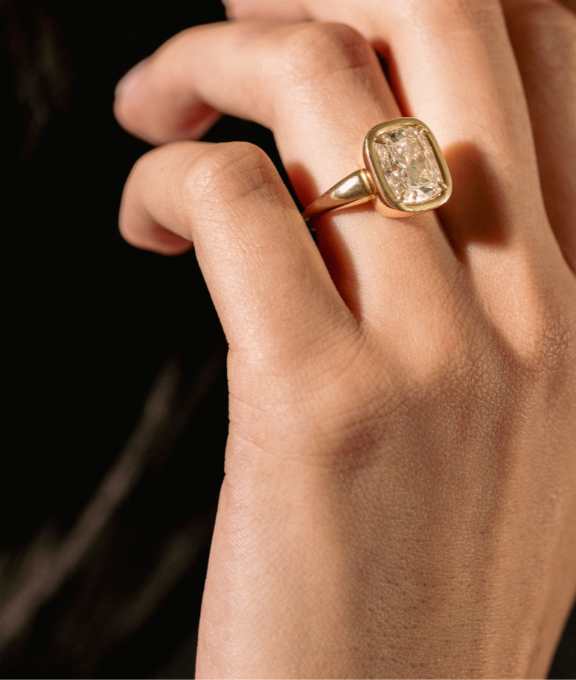
An old mine-cut antique diamond dates from roughly the early 1700s to the late 1800s. Set in a squarish cushion outline with rounded corners, it features 58 chunky facets, a small table, a high crown, a deep pavilion, a bruted girdle, and a large open culet. It is the most frequently seen cut on Georgian and Victorian rings, brooches, and pendants, and is one of the most recognizable antique stones.
The cushion outline is the first tell, with its soft corners on a roughly square stone and edges that rarely line up with the precision of a modern cushion. Look down through the table, and the open culet appears as a small, flat circle near the center. The table is small relative to the diameter, making the crown look noticeably tall from the side.
Light behaves differently in an old mine than it does in a modern brilliant. The chunky facets return broad flashes of color, often described as a candlelit glow, with stronger fire than a similar modern stone. Under candlelight or warm bulb, the stone appears to breathe with shifting color, while harsh overhead light softens the effect by design. Cutters in the 18th and 19th centuries shaped these stones based on the lighting found in everyday homes.
Original old mine cuts were once routinely recut into modern brilliants to meet mid-20th-century tastes, reducing the amount of surviving true antique stones. Estate Diamond Jewelry and Erstwhile note that the rarity of unmodified old mine cuts adds a 10 to 25% premium on top of the comparable price for modern brilliant-cut stones, particularly for stones over 2 carats with documented origins.
The premium increases when the piece features an original Georgian or Victorian setting in good condition, because the mounting and stone tell the full story of when the cut was made.
 The old mine cut is the defining diamond of Georgian and Victorian jewelry, as seen on our
Signature Cathedral Solitaire Engagement Ring With Old Mine Cut Diamond.
The old mine cut is the defining diamond of Georgian and Victorian jewelry, as seen on our
Signature Cathedral Solitaire Engagement Ring With Old Mine Cut Diamond.
The Old European Cut, Up Close
An old European cut is a round antique diamond cut produced from roughly 1880 to 1930. It features 57 to 58 facets, a small table at 53% or less of the diameter, a crown angle of at least 40 degrees, a deep pavilion, a bruted girdle, and an open culet smaller than the old mine but still visible through the table. The GIA describes it as the precursor to the modern round brilliant.
The round outline is the primary difference from the old mine. The introduction of motorized bruting in the late 1800s allowed cutters to round the stones more reliably than they could by hand. Once that became practical, the old mine’s cushion outline gave way to the rounder shape of the old European, and the facets became longer and slightly more uniform.
The cut still retains the antique signature, with a tall crown, a small table, a deep pavilion, and an open culet. From above, you see chunky flashes that appear warmer and softer than a modern brilliant, with more visible fire and less of the bright white light of a modern Tolkowsky cut. From the side, the stone looks taller than a modern round of similar diameter, sometimes by a noticeable margin.
GIA grades old European-cut diamonds for color, clarity, and carat, while also recording their proportions. However, the laboratory does not assign a modern cut grade because the proportions would fall in the Fair or Poor range on the modern scale.
Erstwhile and The Diamond Pro report that exceptional old European cuts can sell for 10 to 15% more than comparable modern round brilliants, while average examples often sell at similar prices or slightly below them. Origin, condition, and the 4Cs influence where a stone falls within that range.

The old Euro retains the antique signature, tall crown, small table, deep pavilion, open culetas, you can see on our Crescent Solitaire Engagement Ring With Old Euro Cut Diamond.
How the Two Cuts Compare Side-by-Side
The easiest way to tell an old mine from an old European is to examine the outline, then the facet shape, culet size, and how the stone returns light. The two cuts share several other characteristics, which is why beginners sometimes confuse them at first glance.
A few comparison points worth noting:
-
Outline: Old mine is cushioned with rounded corners; old European is round.
-
Facet shape: Old mine-cut facets are chunkier and more geometric, while old European-cut facets are longer and more refined, especially in the pavilion.
-
Culet: Both are open, but the old mine culet is larger and easier to see face-up.
-
Crown and table: Both have tall crowns and small tables, with the old European crown often slightly steeper at 40 degrees or more.
-
Girdle: Both bruted.
-
Era: Old mine peaks in the Georgian and Victorian eras; old European peaks in the Edwardian and Art Deco eras.
Light behavior is another characteristic that distinguishes the two. An old mine produces chunky, almost block-shaped flashes, with strong fire and a soft warmth that reads beautifully under candle, restaurant lighting, and the morning sun. An old European retains that warmth, but the facets are long enough to reflect more light back through the table, creating a better, more refined effect, somewhere between the old mine and the modern brilliant.
Distinguishing between the two cuts in person usually takes about 30 seconds. If the differences are harder to spot, overhead and side views taken in soft daylight often help more than images shot under a jeweler’s lamp. A short video recorded under warmer room lighting is even more useful because it reveals how each stone responds to movement on the wearer’s hand. Both cuts come alive in motion in ways still photography rarely captures.

The fastest way to tell an old mine from an old European is the outline.
Where Rose Cut Diamonds Fit In
A rose-cut diamond is an early antique style that is flat on the bottom and domed on top, covered in triangular facets that meet at a central peak, with anywhere from 3 to 24 facets depending on the era and cutter. It predates the old mine cut by roughly two centuries, with the oldest known pendant-set full rose believed to date to the late 16th century.
The flat back is the most useful detail for a beginner. Modern rose cuts have no pavilion, so light passes through the stone rather than bouncing back from a deep cone of facets. That gives the rose cut a softer, more transparent shine, closer to a candle’s reflection on water than the bright sparkle of a brilliant. Some view it as quiet, and others as romantic, but both readings are fair.
There is a practical advantage as well. Because more of the carat weight sits across the surface, the face-up size appears larger than that of a modern brilliant with the same weight. Ken & Dana Design notes that a 1.00-carat rose cut measures roughly 7.5 mm across, while a 1.00-carat round brilliant measures closer to 6.5 mm. The result is a stone that looks noticeably larger for the price.
Rose cuts come in many outlines, such as round, oval, pear, kite, hexagon, square, and cushion. That flexibility is why they are used in everything from Georgian mourning jewelry to modern minimalist settings, and why they appear in both antique and contemporary designs that borrow the historical look. A rose cut also fits a low-profile bezel, which is one reason it is regularly used, even outside antique-collecting circles.
The Tools, the Math, and the Move to Modern
The move from old cuts to the modern round brilliant resulted from two changes within a few decades of each other. Motorized bruting began in the late 1800s, and the trade moved from hand-shaped stones to those cut to specific proportions for maximum brilliance and fire.
Before that, cutters worked with simple tools like the bow lathe, used since Greek and Roman times, which allowed the cutter to spin a piece against an abrasive. The jamb peg, a manual faceting setup with an indexed gear arrangement, enabled the cutter to set angles by feel and habit rather than by formula.
Both tools rewarded long practice and produced the small asymmetries that define hand-cut antiques. A steam-powered diamond lathe entered use in the mid-1870s, making bruting faster and more uniform, leading to the rounder outline of the old European cut.
Marcel Tolkowsky, a member of a Belgian family of diamond cutters, published his thesis “Diamond Design” in 1919 while studying engineering at the University of London. He calculated proportions for a 58-facet round stone with 33 crown facets and 25 pavilion facets, a crown angle of 34.5 degrees, a pavilion angle of 40.75 degrees, a table at 53% of the diameter, and a total depth of 59.3%. The American Gem Society adopted those proportions as a grading standard in the 1950s.
American cutter Henry Morse worked with similar proportions before Tolkowsky’s paper, and the transitional cut from the late 1800s through the mid-1900s is the practical bridge between the old European and the modern round brilliant.

Cutters once worked by hand with bow lathes and jamb pegs, producing the small asymmetries and individual character that make antique stones what they are.
Buying an Antique Cut Without Surprises
The first piece of buying advice is also the simplest. Ask the seller if the stone is “antique” or “antique-cut,” because the two phrases describe different things. An antique diamond is an old stone that was cut in its own era, while an antique-cut diamond is a modern, sometimes lab-grown stone shaped in an older style with a fresh culet and a polished or faceted girdle.
A short visual checklist helps in person:
-
An open culet visible through the table as a small flat circle.
-
Bruted (frosted) girdle rather than a polished or faceted one.
-
Small asymmetries in outline and facet placement.
-
Tall crown and small table when viewed from the side.
-
A warmer, chunkier light return than a modern brilliant.
GIA reports are useful when available. The lab grades color, clarity, and carat for old cuts and notes their proportions, while flagging that the modern cut grade is not applicable. An independent appraisal from a gemologist specializing in antique stones provides additional confidence, especially for pieces without paperwork.
Pricing context also helps. PriceScope’s 2024 trade overview lists old mine cut prices by carat at roughly $1,800 to $2,000 for 0.50 to 0.70 ct, $2,700 to $4,000 for 1.00 to 1.40 ct, $4,000 to $5,200 for 1.50 to 1.99 ct, and $5,900 to $7,200 for 2.00 to 2.99 ct. Appropriate rarity premiums are applied to exceptional examples.
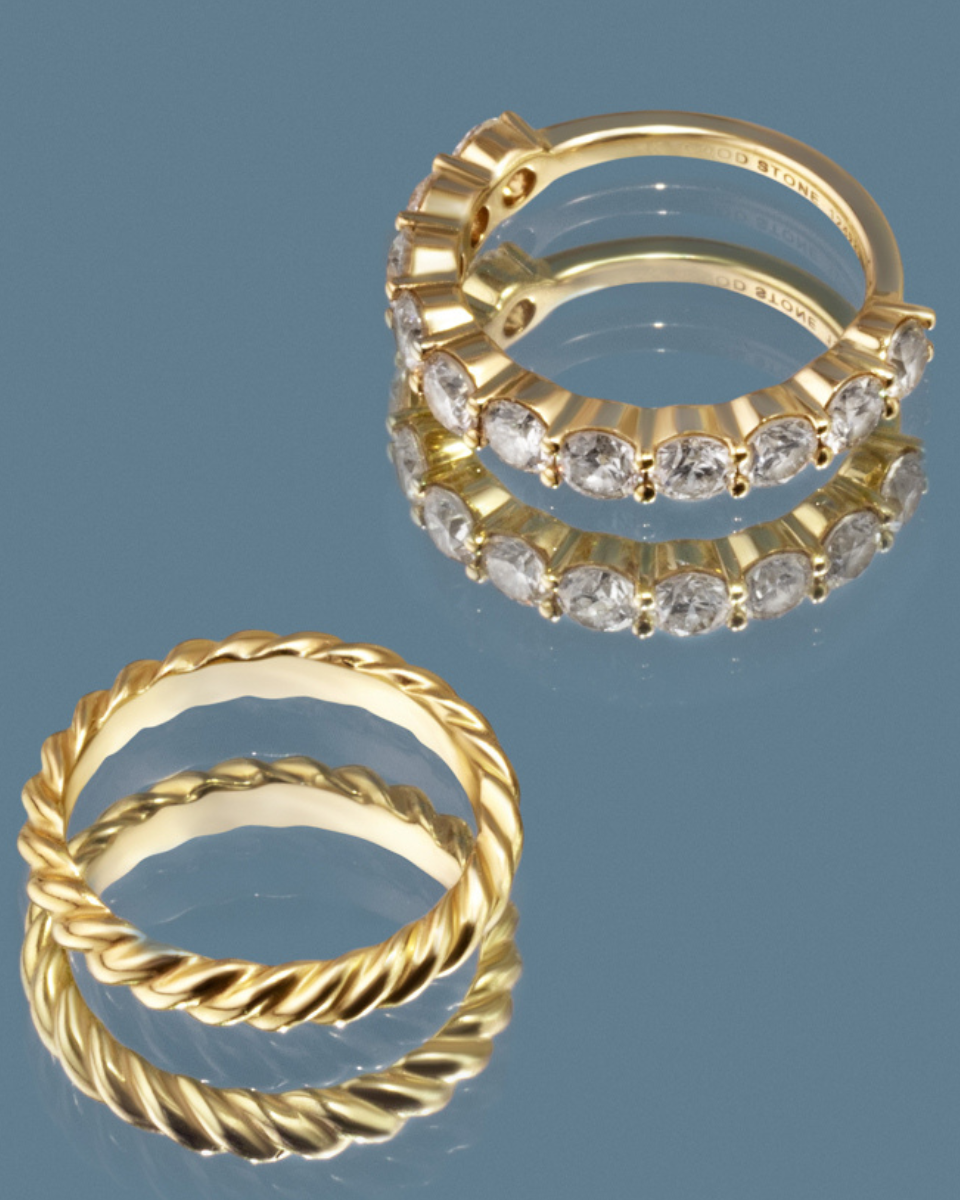
Estate Diamond Jewelry and Erstwhile note premiums of 10 to 25% for higher-quality stones, especially those over 2 carats, with documented history. GOODSTONE offers antique-style settings for those who want the old-cut look paired with new metalwork. Whichever direction you lean, the key is to align with the stone, paperwork, and the seller’s expertise, then examine them closely before committing.

The most important distinction to clarify upfront is whether a stone is genuinely antique or antique-cut.
Frequently Asked Questions
How can you tell if a diamond is an old mine cut?
Look for a cushion outline with rounded corners, a small table, a high crown, a deep pavilion, a bruted girdle, and a large open culet, visible through the table when viewed face-up. Hand-cut asymmetries are common and expected. The combination of these features confirms the cut.
Are old European-cut diamonds rare?
Yes. Original old European cuts are rare because many were recut into modern brilliants during the 20th century to suit mid-century tastes. The remaining stones form a limited pool, which contributes to the value of well-preserved examples and the premium some sellers attach to documented antique pieces.
Do old European-cut diamonds get GIA certificates?
Yes. GIA grades old European cuts for color, clarity, and carat and records their proportions, but does not assign a modern cut grade because the proportions would land in the Fair or Poor range on the modern scale. The report serves as independent verification of the stone’s basic attributes.
What is a rose cut diamond?
A rose-cut diamond is flat on the bottom and domed on the top, with triangular facets meeting at a central peak. Rose cuts can have anywhere from 3 to 24 facets and date to the 16th century, with the full 24-facet version becoming popular through the Georgian era. They give a softer, more transparent shine than a brilliant stone.
Are old mine-cut diamonds more valuable than modern brilliants?
Sometimes. Old mine cuts often sell at prices similar to modern brilliants of comparable design, while exceptional examples can have premiums of about 10 to 25%, especially for stones above 2 carats with documented origins. Quality, condition, and the 4Cs remain key price drivers.



Deja un comentario (todos los campos son obligatorios)