





The Math Behind Antique Cuts: Why They Sparkle
Antique diamond cuts, like Old Mine cuts and Old European cuts, sparkle the way they do because cutters established their geometry before electric light, and Marcel Tolkowsky’s 1919 thesis reshaped the modern brilliant. These stones feature steeper crowns, smaller tables, deeper pavilions, and open culets that keep light moving inside the diamond through fewer, larger internal reflections. The result is a broader, slower flash with stronger colored fire and less rapid white glitter than a modern round brilliant produces.
Beneath that surface is a stubborn number, the diamond’s refractive index of 2.417. That figure establishes a critical angle of roughly 24.4 degrees and determines whether light remains inside the stone or escapes through the wrong part of the pavilion.
Examine an old mine cut under a lamp, and the geometry becomes visible. The larger facets behave like a small set of broad, polished mirrors, while the open culet draws a faint ring through the table. The stone performs the same optical task as a modern brilliant, only in fewer and larger steps.

Antique diamonds were cut long before electric light, creating a slower, broader sparkle defined by fire rather than brilliance. Their distinctive proportions continue to captivate collectors centuries later.
What Sparkle Is: Brilliance, Fire, and Scintillation
Sparkle covers three separate optical effects, and antique cuts emphasize them in different proportions than modern brilliants do. Gem labs and most jewelry education materials divide the term into brilliance, fire, and scintillation, with each describing a measurable behavior of light inside the stone. Borsheims defines brilliance as the return of white light to the eye, fire as the rainbow flashes created through spectral dispersion, and scintillation as the alternating pattern of bright and dark areas that appear when either the stone or the viewer moves.
Brilliance depends on how much light enters the table, reflects off the pavilion facets without leaking, and returns through the crown. Fire depends on dispersion, the optical property that separates white light into spectral colors as it bends. Diamond has a dispersion of 0.044, measured between the violet and red ends of the visible spectrum. According to the International Gem Society, that figure is unusually high for a colorless gem. Scintillation is purely geometric. The number, size, and arrangement of the facets determine how many distinct flashes appear as the viewing angle changes.
A modern round brilliant is engineered to balance all three effects, emphasizing the return of white light. Antique cuts trade some of that brilliance for stronger fire and a slower, broader scintillation pattern. None of those properties exists in isolation because they operate on a sliding scale, and the cut determines where that balance settles.
The same colorless rough crystal appears differently as an old mine, old European, or Tolkowsky-proportioned modern brilliant because each cutting style routes incoming light along a different internal path before it returns to the eye.

A diamond's sparkle is made up of three optical effects: brilliance, fire, and scintillation. The balance between them depends entirely on the geometry of the cut.
How Diamond’s Refractive Index and Critical Angle Set the Rules
Cut geometry matters because diamonds bend light aggressively and allow very little of it to escape on the first pass. Diamond has a refractive index of 2.417 at the sodium D line of 589 nm, one of the highest values recorded for any naturally occurring transparent material. When light attempts to leave the stone, the angle at which it can escape directly is limited by the critical angle, calculated as the arcsine of 1 divided by the refractive index. In a diamond surrounded by air, that angle works out to roughly 24.4 degrees from the facet normal.
That small number sets a strict boundary for how light behaves inside the stone. Any ray that strikes an internal facet at more than 24.4 degrees from the normal cannot escape and instead reflects back into the stone in a process known as total internal reflection.
A cutter’s job is to arrange the facets so that light entering through the table strikes the pavilion facets at angles greater than the critical angle, bounces internally, and returns through the crown toward the viewer. If the pavilion is too shallow, light leaks through the bottom, creating a fish-eye effect. If it’s too steep, light escapes through the sides, leaving a dark center behind.
That same 24.4 degree window is why antique cuts still work, even though they are far from Tolkowsky’s calculated optimum. As long as the pavilion is steeper than about 39 degrees, most rays meet the critical angle requirement on at least one bounce. The question is what character the returning rays will have once they exit. The result will be either crisp white light, a colored flash, or a soft glow. That depends on the facet count, facet size, table proportion, and crown height, which is where the antique and modern numbers differ.

Diamond's high refractive index allows light to bounce internally before returning to the eye. Proper facet angles help maximize this journey through the stone.
Why Old Mine Proportions Produce a Chunky Flash
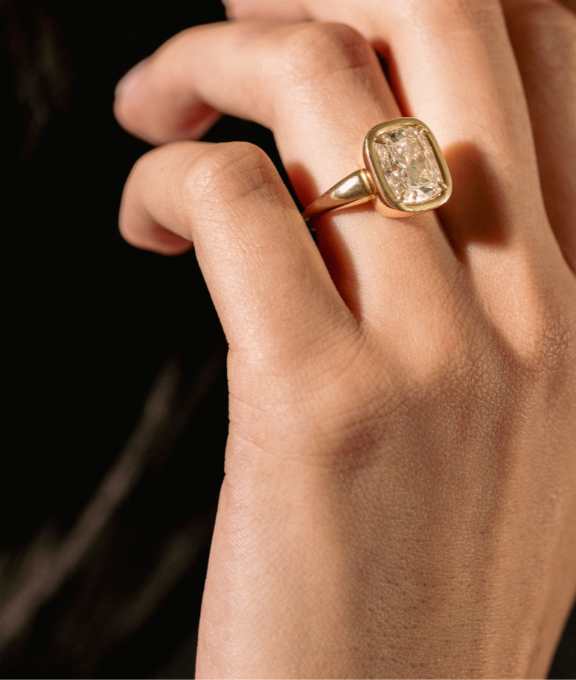
Old mine-cut diamonds produce broad, slow, colored flashes because their proportions concentrate light into fewer large exits. The classic numbers, drawn from estate-jewelry references, place the table at 38 to 45% of the diameter, the crown angle at 40 degrees or steeper, the pavilion deeper than a modern brilliant, and the culet open as a small flat facet rather than closed to a point. The outline is a soft cushion, and never a perfect circle.
Each crown facet acts like a small, polished plane that captures light and returns it at a specific angle. Because old mine cuts use fewer crown facets and smaller tables, the bright surfaces appear larger and more separated than in a model brilliant. As the stone tilts, large flashes move across the surface instead of breaking into dozens of fine points of light, creating what jewelers describe as a chunky flash. Steeper crown angles force light through a longer prism path before it exits, strengthening spectral separation and producing more visible color.
The open cutlet is the other signature feature. In a modern brilliant, the culet closes to a point, so no central feature is visible when you look through the table. In an old mine, the culet is a small, flat facet at the base of the pavilion. Viewed face up, it appears as a faint ring or dot beneath the table. That feature is the unavoidable optical result of a flat surface where modern stones use a sharp vertex, and is one of the key identifiers of an antique cut.
Hand cutting is what gives antique cuts their irregular character. Cutters in the 18th and 19th centuries worked from rough crystals using basic tools, following the stone’s natural shape to retain weight. No two old mines share identical proportions, which is why a three-stone ring set with old mines often displays slightly different flash angles from the same viewing angle. Collectors prize that feature, and no machine-cut stone can reproduce it.
Even within a single old mine, the four sides of the cushion outline are seldom perfectly equal, so the facets meet slightly off-center. That subtle asymmetry contributes to the softer, more painterly movement of light across the table.

Old mine cuts feature small tables, deep pavilions, and open culets that produce their signature chunky flashes of light. No two stones are exactly alike.
Old European Proportions and the Move Toward the Round Brilliant
Old European-cut diamonds share the same broad-flash optical character as old mines while moving closer to the modern round brilliant. Antique jewelry references place the table at roughly 38-53%, with crown angles near 40 degrees, a deep pavilion, and an open culet smaller than those found in old mines. The outline is fully round rather than softly squared.
The round shape became practical for production after the bruting machine arrived in 1874. According to Andria Barboné Jewelry, the machine spins two diamonds against one another to grind a circular girdle, removing the biggest obstacle to round outlines and allowing cutters to pursue consistent radial symmetry. From the late 19th century into the early 20th century, the old European cut became the dominant fine-jewelry diamond style, frequently appearing in Edwardian and early Art Deco settings.
Light return in an old European cut sits closer to a modern brilliant than it does in an old mine, although the balance still favors fire over white brilliance. The smaller culet creates a less visible central ring, the slightly larger table admits more light, and the symmetrical facet arrangement produces an even flash pattern while preserving the broad-flash character. Old Europeans display the same, slower, color-weighted sparkle that defines antique cuts, but with a tighter geometry that foreshadows the optical optimization that Marcel Tolkowsky would later publish.

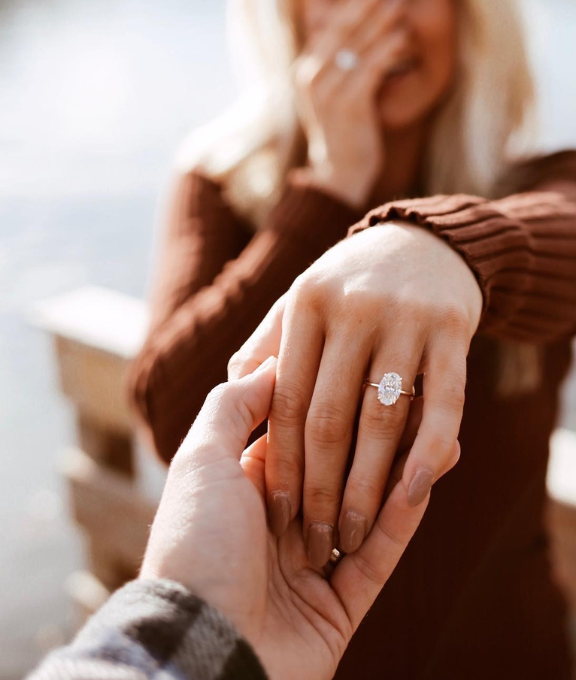
Old European cuts bridged the gap between antique cutting traditions and the modern round brilliant. Their sparkle balances broad fire with improved symmetry as seen on our Crescent Solitaire Engagement Ring With Old Euro Cut Diamond.
How Candlelight Shaped These Cuts and How Modern Light Reads Them
Antique cuts were designed around candlelight and oil lamps. The proportions that suit those low, warm point sources differ from those optimized for bright LEDs or daylight. A wax candle produces roughly 13 lumens, and the light comes from a single small flame in a fixed position.
This is why old mines and old Europeans are often called candlelight diamonds, a point noted by the Natural Diamond Council. The cutters who shaped these stones worked backward from how the finished piece would appear in a drawing room or candlelit dinner setting.
Under that kind of lighting, a small number of broad, bright facets catch a single point source cleanly and return a few strong, distinct flashes. The steep crown bends light through a longer prism path, increasing spectral separation and pulling more visible fire from a dim source. The open culet introduces a soft center spot, softening the overall light return and giving the stone a warmer appearance rather than an icy one.
Modern lighting changes the effect entirely. Office LEDs, jewelry-store spotlights, and outdoor daylight are bright, broad, and often cooler in color temperature, favoring cuts that scatter many small flashes across the eye instead of a few large ones. Under those conditions, an old mine can look softer or less brilliant than a modern stone of the same carat weight.
Under candlelight, however, the same stone surpasses its modern counterpart in visual character, even if a meter would still measure less white light return. That difference explains why some buyers seek antique cuts for evening wear or settings intended to be seen primarily at night.
The Math Behind Modern Round Brilliant Comparisons
Tolkowsky’s 1919 thesis forms the mathematical foundation behind modern brilliant cuts, and explains why a well-proportioned modern stone returns more white light than an antique cut. While completing his studies in London, he calculated the proportions that would maximize the return of light in a round diamond, given the known refractive index and dispersion.
Editor Jasper Paulsen later transcribed the original figures from the thesis. Tolkowsky placed the pavilion angle at 40 degrees 45 minutes (40.75 degrees), the crown angle at 34 degrees 30 minutes (34.5 degrees), the table at 53% of the girdle diameter, and the total depth at 59.3%.
Those numbers create two controlled internal bounces for nearly every ray entering the table. With a 40.75-degree pavilion, light striking the first pavilion facet exceeds the 24.4-degree critical angle and reflects toward the opposite pavilion. The second pavilion facet also hits above the critical angle and exits through the crown close to vertical.
Tolkowsky also wrote that a steeper pavilion would improve raw reflection but would cause dispersion, and he chose 40.75 degrees because it balanced the two. That balance is what people point to when describing a modern ideal cut as having the right ratio of brilliance and fire.
Modern grading takes that math further. In 2005, the American Gem Society introduced its Performance Grading System, which scores brightness, dispersion, leakage, and contrast on a 0-to-10 scale, with zero representing the ideal. Instead of relying only on proportion ranges, the system uses ray-traced light performance to evaluate how a stone handles light.
The Holloway Cut Adviser, patented by Garry Holloway in 2007, predicts light return, fire, scintillation, and spread on a lab report. It is meant as a rejection tool for stones that score above 2, and both tools are calibrated to the round brilliant. GIA does not assign a cut grade to fancier designs, including most antique cushions, which is why old mines and old Europeans stay outside the modern grading scale.
Compared together, a well-cut modern brilliant returns more white light than a comparable old mine or old European. Tolkowsky’s math supports this claim, and ray-tracing software confirms it. What the math does not say is that more white light is better for every viewer in every setting.
GOODSTONE’s cut-quality reference notes that the cut grade indicates how a diamond handles light and ultimately determines how much sparkle reaches the eye. That principle applies to antique cuts as well, although the goal changes. In antique stones, the cut shapes the amount of returned light and the pace, size, and color of the flashes themselves.
For some buyers, the wider, color-weighted flash of an antique cut is the reason to choose one. Others believe that the higher light return of a modern cut is what a diamond should look like. Both answers are mathematically defensible, and the same critical angle of 24.4 degrees applies to both stones. The proportions determine what the sparkle looks like once the light returns.
Frequently Asked Questions
What is the refractive index of diamond?
The refractive index of diamond is 2.417, measured at the sodium D line of 589 nm, which is among the highest values for any natural transparent material. That high refractive index is the reason diamonds bend light so strongly and the reason its critical angle for total internal reflection is so small.
What is the critical angle for a diamond?
The critical angle for diamond in air is arcsin (1/2.417), which is about 24.4 degrees. Any ray that strikes a pavilion facet at more than 24.4 degrees from the normal of that facet cannot escape and is reflected back into the stone, which is why pavilion geometry controls so much of the visible sparkle.
Why do old mine-cut diamonds have an open culet?
Hand cutters working in the 18th and 19th centuries left the base of the pavilion as a small flat facet rather than grinding it to a point to protect the tip from chipping in setting, and because the rough crystal often suited that finish. Viewed face up, the open culet appears as a small ring or dot through the table, making it one of the easiest ways to identify an antique stone.
Why are antique diamonds called candlelight diamonds?
Antique diamonds earned the nickname because cutters shaped them before the arrival of electric light. Their proportions were designed to perform under candles and oil lamps, which produced low, warm point-source lighting at roughly 13 lumens per flame. Their broad facets and steep crowns turned that dim light into large, colorful flashes, giving the stones their distinctive candlelit appearance.
Are old mine-cut diamonds worth more than modern diamonds?
Antique cuts usually trade at or below modern round brilliants of the same carat weight, since they return less white light, and lab cut grading scales favor the modern proportions. The origins, rarity, and collector demand can push old mines above their modern equivalents, especially well-documented Georgian and Victorian pieces.
Does GIA grade the cut of cushion or old European cut diamonds?
GIA does not assign cut grades to fancy shapes, including most antique cushions and old Europeans. AGS Laboratories pioneered ray-traced light performance grading for these shapes, and that program is now offered through the AGS Ideal Report issued by GIA for selected outlines.




Deja un comentario (todos los campos son obligatorios)