





What You Should Know About Lab-Grown Elongated Old Mine Cuts
A lab-grown elongated old mine-cut is an antique-style diamond igrown above ground over a period of weeks rather than mined, then finished with the elongated cushion outline and antique portions associated with Georgian- and Victorian-era stones.
Most fall within a length-to-width ratio of roughly 1.15 to 1.40 and feature the small table, high crown, deep pavilion, and open cutlet that define the cut. In 2025 and 2026, prices for comparable lab-grown versions often ran 60 to 85% below those of natural diamonds with similar specifications.
If you love the soft, candlelit glow of antique cuts and you want a larger carat weight than the antique market offers, the lab-grown route deserves a careful look. The result is an antique-inspired stone that remains accessible in sizes and proportions the vintage market rarely provides.

A lab-grown elongated old mine cut delivers the soft, candlelit glow of a Georgian-era antique stone at a fraction of the cost.
What Is an Elongated Old Mine Cut?
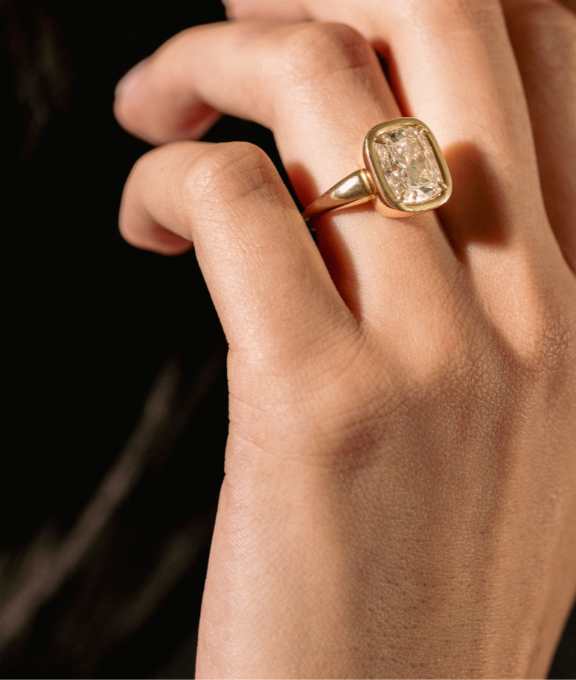
An elongated old mine cut is a rectangular variant of the classic old mine cut, with similar antique character and a length-to-width ratio that gives it a softly extended outline. The shape ranges between a square cushion and a true rectangle, with rounded corners and a gentle cushion silhouette. Diamond Pro notes that the old mine features 58 facets, the same as a modern round brilliant, but arranged with different proportions.
The proportions are the heart of it. A small table accounts for roughly 38% to 45% of the diamond’s total diameter, the crown sits high above the girdle, and the pavilion is deeper than most modern stones. The culet, which is typically a tiny point or absent altogether, is large and open on an old mine-cut diamond, and can be seen through the table above, while the girdle is thick. None of these features were standardized when the originals were hand-cut in the 1700s and 1800s, so each old mine has its own distinctive details.
People sometimes confuse the old mine with the old European cut. The simplest way to tell them apart is by their shape. Old European cuts are round, while old mine cuts are squarish or cushion-shaped; the elongated version extends the cushion into a rectangle. Lauren B Jewelry’s antique-cut guide indicates that old European cuts have a smaller, more symmetrical culet and a larger table, while old mines have chunkier faceting and a visible culet that makes antique stones glow under candlelight instead of bright LED lights.
The length-to-width range matters for how the stone sits on the hand. A ratio near 1.20 looks softly elongated and classic, while at 1.30 to 1.40, the stone is slimmer and more rectangular, which many buyers find flattering on the finger. Authentic antique elongated old mines usually range from 1.15 to 1.30, while lab-grown versions can be cut anywhere across the band, as the cutter determines the proportions.

An elongated old mine cut is a rectangular variant of the classic antique cushion as seen on our our Signature Cathedral Solitaire Engagement Ring With an Old Mine Cut Diamond.
How Lab-Grown Rough Changes the Antique Cuts
Lab-grown material makes antique cuts more accessible because cutters can absorb the additional yield loss these shapes require. Antique cushions and old mine cuts remove more weight from the starting crystal than modern brilliant shapes because their chunky facets and high crowns consume a larger portion of the stone during cutting. With natural diamonds, the reduced yield raises the cost. Lab-grown production changes the equation by supplying larger starting material in a matter of weeks, allowing cutters to hand-finish antique outlines without pushing prices beyond the reach of most buyers.
Two growth methods account for nearly all lab-grown diamond rough. The first is High Pressure High Temperature, which recreates the conditions of the Earth’s mantle at pressures of 5 to 6 GPa and temperatures between 1,300 and 1,600 degrees Celsius.
The second is Chemical Vapor Deposition, which operates at lower pressures and temperatures ranging from 700 to 1,300 degrees Celsius. In the CVD process, carbon-rich gas deposits onto a diamond seed inside a vacuum chamber over roughly 4 to 6 weeks.
GIA’s overview confirms that both methods produce stones with the same chemical, physical, and optical properties as mined diamonds, including a hardness of 10 on the Mohs scale.
The stones are still hand-cut. Skilled cutters shape the rough on a wheel while judging crown height, pavilion depth, and culet size by eye and feel. The slight irregularities that give old mine cuts their character come from the same manual process used on antique originals. The difference lies in availability rather than technique.
A natural antique elongated old mine in the 2- to 3-carat range with strong color is still an unusual find. Lab-grown versions, by contrast, are often cut on demand. Sellers such as Ouros Jewels and Diamondrensu list 1- to 3-carat lab-grown old mine cushion cuts as standard inventory, with larger sizes available by request.
This is where the carat range opens up. Elongated old mines over 3 carats are rare on the secondary market and command premiums when they appear. Lab-grown elongated old mines often reach 4 and 5 carats, since the rough is grown to the size the cutter needs.
That flexibility is the main draw for buyers who love the antique aesthetic but want a larger center stone. GOODSTONE offers both natural and lab-grown old mine cushion options, including bespoke work, and antique-cut lab-grown stones across that wider carat range.

Lab-grown material makes antique cuts more accessible because cutters can absorb the additional yield loss these shapes require without the cost pressure of working with expensive natural rough.
Lab-Grown vs. Natural Pricing from 2025 to 2026
In 2025 and 2026, lab-grown diamonds cost between 60 and 85% less than natural stones, and the gap has widened as wholesale prices for lab-grown stones fell. MadisonDia’s 2025 price guide placed the average retail price of a 1-carat lab-grown stone at around $1,000, with comparable natural 1-carat stones averaging $4,200 and ranging from $3,000 to $6,000 depending on color and clarity. A 2026 report from Stacker and the Rio Grande Guardian placed the lab-grown discount at about 73%, with some segments reaching 81 to 86%.
Wholesale pricing tells a different story. Labrilliante’s 2025 market data placed wholesale lab-grown 1-carat diamonds near $191 per carat during the second quarter of 2025, while major retailers sold comparable stones for roughly $800 to $1,200. The gap reflects retail markup far more than any meaningful difference in quality. CBC Marketplace reported in 2024 that some lab-grown engagement rings carried retail markups of 5 to 10 times the wholesale price.
Production costs declined by roughly 15 to 20% per year as growers improved yields and expanded capacity, putting steady downward pressure on lab-grown diamond pricing and resale value. A buyer who purchased a 1-carat lab-grown stone for $1,200 in 2024 may find a comparable 2026 version selling for $800 or less, which limits what secondary buyers are willing to pay.
According to data from Lab Grown Central and Labrilliante, resale recovery in 2025 typically ranged from 20 to 40% of the original retail price, while private wholesale offers often fell between 10 and 30%.
Natural diamonds hold value differently. Data from Bain & Company and De Beers Group indicate that ultra-high-end natural rough retains scarcity value, while broad commercial natural stones account for roughly 25 to 50% of retail. The picture is mixed, with neither category offering a strong financial investment, and natural stones depreciating more slowly than lab-grown stones.
For a buyer planning to wear the diamond for decades, resale is rarely the deciding factor. The savings on the front end, often $2,000 to $5,000 on a 1-carat center, can be put toward a better setting, a larger center stone, or simply kept. That trade-off is the practical case for buying lab-grown.

In 2025 and 2026, lab-grown diamonds typically cost 60% to 85% less than natural stones of comparable specifications
Reading the Certificate: GIA vs. IGI for Lab-Grown
Most lab-grown diamonds have an IGI report rather than a GIA one because GIA changed its lab-grown grading approach in October 2025, and IGI now grades over 70% of the lab-grown market. An IGI report on a lab-grown stone provides the same 4Cs information buyers expect on a natural-stone certificate, including color, clarity, cut grade, and carat weight. It also states the growth method and discloses any post-growth treatments, such as HPHT color enhancement.
In October 2025, GIA replaced its detailed 4Cs grading system for lab-grown diamonds with a simplified format called the Laboratory-Grown Diamond Report. Instead of assigning the traditional color and clarity grades, the new system classifies stones as Premium or Standard. GIA still confirms that a diamond is lab-grown, identifies the growth method on most report types, and notes any treatments. Buyers who prefer more detailed color and clarity information will usually find IGI reports more informative.
Certificates have dual meaning for elongated old mine cuts. The first is the basic disclosure required by the Federal Trade Commission’s Jewelry Guides, which requires sellers to identify lab-grown stones using “laboratory-grown,” “laboratory-created,” or a manufacturer-created equivalent preceding the word “diamond.” A signed IGI or GIA certificate provides that information. The second is the laser inscription on the girdle, which features the report number and confirms the stone matches the certificate.
Cut grade on antique shapes is a different matter. Modern cut-quality scales are built around round brilliants, and they loosely apply to antique cushions. IGI applies a grade cut to fancy shapes, but the assessment is more general than for rounds. For antique cuts, your eye and the photos matter more than a letter grade. Look for intentional symmetry, a culet that sits roughly centered, and a crown and pavilion that appear balanced when viewed from the side.
 IGI now grades over 70% of the lab-grown market and continues to issue full 4Cs reports, making it the more informative choice for buyers who want detailed grading data.
Cut Quality Cues to Check on an Elongated Old Mine
The most useful cut-quality cues on an elongated old mine are length-to-width ratio, crown height, table size, culet visibility, and the feel of the hand-finished symmetry. Each can be read from photos and videos, and show how well the stone delivers antique character, or where it might seem like a lazy modern cushion with a few extra facets.
Start with the ratio. For an elongated outline, a 1.15 to 1.20 ratio indicates a soft, classic stretch, while a 1.25 to 1.30 ratio gives a more visible rectangular shape that flatters most fingers. Anything from 1.30 to 1.40 is elongated, which looks striking in larger carat sizes. Above 1.40, the stone starts to look like an antique radiant or a stretched cushion.
Crown and table set the candlelit glow. A small table, around 38 to 45% of the diameter, paired with a high crown, gives the stone its fire and depth. If the table is large or the crown is shallow, the stone will look more like a modern brilliant cushion than an old mine, even if it is described as one. Side-profile photographs are valuable for this assessment.
The culet is the signature of an old mine. It can be seen through the table from above as a small ring or window at the heart of the stone. If the cut is closed or barely visible, it has lost much of its antique identity. The girdle should look thick, keeping with the period style, and faceting should feel hand-finished, with slight asymmetries that display character rather than carelessness.
Color and clarity expectations shift slightly with antique-style cuts. In an old mine cut, the chunky facets and visible culet create a warmer appearance, allowing G and H colors to read brighter than they often do in a modern round brilliant. Clarity grades such as VS2 and SI1 are usually sufficient because the broader facet pattern effectively disguises smaller inclusions.
Lab-grown production also changes the grading equation. D to F color and VVS1 to VS1 clarity are widely available at prices low enough that many buyers choose higher grades than they would consider in a comparable natural diamond.
 The key things to assess in an elongated old mine are length-to-width ratio, crown height, table size, and culet visibility.
When a Lab-Grown Antique Cut Makes Sense
A lab-grown elongated old mine cut makes sense when you love the antique look, want flexibility in size and proportions, and value the lower upfront cost over a modest resale recovery later. That covers a wide range of buyers, including:
-
Those drawn to vintage style who want a 2- or 3-carat center stone without the antique-market cost.
-
Ethically motivated buyers who prefer the smaller per-carat carbon footprint of laboratory production.
-
Engaged couples who would rather spend the savings on the wedding, the setting, or simply nothing else.
Sometimes, a natural antique stone is the better fit. Collectors who care about origins, including the cutter, the era of cutting, or the unique handprint of an original Georgian or Victorian piece, are buying something a lab-grown stone cannot replicate. Heirlooms that will be passed down also fall into this category. Some buyers genuinely prefer knowing that the carbon in their stone originated from the ground.
The environmental and ethical case for lab-grown is real, but it should be read plainly. Frost & Sullivan figures indicate that carbon emissions from mined diamonds amount to nearly 57,000 grams per carat, compared with 0.028 grams per carat for lab-grown. A 2024 Nature paper on the environmental impact of the diamond industry reaches similar conclusions. The advantage decreases if the lab uses fossil-fuel grid power, so transparency on the energy mix from the producer is worth asking about.
The FTC’s Jewelry Guides set disclosure expectations for any seller. The origin should be stated plainly using “laboratory-grown” or an equivalent term before the word diamond; environmental claims should be substantiated under the Green Guides, and the certificate should be available on request. GOODSTONE’s lab-grown options are designed for buyers who want to specify length-to-width ratio, carat target, and color and clarity preferences from the start.
The wholesale-to-retail spread on lab-grown diamonds remains wider than that for natural stones because wholesale pricing has declined faster than retail pricing has adjusted. Buyers should feel comfortable asking for a clear breakdown of the loose stone cost, setting cost, and certification details. Sellers specializing in antique cuts should also provide side-profile photos, videos under different lighting conditions, and written descriptions. With the right information, a lab-grown elongated old mine cut can deliver the appearance of a 200-year-old stone at a price point that leaves far more room in the budget.
Frequently Asked Questions
Are lab-grown diamonds real diamonds?
Yes. Lab-grown diamonds have the same chemical, physical, and optical properties as mined stones, including a Mohs hardness of 10. The Federal Trade Commission has recognized them since 2018, on the condition that sellers disclose the lab-grown origin using approved terminology. GIA’s research division has published similar findings on the optical and chemical equivalence.
How much do lab-grown diamonds cost in 2026?
A 1-carat lab-grown diamond typically retails between $800 and $1,200 in good color and clarity, with wholesale prices near $191 per carat, according to Labrilliante data. A comparable natural 1-carat stone runs roughly $3,000 to $6,000, per MadisonDia’s 2025 price guide. Larger lab-grown stones scale up, but the per-carat discount relative to natural stones is similar.
Do lab-grown diamonds hold their value?
Lab-grown diamonds usually resell for 20 to 40% of their original retail value, with private-buyer offers sometimes as low as 10 to 30%, and natural diamonds roughly 25 to 50%. Neither category is a strong financial investment, and lab-grown is best treated as a luxury purchase over one of value.
How can you tell a lab-grown diamond from a natural one?
You cannot tell them apart by eye, even with jeweler training, when the carat, color, clarity, and cut match. Definitive identification requires laboratory equipment such as the GIA iD100 or DiamondView, which read growth patterns and phosphorescence. The certificate and the laser inscription on the girdle are the practical information buyers can rely on.
Do lab-grown diamonds get cloudy over time?
High-quality lab-grown diamonds do not cloud with age, since their chemistry matches that of natural stones. Cloudiness is observed in lower-grade CVD stones with internal grain or in HPHT-treated material that retains processing haze. Surface dullness caused by skin oils, lotions, or soap residue is common on any diamond and clears with warm water cleaning.
What is the difference between IGI and GIA certification for lab-grown diamonds?
IGI continues to issue full 4Cs grading reports for lab-grown stones in 2026, including color, clarity, cut, carat, growth method, and any treatments, grading over 70% of the lab-grown market. As of October 2025, GIA replaced its 4Cs lab-grown grades with a simpler Premium or Standard quality assessment. Buyers who want full letter and number grades should rely on IGI data.



Deja un comentario (todos los campos son obligatorios)