






What Eye Clean Means When Shopping for Diamonds Online
The words “eye clean” do not appear on a GIA grading report. No lab stamps it on a certificate, no gemologist writes it in official notes, and no governing body has defined it as a formal category.
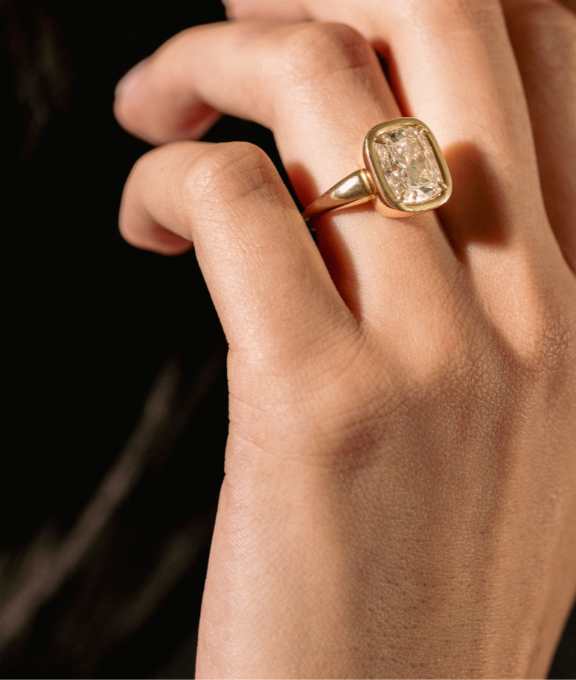
Eye clean is what actually matters once the diamond is worn, whether it's an emerald cut or a round brilliant.
The reason is simple. Every clarity grade assigned by GIA is determined under 10x magnification, and nobody lives their life looking at a ring through a loupe. What you care about, and what the person across the table from you at dinner will notice, is how the diamond looks to the naked eye.
Understanding this concept can help you spend wisely and choose a diamond that looks beautiful at normal viewing distances.

"Eye clean" doesn't appear on any grading report, but it's the standard that actually matters once a diamond is on your finger.
How GIA Grades Clarity
GIA uses a scale with 11 grades across six categories, ranging from Flawless to Included. A grader evaluates the diamond under 10x magnification and considers five factors:
- The size of any inclusions
- Their nature
- Their position within the stone
- The contrast they create against the surrounding diamond (called relief)
- How many are there are
Where an inclusion sits matters a great deal. An inclusion tucked near the edge of a stone will pull the grade down less than the same inclusion sitting right under the table facet, because the table is the large flat surface on top of the diamond where your eye goes first.
A small white pinpoint near the girdle and a dark crystal dead center under the table might exist in two stones with the same clarity grade, but those two stones will look very different to you in person.
Which Clarity Grades Are Reliably Eye Clean
The answer depends on the diamond’s size and its shape. For round brilliant cuts, VS2 and above are eye clean in the vast majority of cases, according to the International Gemological Institute.
Smaller round brilliants under 1 carat can often look perfectly clean at SI1 or even SI2, because the stone is small enough that minor inclusions become nearly impossible to see without magnification. Once you move above 2 carats, VS1 and VS2 remain safe.
For carats over 3, the IGI recommends checking VVS2 stones individually, as larger table facets give the eye more room to detect minor flaws.
Step-cut diamonds, such as emerald, Asscher, and baguette cuts, behave differently. Their long, open facets do not scatter light the way a round brilliant does, so inclusions become easier to spot. For step cuts, VS1 is a safer starting point if you want confidence that the stone will look clean.
The IGI notes that shoppers can sometimes find stones in the SI1 and SI2 ranges that show no visible inclusions to the naked eye and look similar to higher-graded diamonds at a lower price.

For round brilliants, VS2 and above are eye clean in the vast majority of cases, while stones under 1 carat can often look clean at SI1 or even SI2.
Which Inclusions Affect a Diamond’s Appearance
Not every inclusion will bother you the same way.
- Dark crystals located under the table facet are the most problematic because they create visible contrast against the surrounding stone.
- Clouds, which are tight clusters of tiny pinpoints, can give a diamond a hazy or milky appearance if they are large enough, and that haziness reduces how much light passes through the stone.
- Twinning wisps are messy tangles of pinpoints, feathers, and crystals that form irregular patterns, and they can be distracting when they are prominent.
- Cavities are openings on the diamond’s surface left behind when an inclusion gets dislodged during polishing, and they tend to collect dirt and oil over time, becoming darker and more noticeable.
On the other hand, the following inclusion types are generally not a concern:
- Small white pinpoints, which are generally invisible without magnification
- Transparent, colorless crystals, as they do not disrupt light flow and tend to blend in
- Feathers, which are among the most common types, are usually so slim and whitish that they have no visible effect on the diamond’s appearance
How to Check for Eye Cleanliness When Buying Online
You cannot hold the diamond up to your eye when buying on a screen, so you need to use the tools available to you effectively.
Watch the 360-Degree Video at Reduced Magnification.
Most reputable online retailers provide 360-degree HD videos of their diamonds, typically shot at 20x magnification. A practical trick is to resize the video window or zoom out until the diamond appears at roughly 2x magnification.
This gives you a much closer approximation of how the stone will look on a finger, and any inclusion that remains visible at 2x is worth paying attention to.
Compare with the GIA Plot Diagram
A GIA grading report includes a diagram that shows the location of each inclusion and blemish within the stone. The plot tells you the type and location, but it does not tell you how visible that inclusion is to the naked eye. Pair the plot with the video. If the plot shows a dark crystal right under the table and you can see something in the video at low magnification, that stone is probably not eye-clean.

The GIA plot diagram shows you where each inclusion sits within the stone, but it doesn't tell you how visible that inclusion is to the naked eye.
View Under Different Lighting Conditions
If the retailer provides images or videos under multiple lighting conditions, review them all. This will verify that:
- Some inclusions are more visible under direct light.
- Others become less visible under diffused light, or vice versa.
How Cut and Setting Help
A well-cut diamond returns more light to your eye, and that light return can effectively hide minor inclusions that would be more obvious in a poorly cut stone. Brilliant cuts like rounds and cushions have more facets that scatter and redirect light, making them naturally more forgiving of small flaws.
The setting you choose also plays a role. A prong that sits over an inclusion near the edge of the diamond will cover it entirely once the stone is set. Bezel settings wrap a thin metal rim around the entire perimeter of the diamond, which is particularly effective at concealing inclusions near the girdle.
Bezel settings are a popular choice for their modern look and the protection they provide for the stone.

A well-cut diamond returns more light to the eye, and that brightness can effectively mask minor inclusions that would be more obvious in a poorly cut stone.
The Money You Save by Buying Eye Clean
Flawless diamonds are extremely rare, and their prices reflect that rarity.
For many engagement ring buyers, there is no visible difference between a Flawless diamond and a carefully chosen VS2 or SI1. They look the same on the hand. The price difference, however, can be considerable. Those savings can be used for a better cut, a larger carat weight, or a different setting.
Cut has the greatest effect on how a diamond sparkles, so allocating your budget to an Excellent Cut grade rather than a higher clarity grade usually results in a more visually appealing ring.

A carefully chosen VS2 or SI1 can look identical to a Flawless diamond on the hand, at a fraction of the price.
Watch Out for the SI3 Grade
Some labs assign an SI3 clarity grade, but GIA does not recognize it and has studied the suggestion multiple times over the years without finding a reason to adopt it. GIA has concluded that stones graded SI3 by other labs would typically receive an I1 grade under GIA’s system.
The practical advice here is simple: if a retailer offers you an SI3-grade diamond, ask for a GIA-graded stone instead. GIA’s grading standards are the most widely accepted in the industry, and buying a GIA-graded diamond removes a layer of ambiguity you do not need when you are already making decisions from behind a screen.
How GOODSTONE Approaches Clarity
We carry diamonds ranging from Flawless to SI2, covering the most common grades for engagement rings. Our collection includes only Excellent Cut-grade diamonds, both natural and lab-grown. Each stone in our inventory is cut to maximize light performance.
This Excellent Cut standard is important for eye cleanliness because superior light performance helps mask minor inclusions that may be more visible in a stone with a lower cut grade.
For shoppers seeking guidance in assessing a stone’s eye cleanliness from images and video, we offer a personal concierge service. A gemologist review can be a valuable addition, giving you added confidence when evaluating clarity online.

At GOODSTONE, a personal concierge service with gemologist review is available for shoppers who want added confidence when evaluating clarity from images and video.
What Matters Most When Choosing Diamond Clarity
The clarity grade on a lab report reflects what a grader found under 10x magnification. While it is useful information, it does not indicate how the diamond will appear at normal viewing distances.
Eye clean is a practical standard that guides real-world choices. By matching the clarity grade to the size and shape of the diamond you want, learning which inclusions to avoid, and using video tools at reduced magnification to inspect stones before buying, you can purchase a diamond online that looks beautiful to everyone who sees it.
The grade on the report is for documentation. The appearance of the diamond matters most when it is worn.




Leave a comment (all fields required)