





What Is a Tulip Setting Engagement Ring?
Most buyers who search the term tulip setting expect floral engraving or a flower-form head. The name refers to the prong architecture instead. The prongs curve upward from the band and wrap around the center stone the way petals wrap a tulip bud, and nothing on the surface is decorated at all. The setting's real tradeoffs in height and wedding-band fit follow from those curved petals, and they repay examination before any purchase. And this style looks refined, and beautiful on any stone from rounds to marquises.

A tulip setting brings a sculptural, organic quality to an engagement ring without relying on traditional floral details.
What Makes a Setting a Tulip Setting?
Standard prongs rise straight from the mounting and do a purely functional job, while tulip prongs curve. Each one sweeps up from the base of the ring and cups the center stone, so the head of the ring resembles a tulip bloom lifted above its stem. Four or six petals are the usual count. The prongs are integrated into the basket as one sculpted unit, not soldered on as individual claws.
The architecture is easy to confuse with two neighboring ideas. Floral or nature-inspired rings often have engraving or vine bands, and neither makes a setting a tulip. Cathedral settings are defined by arches of metal rising from the band to meet the head, an independent feature. The two combine freely. Many tulip rings have cathedral shoulders beneath the petal basket. A buyer comparing listings should read the prongs, not the marketing adjectives.
The term has older roots than the current trend suggests. Forum threads debating basket and tulip mountings against six-prong settings date back to 2003, when the style was described as giving the stone a touch more height and profile for a modestly priced mounting. Current petal-prong designs return to that silhouette, now described as sculptural and nature-inspired.

The defining detail of a tulip setting is hidden in its architecture. Instead of rising straight toward the diamond, the prongs curve upward like petals around a bloom, creating a softer and more dimensional profile.
What Do Petal Prongs Do for the Stone?
The petal form changes how the stone handles light because each prong cups the stone and the basket around it is open. Light reaches the center diamond or sapphire from more angles than a closed or low basket allows. The elevated head adds to this. Raising the stone above the band gives light an unobstructed path in and out. Cut quality still dominates sparkle, though the construction supports it.
Elevation is the point of the design. It is also the first thing some buyers reject, since the stone stands visibly above the finger. That produces the tall profile the style is known for. It also makes a taller ring than a low basket. Buyers comparing settings in person walk away from tulip mounts on height alone, even while praising the top view. Product photos rarely show the elevation because they are shot face-up.
Buyers usually find the style through its side view first. A saved photo of a ring's profile leads to a search for something floral. The moment of recognition comes when the buyer learns the look is a specific prong architecture with a name. Owners then describe showing the ring off from below, the angle the top-down product photo never captures.
Enthusiasts shopping for it ask about metal mass as well as silhouette. Thicker petals look more secure. Buyers handling candidate rings in person end up judging the prongs by heft. That instinct is sound, because in a design without straight prongs, the curved metal does all the gripping. A petal that flexes under thumbnail pressure is undersized for daily wear.

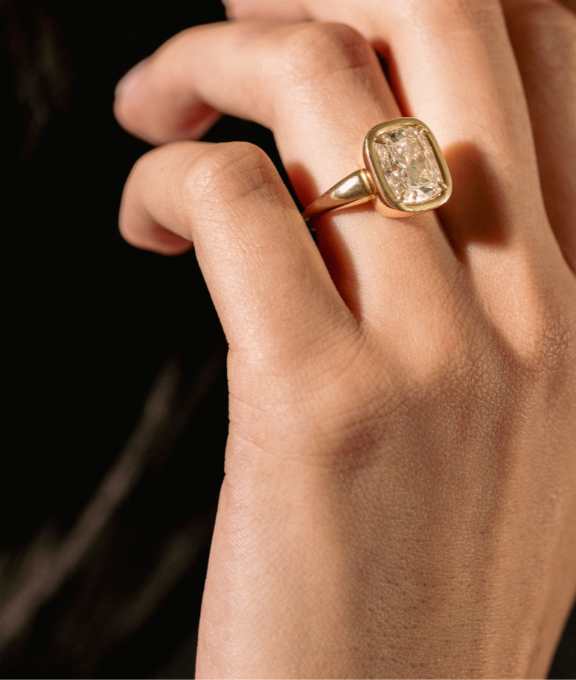
Petal prongs create an open, elevated setting that allows the center stone to remain visible from nearly every angle. A beautiful example is our Tulip Basket Cathedral Engagement Ring with Square Cushion Cut Diamond.
Is a Tulip Setting Secure?
Properly engineered, a tulip setting is secure, and the engineering centers on the gallery rail, a horizontal bar connecting the prongs partway up the head, the traditional way to reinforce a prong setting. On a tulip basket, that bar cuts straight across the petal lines. The cleanest feature of the design is exactly what the standard reinforcement would interrupt.
Working bench jewelers resolve this by stone outline. A tulip basket built without a gallery rail is recommended only for round and oval stones. Those outlines distribute pressure evenly around the curved prongs. Cuts with corners, emerald and radiant among them, concentrate stress at the corner points and need the rail or equivalent reinforcement. A buyer set on a cornered cut in a tulip basket should expect the basket to be built differently. A jeweler who dismisses the question has not resolved it, and the answer determines how the basket gets built.
One workaround has become common. A small hidden halo at the base of the petals braces the head the way a rail would, adding security without crossing the petal silhouette. Some designs go further and set tiny diamonds inside the petals themselves. Market listings now pair petal prongs with hidden halos frequently enough that the combination functions as its own subcategory.
GOODSTONE builds non-traditional settings around the specific stone, planning petal thickness and curvature against that stone's exact outline, with reinforcement set the same way before production. A basket built this way balances all three for one outline. Stock tulip mountings exist but are sized to a stone class, which leaves the fit between stone and petals looser by definition.

Petal thickness, stone shape, and reinforcement all work together to create a tulip setting that feels graceful without compromising everyday security.
What Are the Height, Snagging, and Wedding Band Tradeoffs?
Any elevated setting catches more. A high-set tulip head can snag on knits and hair. The raised stone takes more incidental impact than a low one. Buyers with hands-on work should weigh this honestly. No amount of petal sculpting changes the physics of a tall ring.
The open basket also asks for more cleaning attention than a low solitaire. Lotion and dirt collect beneath the elevated stone and inside the petal curves, where a soft brush reaches only with some patience. The prongs need a periodic wear check like any prong setting. Most jewelers suggest a professional inspection once or twice a year.
The wedding band question arrives later than it should. The petal basket flares outward at the base of the stone. A straight band will not fit flush against the shank at that point. Contour bands, curved to follow the basket's outline, are the answer buyers are most often quoted. An open spacer ring is the other fix, a third ring that takes up the gap so the band can rest flush.
The regret pattern is consistent enough to plan around. The gap looks minor at purchase and becomes something the wearer notices daily once the band arrives. Deciding on the band strategy at the engagement-ring stage costs one conversation, and most makers will quote the contour at the same time as the head. Decide which of the three applies while the band is still being ordered.

A hidden halo can add more than a subtle touch of sparkle beneath the center stone. In a tulip setting, it can also reinforce the petal basket while preserving the clean, floral silhouette from the side.
What Does a Tulip Setting Cost, and What Can You Customize?
Setting-only prices for tulip and petal designs observed across lab-diamond and moissanite retailers are roughly $1,200 to $2,900, above a plain solitaire mounting, because each petal is sculpted and finished individually and many versions include accent stones. Custom variables cover petal count and the thickness and curvature of each one. The basket's openness, the overall height, any diamond accents inside the petals, and the metal are likewise open to specification. Platinum wears best of the three metals, while white gold and rose gold give the design a different character, with rose gold reinforcing the floral association. A tulip basket also accepts sapphires and moissanite. Bench jewelers report steady demand for round and oval sapphires in petal designs.

The elevated profile that gives a tulip setting its beauty also changes how the ring wears. Setting height, everyday snagging, and wedding-band fit are worth considering alongside the design itself.
Frequently Asked Questions
What is a tulip setting engagement ring?
It is a prong setting where curved, petal-like prongs rise from the band and wrap around the center stone, resembling a tulip bloom above its stem. Listings sometimes label this architecture as lotus prongs.
Is a tulip setting secure without a gallery rail?
If the stone is round or oval, the rail is optional, because those outlines distribute pressure evenly across the curved prongs. Cornered cuts like emerald and cushion need the rail or a hidden-halo brace at the base of the petals.
What diamond cuts work best in a tulip setting?
Round and oval are the bench-recommended pairings, and round or oval sapphires see steady demand in petal baskets as well. Pear and marquise outlines can be petal-set, but their points concentrate stress the way corners do. Cornered cuts are possible with reinforcement built in.
What is the difference between a tulip setting and a cathedral setting?
The tulip term describes petal-formed prongs cradling the stone, the cathedral term describes arched shoulders rising from the band, and the two features combine so often that listings regularly advertise a cathedral tulip carrying both.
Does a tulip setting raise the center stone?
Raising the stone is deliberate. The design lifts it above the band for light entry and produces the tall profile some buyers reject in person, though lower-set petal variants trade some of that light entry for a reduced profile.
Does a tulip setting snag on clothes?
Elevated settings catch more than low ones, so expect snagging on knits and hair and more incidental impact than a flush basket, though rounded petal tips catch less than sharp claw tips at that height.
Can a wedding band fit flush with a tulip setting?
A straight band usually leaves a gap, since the petal basket flares at the base of the stone. An open spacer ring or a contour band cut against that basket's flare closes the gap.
Can a tulip setting use moissanite or sapphire instead of a diamond?
If the stone is a sapphire or a moissanite, identical outline rules apply. Benches set sapphires in petal baskets regularly, and boutiques sell tulip and lotus-prong moissanite versions.



Leave a comment (all fields required)