


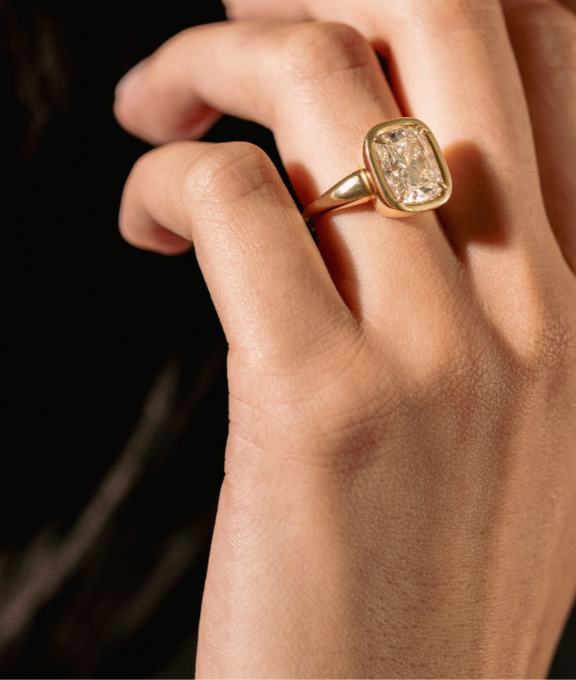


Colored Diamonds Explained: Why Some Cost More Than a Flawless White
A GIA-certified 1-carat internally flawless red diamond starts around $1 million. A 1-carat D-color natural white diamond of equal weight, the top grade on the colorless scale, runs roughly $14,000 to $18,000.
The gap of 60 to 70 times comes from a grading system that rewards the exact thing white diamonds are marked down for, visible color, and from a supply side fixed by geology rather than by mining decisions.

Colored diamonds reveal an entirely different side of fine jewelry, where rarity is measured by the presence of color rather than its absence.
How Does Fancy Color Grading Differ From the White Diamond Scale?
A white diamond is graded on absence. The D-to-Z scale measures how little body color a stone shows. Every step away from D lowers the price. Fancy colored diamonds are graded on presence. GIA evaluates hue and tone alongside saturation before assigning an intensity grade. The lowest grades are Faint and Fancy Light. Above them the scale runs Fancy, then Fancy Intense, then Fancy Vivid. Deeper saturation means a rarer stone and a higher price per step.
The rarity baseline explains the premium. Fewer than 0.01% of natural diamonds contain enough saturation to earn a fancy grade. Trade shorthand puts the figure at one fancy colored carat for every 10,000 carats mined. A flawless white diamond is uncommon. A naturally colored one is statistically closer to a rounding error.
Intensity multiplies value instead of adding to it. Each step up the intensity scale can multiply the price of a stone of identical weight and clarity several times over. A 1-carat Fancy Vivid Blue is worth many times a 1-carat Fancy Light Blue. The two stones can match on carat and clarity and belong to different price markets anyway.
 While white diamonds are valued for their lack of color, fancy colored diamonds are celebrated for the richness of their hue.
What Causes the Color in a Diamond?
Each hue has a different geological cause. Rarity is therefore set per color by physics and chemistry, and not by what buyers in a given decade happen to want. The main mechanisms are nitrogen, boron, and lattice distortion, and each fixes the supply of one hue independently of the others.
Because the geological causes differ from hue to hue, the supplies differ as well. Nitrogen enters the lattice readily during growth. Boron almost never enters it at all. Lattice distortion violent enough to produce red is the rarest mechanism of all. The price ordering in the next section tracks these accidents almost one to one, and no hue can substitute for another at a matching price because each color's supply was set by a different mechanism.
 The remarkable colors found in natural diamonds begin deep within their crystal structure.
Which Diamond Colors Are Rarest, From Yellow to Red?
Red ranks at the top. Fewer than 20 to 30 true red diamonds are known to exist. The two published counts disagree because one counts stones and the other counts GIA certificates graded Fancy Red without color modifiers, and a discrepancy of this kind is itself evidence of how thin the supply is. Only 0.04% of fancy-color submissions to GIA receive the grade. Prices range from $1 million to more than $2.5 million per carat.
Blue follows, at about 0.02% of mined diamonds. Any Fancy Vivid Blue over 10 carats counts as a generational rarity. The Cullinan mine in South Africa has been the principal historic source, producing the rough behind the Wittelsbach-Graff and the Heart of Eternity. Green is comparably scarce, with under 0.1% of mined diamonds qualifying as Fancy Green. The Dresden Green and the Ocean Dream are the reference stones. The green diamond engagement ring Ben Affleck gave Jennifer Lopez in 2022 returned the color to mainstream attention.
Pink supplies its own case study in concentration. The Argyle mine in Western Australia produced roughly 90% of the world's pink diamonds across its 37 years of operation. Pinks amounted to under 1% of even that mine's output, and a year's production of pinks over half a carat could fit in the palm of one hand.
Most natural diamonds show a yellow or brown tint, which puts both colors at the accessible end of the ranking, and saturation at the lower fancy grades adds little to price. Brown ranks as the least expensive natural fancy color, and champagne stones are graded on Argyle's own C scale apart from the GIA system. The steep upper half and flat lower half of that ordering are the same rarity math seen from two directions.

While champagne and yellow diamonds are more accessible, naturally occurring pink, green, blue, and especially red diamonds belong to some of the rarest categories in fine jewelry.
What Should You Check Before Paying for a Colored Diamond?
Why a Fancy Color Grade Is a Range
GIA intensity grades are ranges, and the ranges widen toward the top of the scale. If the step from D to E on the white scale were an inch wide, the Fancy Vivid Yellow grade would measure about two feet across. Five diamonds photographed side by side, all certified Fancy Vivid Yellow, showed visibly different color and a price spread near 50%. The strongest of the five was graded SI2 on clarity. It traded at about 50% more than the weakest, a cleaner stone with weaker face-up color. The width of the top grades is one reason auction houses publish estimate ranges for important colored stones in place of single figures.
The practical reading is that a certificate identifies a band of appearances rather than a single point. Two stones with identical paperwork can differ enough in appearance that an experienced dealer prices them apart. Some nuances visible to graders do not register for a normal buyer. Comparing stones in person, or through a trusted intermediary who has, matters more in fancy color than anywhere else in the diamond market.
Why the Cut Serves the Color
Colored diamonds are cut to concentrate and even out body color, which is why cushions and radiants dominate the category and round brilliants are rare among the great pinks and blues. A round brilliant is engineered to return light. That goal works against color. Even saturation across a step cut is harder to achieve, so the emerald cut of the Oppenheimer Blue was regarded as a daring choice for a stone of that importance.
Clarity and finish take a secondary role throughout the category. Buyers trained on white diamonds routinely over-weight the clarity line of a colored diamond report and under-weight the face-up color that drives the price.
Sourcing a Specific Natural Color Grade
A buyer commissioning a custom engagement ring with a natural pink center stone of a given intensity and size runs into a binding constraint of supply. Locating a specific natural fancy grade at a specific size can take weeks, and some grade-and-size combinations cannot be promised at any budget, because the supply of natural top grades is finite and shrinking. That limit applies to any jeweler, and it applies to the sourcing step before any design work begins.
GOODSTONE, a custom and ready-to-ship engagement ring house, sources colored diamonds on request through its designer-led custom process, with the same designer following the commission from the initial consultation through final production. The arrangement suits buyers who want a colored stone evaluated against alternatives in person or on video before committing. Whatever the source, the paperwork requirement does not change. For a natural-colored stone, the laboratory report must state natural color origin. For blue diamonds the Type IIb designation is the verification.
How Did the Argyle Closure Cap the Pink Diamond Supply?
The single largest supply event in the colored diamond market was a closure. Argyle produced 865 million carats of rough over its 37-year life. The closure was announced in 2018, and production stopped permanently in November 2020. What remains is inventory that can only shrink. No substitute source for pink diamonds exists anywhere in the known mining pipeline.
Pink prices had been rising for years before the closure on ordinary scarcity. The closure converted a trend into a permanent condition. In the year following it, Fancy Pink rose 23%. Fancy Intense Pink gained 29%, and Fancy Vivid Pink added 39%. Argyle's provenance now functions as an asset class of its own within an already scarce category. Trade sellers citing Fancy Color Research Foundation figures, unaudited industry estimates, put average annual appreciation for pinks near 18% over five years and near 500% for top grades over 20. The direction of those estimates matches the public auction results discussed below.

Once responsible for most of the world's pink diamond production, its absence has made these already rare stones even more exceptional.
What Do Colored Diamonds Fetch at Auction?
The top of this market is measured in public. The CTF Pink Star, a 59.60-carat Fancy Vivid Pink, sold for $71.2 million at Sotheby's Hong Kong in April 2017, the record for any gemstone at auction, bought by Chow Tai Fook. The Williamson Pink Star, 11.15 carats and Fancy Vivid Pink, sold for $57.7 million in October 2022 and set the per-carat record for any diamond at $5.17 million.
The Oppenheimer Blue shows how these prices form. The 14.62-carat Fancy Vivid Blue, graded VVS1 and Type IIb, sold for $57.54 million at Christie's Geneva in May 2016, $3.93 million per carat. Bidding opened near $30 million against an estimate of $38 to $45 million. Over roughly 25 minutes the field narrowed to two phone bidders, and increments shrank to $200,000 before the close. The room applauded when the gavel fell. The stone was named for Sir Philip Oppenheimer of the De Beers family. Its original Verdura platinum mounting added value of its own.
The surrounding results fill out the pattern. The Blue Moon of Josephine brought $48.4 million in November 2015. Seven years later the De Beers Cullinan Blue reached $57.4 million, and the Winston Pink Legacy had already passed $50 million in 2018. Records in this category reset every few years, and each reset has been upward.
Auction prices are far above anything a retail buyer will encounter, and they serve a different evidentiary purpose. They demonstrate that at the top grades, supply cannot respond to demand. When a 59-carat vivid pink appears, the world bids because no pipeline is producing another one. Retail prices for fancy colors follow the same supply constraint in weaker form.

Record-setting pinks and blues reveal how remarkable color, provenance, and extreme rarity can transform a diamond into a collector's treasure.
Why Can a Colored Diamond Cost More Than a Flawless White?
A flawless white diamond is rare within its grading scale. Even so, tens of thousands of D-color stones exist. Clarity perfection adds a premium without constraining supply at the category level. A fancy colored diamond is scarce at the category level, graded on a property the white scale penalizes and supplied by geological accidents with finite budgets. In the pink case the principal source has closed permanently. Auction results confirm that demand at the top is real and recurring. Supply at the top grades is a fixed inventory, and a price gap built on capped supply has no mechanism for narrowing.
Frequently Asked Questions
Are yellow diamonds more expensive than white diamonds?
A Fancy Light yellow can cost less than a colorless diamond of equal size, because yellow tint is the most common color in natural diamonds. Prices climb steeply once saturation reaches Fancy Intense and Fancy Vivid.
What is a canary diamond?
Canary is the trade name for a strongly saturated yellow diamond, typically Fancy Vivid or strong Fancy Intense, showing pure yellow without brownish modifiers, with nitrogen in the crystal lattice as the cause.
Do colored diamonds sparkle?
Colored diamonds sparkle, although in champagne and brown shades too much depth of color visibly dims the stone, so moderate tones with bright overtones bring higher prices.
What is the Hope Diamond?
The Hope Diamond is a 45.52-carat natural blue diamond from India's Golconda region, now in the Smithsonian, and the most famous colored diamond in the world.
Are lab-grown colored diamonds worth anything?
They are real diamonds with identical chemistry to natural stones, and they cost 70 to 80% less than natural fancy-color equivalents. Resale value is a small fraction of the purchase price, and lab-grown stones have not appreciated the way natural fancy colors have.
What is the difference between Fancy Intense and Fancy Vivid?
Vivid is the higher saturation grade and the higher price. Both grades are ranges wide enough that a borderline stone can receive Fancy Intense on one submission and Fancy Vivid on another. At this level, in-person comparison of the actual stones gives more information than the printed grade.
How can you tell if a colored diamond is natural?
By laboratory testing, never by eye. Even experienced gemologists cannot confirm natural color from appearance. HPHT treatment can turn brownish stones pink, and irradiation followed by annealing produces pinks as well. A treated stone can be worth 5 to 10 times less than a natural stone of identical appearance.
What are Argyle pink diamonds?
They are pink diamonds from the Argyle mine in Western Australia, the source of about 90% of the world market until the mine closed in November 2020. From 1984 the mine sold its finest pinks through an invitation-only annual tender of roughly 60 stones, and Argyle-certified stones now command premiums of 20 to 50% over comparable pinks from other sources.
Can a setting make a colored diamond look better?
A setting can, and experienced buyers plan for it. Yellow gold prongs or baskets deepen stones graded Very Light or Light yellow. Rose gold makes Fancy Intense pinks appear vivid in a halo, so some buyers deliberately purchase a grade down and let the metal complete the effect.



Leave a comment (all fields required)