


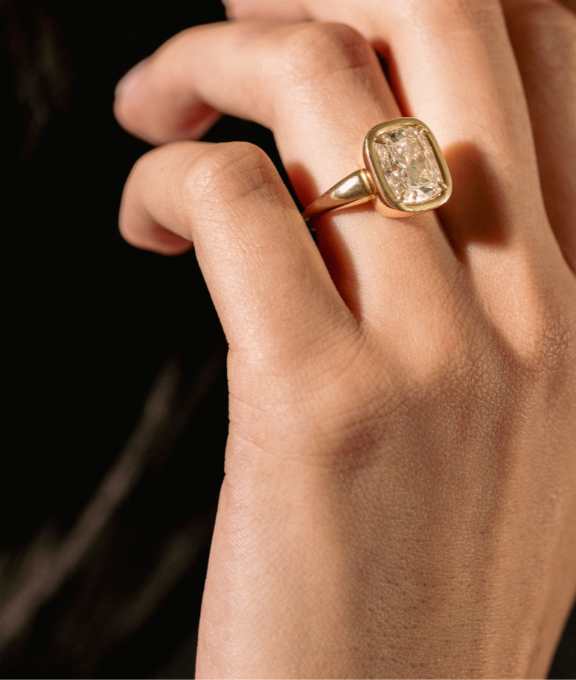




How to Spot a True Antique Cut Diamond from a Replica
A true antique cut diamond is a stone shaped by hand before the early 1930s, typically in one of four styles: old mine, old European, rose, or transitional. You can distinguish it from a modern replica by examining the girdle texture, the open culet, the slight irregularities in the faceting, the soft wear at the facet edges, and the accompanying paperwork.
Both true antiques and modern replicas are genuine diamonds, so the question is never whether the stone is real. The real question is when it was cut and by whose hand. That distinction can change the value of an otherwise similar stone by thousands of dollars and also shape the meaning of the ring when worn.
The first time someone places a loose old mine-cut diamond in your hand and asks you to examine it through a 10x loupe, you notice a quiet circle in the center of the stone, almost like a tiny window. That opening is the cutlet. Even before reading the lab report or asking about the stone’s origin, that feature already reveals much of the era you are looking at.

Both modern replicas diamonds are genuine diamonds; the question is when it was cut, and by whose hand.
What Does “True Antique” Mean?
A true antique cut is a diamond shaped by hand on a wheel before the cutting trade reorganized around the modern round brilliant in the early 20th century. That period covers stones cut from roughly the early 1700s through the late 1920s, with transitional cuts extending into the very early 1940s.
A replica, by contrast, is a modern stone cut to imitate antique proportions, either freshly faceted from rough or recut from a modern brilliant. The diamond itself may be natural or lab-grown, but while the material is genuine and the proportions resemble the original, the cut is contemporary.
Most of the confusion in the market sits along this exact line. A jeweler might describe a stone as an “old cut” because it has the correct outline and a visible culet, even if it was cut recently. Marketplace listings sometimes use the word “antique” loosely, relying on appearance rather than confirming a date. The goal of inspection is to determine whether the cut, wear, documentation, and setting align with the era being represented.

A true antique cut is a diamond hand-shaped on a wheel before the trade reorganized around the modern round brilliant in the early 20th century.
The Four Antique Cut Families
Antique cut diamonds fall into four recognized families, each with its own outline, facet pattern, and date window. Knowing them saves time when you pick up a stone, because you can match the silhouette to the era before you even turn on the loupe.
Old mine cuts run from the early 1700s through the late 1800s. They have a square or slightly rectangular cushion outline with rounded corners, a small table, a tall crown, a deep pavilion, and a larger culet. They feature 58 facets, the same count as a modern round brilliant, but bigger, and the outline is hand-drawn enough that no two stones are alike
Old European cuts run from roughly 1890 to 1930. The introduction of the bruting machine in 1874 allowed cutters to properly round the outline, resulting in a circular silhouette, an octagonal table, a high crown, a small table, a deep pavilion, and a smaller culet. The facets are longer and slightly more precise than those of old mine stones, but still appear chunky next to modern brilliants.
Rose cuts originated in 16th-century Europe and were popular through the Georgian and Victorian periods. A rose cut has a flat base, domed top, no pavilion, and triangular facets that meet at a point in the center. Early rose cuts had as few as 6 facets, while later versions had 12, 18, or 24 facets.
Transitional cuts sit between Old European and modern round-brilliant work and existed from roughly the 1920s to the 1940s. They are not a single fixed proportion set; tables grew larger across the decade, crown heights dropped, pavilion depths shrank, and the culet pulled in toward a point. Some collectors call them “early modern brilliants.” A transitional stone looks almost contemporary at first glance, then reveals its age in the slightly oversized table and a faint culet.

Antique cuts fall into four recognized families, each with its own outline, facet pattern, and date window.
Visual Signals You Can Read Without a Loupe
You can read several age signals from a few inches away, in normal indoor light, before you reach for any tools. The first is the open culet. Hold an old mine cut over a white card, and you will see a small circle in the middle of the table, like the dot at the bottom of a question mark. Modern round brilliants are pointed at the bottom, so they have no center window. A round brilliant with a small dot is likely an Old European or transitional stone rather than a modern stone.
The outline immediately reveals the stone’s family. A square-with-rounded-corners outline is an old mine, a round outline with a chunky light pattern is old European or transitional, and a flat-bottomed dome is a rose cut. The designs predate the early 20th century, so a stone in any of those silhouettes is usually worth a closer look.
The way a stone sparkles also reads differently. Modern round brilliants produce quick, white, splinter-like flashes because their facets are smaller and arranged to maximize light return. Antique cuts use broader facets, so the light moves more slowly across the surface, often creating what collectors describe as a candlelit glow.
Tilt the stone beneath a lamp and watch how it responds. If the light pulses softly in broad bands with traces of color, you are likely looking at antique work. If the sparkle breaks into rapid, glittering flashes, the stone is probably modern.
Color is the last casual signal. Antique stones tend to grade warmer, often in the K through M range, because cutters of the era prioritized weight retention and candlelight performance over the modern preference for an icy face. Many antique stones also show medium to strong blue fluorescence, which can soften that warmth in daylight. A faintly warm, fluorescent stone is more consistent with an antique origin, although neither feature is proof on its own.

Several age signals are readable from a few inches away in normal indoor light.
What to Look For Under a 10x Loupe
Once you reach for a 10x jeweler’s loupe, the first thing you’ll notice is the girdle. A true antique stone almost always has a bruted girdle, meaning the rim of the diamond is rough and matte rather than polished smooth. Under magnification, it appears frosted and faintly grainy, and sometimes shows uneven thickness around the stone. Polished or faceted girdles became standard after the 1940s. If the girdle is glassy and even, it is most likely a modern cut or a recut of an antique outline.
The facets provide the second test. Hand cutting produces small but visible asymmetries where four or five facets meet at a single point on the crown. In a true antique stone, those junctions often sit slightly off-center, the facets vary subtly in size, and the outline appears faintly uneven as you rotate the stone through the loupe. Modern recut stones usually show sharper facet junctions and tighter symmetry. When a stone marketed as antique appears perfectly symmetrical, that precision is a reason to ask more questions over a compliment.
Finally, examine the wear. A diamond that has spent 80 or 100 years in a ring acquires small abrasions along the facet edges and tiny chips along the girdle, which are smoothed by daily contact. The culet often shows a faint frosting from rubbing against fabric and skin. Pristine “antique” stones with no wear should be closely examined, since recutting strips away most of those signs of age.
Two warning signs deserve a separate mention. Sharp, unworn facet junctions on a stone that is supposed to be a century old usually mean the stone was recut. Unusual proportions for the claimed era, such as a very thin crown on a supposed old mine, suggest a modern replica or heavy recut.

Under magnification, a true antique stone almost always shows a bruted girdle.
How to Read the Lab Report
A grading report supports the inspection process, but it does not prove that a stone is antique. GIA reports describe the cutting style using terms such as “Old Mine Brilliant,” “Cushion Modified Brilliant,” or “Old European,” alongside measurements, color, clarity, and a plotted clarity diagram. None of those details certifies the age of the cut. GIA evaluates the stone presented to the gemologist on the day the report is issued.
The proportions section of the report is the most useful part for an age opinion. An Old European stone shows a small table percentage, a high crown angle, a deep pavilion, and an open culet listed as small, medium, or large. A transitional stone shows a table closer to modern numbers but still keeps some old-style depth. A modern recut antique-style stone often has proportions that read as a hybrid, with antique outline numbers and modern girdle and culet entries.
Color and fluorescence in the report give you supporting context. K through M color with medium to strong blue fluorescence is consistent with the era, while D through G color with no fluorescence on an antique-looking stone prompts the question of recutting from a modern brilliant.
If the seller has only an in-house appraisal and no independent lab report, ask for one. A GIA, AGS, or comparable report costs a few hundred dollars for a typical stone and provides a documented description of cut style and proportions to confirm any age claim.
Documentation, Setting, and Provenance
Provenance is the documentary trail that connects a stone to a date. The strongest cases pair the lab report with estate paperwork, an insurance appraisal, an original sales receipt, family photographs of the piece being worn, and any maker’s marks or hallmarks on the setting. None of those items proves antiquity on its own, but together they build a record that an appraiser can defend.
The setting itself is one of the clearest forms of provenance. Many true vintage diamonds remain in their original mountings, and the metalwork carries its own history. Hand-engraved galleries, milgrain edges, hand-pierced filigree, and platinum-over-yellow-gold construction all serve as period markers for late-19th- and early-20th-century pieces.
If a stone sits in a brand-new setting, ask why. There may be a legitimate explanation, such as damage to the original mounting or a resize that compromised the head, but the answer should be clearly documented.
Two specific issues deserve closer attention. The first involves antique-style or “vintage-inspired” stones marketed alongside true antiques, without disclosure of dates. Modern natural and lab-grown diamonds are cut in old mine, old European, and rose styles, and many pass a quick visual inspection because their outlines and proportions resemble those of the originals.
The second issue involves recutting antique stones. While the diamond retains its original age and material, recutting smooths the girdle, sharpens the facet junctions, and reduces the culet, removing much of the visual evidence of an antique cut. Recutting is not inherently deceptive, and many stones are recut to repair damage or improve durability. The problem begins when a recut stone is presented as an untouched original.

The strongest provenance cases pair a lab report with estate paperwork, insurance appraisals, original receipts, family photographs, and hallmarks or maker's marks on the setting.
When to Bring in an Independent Appraiser
Bring in an independent appraiser when the stone is worth more than a few thousand dollars, the seller doesn’t provide a recent lab report, the paperwork and visual cues don’t match, or you want a second opinion that does not come from the seller. An independent appraiser holds Graduate Gemologist credentials, has no financial interest in the sale, and writes a report you retain for insurance and resale purposes.
A useful appraisal report includes:
-
The stone’s measurements
-
Weight, color, and clarity grades
-
Cutting style
-
An opinion on the era of cut
-
A description of the setting and any maker’s marks
-
Photos of the piece
-
An estimated replacement value
Costs vary by region and piece, although rings usually range from $75 to $250 and take a few business days to a couple of weeks to complete. The appraiser should also note any signs of recent repair or recutting, since both affect resale value, and specify the basis used to arrive at the replacement number.
It is also reasonable to ask the appraiser to estimate the stone’s value as a true period piece and as a modern stone comparable with the 4Cs. The difference represents the premium attached to age and rarity.
For old mine cuts, that premium ranges from 10 to 25% above a comparable modern brilliant, with stones above 2 carats reaching the higher end because well-preserved examples are rare. Recognizing that spread helps keep pricing discussions grounded and gives you a stronger frame for negotiation.
When sourcing estate and antique pieces through a reputable fine jeweler, they usually arrive with a recent independent appraisal and a GIA or comparable lab report on the center stone. GOODSTONE always includes lab gradings and appraisals with estate offerings. That paperwork does not replace your own due diligence, but it gives you something to read against your loupe inspection rather than starting from scratch.
A true antique cut diamond reveals itself through small, repeated details. The girdle appears frosted, the culet remains open, the facets sit slightly off-center, the wear looks soft and gradual, the documentation matches the stone, and the setting aligns with the era. A replica may look convincing at first glance, but it falls short on at least one of those points after the inspection. Slow down, ask the right questions, and the stone will usually tell you what it is.

Bring in an independent appraiser when the stone is worth more than a few thousand dollars, the paperwork and visual cues don't align, or you simply want a second opinion with no financial stake in the sale.
Frequently Asked Questions
What is the difference between an old mine and an old European cut?
An old mine cut has a square cushion outline with rounded corners and dates from the early 1700s to the late 1800s, while an old European has a round outline and dates back to roughly 1890 to 1930. Old European facets are longer and more precise because of the 1874 introduction of the bruting machine, although both styles show the chunky facet pattern, high crown, and visible culet that mark them as antiques.
Can GIA certify a diamond as antique?
GIA grades and labels the cutting style of a diamond, using terms like “Old Mine Brilliant” or “Cushion Modified Brilliant,” and reports the proportions, color, clarity, and fluorescence. The report does not certify the age of the cut, so it cannot prove a stone is over 100 years old. Provenance is supported by documentation and expert inspection of the girdle, culet, and wear.
What does a bruted girdle look like?
A bruted girdle has a frosted, slightly grainy, matte appearance under a 10x loupe, sometimes with uneven thickness around the stone. It is the standard finish on diamonds cut before the 1940s, when polished and faceted girdles were the norm. A brushed girdle reduces light reflection by roughly 12% compared to a polished one, contributing to the softer sparkle of antique cuts.
Are recut antique diamonds still antique?
A recut stone keeps its original age and material, since the carbon was crystallized and pulled from the earth in the same era. The recutting process strips away the bruted girdle, sharpens facet junctions, and shrinks or removes the open culet, so the visual evidence of antiquity is mostly lost. Most appraisers note recutting in the report and value the stone closer to a modern equivalent of similar 4Cs.
Why are antique diamonds warmer in color?
Antique diamonds often fall within the K through M color range because cutters of the period prioritized weight retention and performance under candlelight, where a slightly warm body color appears creamy rather than yellow. Many antique stones also exhibit medium to strong blue fluorescence, which can make warmer diamonds appear whiter when viewed face-up in daylight. Buyers seeking a true period look often accept and even prefer that softer warmth.
Can a modern diamond be cut to look antique?
Yes. Both natural and lab-grown diamonds are cut in antique styles such as old mine, old European, and rose. Many modern examples look convincing enough that a quick visual inspection will not immediately separate them from true antiques. The most reliable indicators are a polished girdle rather than a brushed one, sharp, highly uniform facet junctions, a pristine culet with little or no wear, and the absence of period documentation or an antique setting.




Leave a comment (all fields required)