






What Is a Bezel Setting? A First-Time Ring Shopper’s Guide
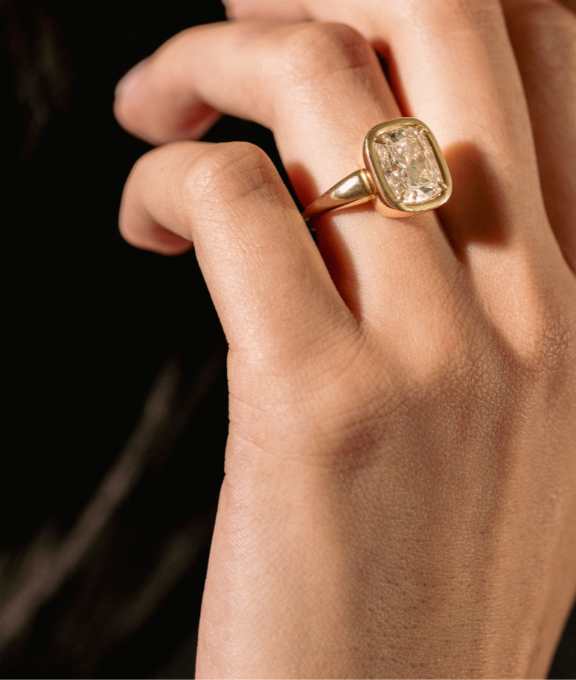
A bezel setting holds a gemstone in place by wrapping a thin, continuous rim of metal around the stone’s edge instead of using small claws known as prongs. Buyers choose it because the surrounding metal protects the stone, rests low and smooth on the finger, and gives the ring a calm, contained appearance that makes it easy to wear.
If your image of an engagement ring centers on a diamond set above the band on four narrow arms, a bezel can take a moment to get used to. The stone remains at the top of the ring, while the metal surrounds it rather than lifting it onto a small platform.
The difference becomes obvious the first time you wear one. Nothing catches or snags, and the stone feels integrated into the ring instead of perched above it.

A bezel setting holds a gemstone in place with a continuous rim of metal wrapped around the stone's edge rather than small prong claws, as seen on our Penumbra Bezel Set Engagement Ring With Emerald Cut.
A Bezel Setting in Plain Terms
A bezel setting uses a continuous band of metal wrapped around the girdle of a stone, with the upper edge folded slightly inward to hold the stone in place. The design dates back to ancient civilizations such as the Byzantine and Roman empires and remains widely used today.
Knowing a few basic terms helps when browsing jewelry listings. The girdle is the narrow outer edge where the upper and lower halves meet. The crown is the portion above the girdle, while the pavilion is the section below it. The gallery is the open space beneath the stone in the ring’s body. In a bezel setting, the metal rim aligns with the girdle and folds gently over the outer edge of the crown.
You may also see the older word “collet” in antique listings, and both the collet and bezel are part of the same family. Collet is usually used for older jewelry, especially Georgian and Victorian pieces, while bezel is the term most modern jewelers use.
A first-time shopper might assume a bezel is a single style, but it is part of a category, with rims that range in thickness, polished smooth or finished with a tiny edge, and set high above the band or nearly flush.

A bezel uses a band of metal aligned with the stone's girdle, with the upper edge folded slightly inward to hold the stone securely in place.
The Main Types of Bezels
The main types you will see in a jeweler’s case are:
-
The full bezel
-
The half or partial bezel
-
The east-west bezel
-
The hidden bezel
You may also see a small group of hybrid designs.
A full bezel wraps the metal rim around the stone without interruption. It is the most protective and secure engagement ring setting available. It is also the most modern and minimal bezel setting because the rim becomes a quiet outline of the stone.
A half bezel, sometimes called a partial bezel or a semi-bezel, covers the two opposing sides of the stone, with the remaining sides left open. It retains the security of a full bezel while allowing more side light to reach the stone, and it feels lighter on the finger. Half bezels are also easier to resize later, since the metal does not fully wrap around the gallery.
An east-west bezel positions an elongated stone, such as an oval, marquise, or emerald-cut stone, horizontally across the finger rather than vertically. The rim follows that horizontal orientation, creating a calm, modern silhouette. GOODSTONE’s half-bezel solitaire styles show how the design comes together in a finished ring.
A hidden bezel is placed on the rim slightly below the table. When looking down at the ring from above, the metal almost disappears, and the stone looks close to a prong-set. It offers some of the security of a bezel, but with a softer visual presence.
Hybrid and double bezel designs take on other forms. Some wrap a stone in two concentric rims, which resembles a quiet halo. Others use asymmetric coverage, covering three-quarters of the stone and leaving one side open.

A full bezel wraps the metal rim around the stone without interruption, offering the most protective and secure setting available, like on our Penumbra Bezel Set Engagement Ring With Round Cut.
A Short History of the Bezel
The bezel is one of the oldest stone-setting methods in continuous use, and it predates the prong setting by centuries.
Ancient and medieval jewelers used bezels because the technique aligns with how metal and stone behave. A rim of soft metal can be hammered down evenly around the edge of a gem without placing stress on a single point. Long before the raised four-prong look became the standard for engagement rings, the bezel was the default.
The most significant historical chapter to know is the Georgian period, which spans from 1714 to 1837. Georgian jewelers worked almost entirely by hand, setting their stones in closed-back bezels and collets. They placed a small piece of foil behind the gem to enhance its color and brilliance.
Diamonds from this period were usually mounted in silver because platinum was difficult to work with using the tools available at the time. Antique brooches with small foil-backed diamonds in scalloped collets are direct ancestors of the modern bezel ring.
During the Victorian, Edwardian, and Art Deco periods, jewelers refined bezels into thinner, more precise forms. In the second half of the 20th century, lower-profile contemporary versions emerged and remain popular today. That long history matters for first-time buyers because a bezel setting is not a passing trend. The design has remained in use for centuries, which is why it still feels balanced and modern today.

The bezel predates the prong setting by centuries, serving as the default stone-setting method from ancient civilizations through the Georgian era.
Why Choose a Bezel?
There are four reasons why people choose bezels.
-
Security: The full rim of metal grips the entire edge of the stone instead of at selected points. A diamond is unlikely to fall out of a bezel because the metal wraps the full circumference of the girdle. Bezels can still loosen from regular wear or after a hard impact, so periodic inspection by a jeweler will help keep them intact.
-
Snag-free feel: This surprises people who have only worn prong rings. There are no points sticking up from the top of the ring, so sweater sleeves, hair, gloves, fabric, and the inside pockets all slide past instead of catching on them. Jewelers often suggest bezels first to nurses, makers, musicians, gardeners, climbers, and anyone who works closely with their hands.
-
Low maintenance: Prong settings need to be checked every 6 to 12 months because the stips wear thin with repeated use. A bezel rim wears far more slowly because it is a single, wider piece of metal. Cleaning is also easier, with mild dish soap, warm water, and a soft toothbrush.
-
A calmer look on the hand: The stone is integrated into the ring rather than raised above it, and the surrounding rim softens the sparkle into a steadier visual rhythm. People who wear minimalist clothing, simple metals, and understated jewelry often prefer bezels for that reason.
How a Bezel Impacts the Stone
Bezels form a thin band around the edge of a stone’s crown, slightly affecting both its size and the way it handles light.
Because the rim folds over the edge of the crown, a bezel-set diamond can appear smaller face up than one in a prong setting. With a thin, neat rim and a properly cut stone, the difference is 1 or 2% of the visible spread. That effect becomes more noticeable with thicker bezels or stones with deep, narrow pavilions. When comparing bezel and prong settings in person, ask to view the same carat weight in both styles, because the difference is easier to see than explain.
Most of a diamond’s brilliance comes from light entering through the open table, bouncing inside the stone, and returning through the same surface. A bezel leaves the table fully exposed, so the primary light path remains unobstructed. The main change affects the side light entering through the crown facets near the girdle. Compared with a four-prong setting, a full bezel can block roughly 10 to 15% of side light.
Bezel-set diamonds look quieter and more contained than similarly cut stones in prong settings. The flashes are gentler, and the sparkle less intense. Some wearers prefer that calmer visual rhythm, while others want the brighter twinkle of an open-prong setting.
A half bezel falls between the two approaches. The rim covers part of the stone while leaving the remaining sides open, producing a gentler side-light effect. Buyers who like the protection of a bezel but want a livelier sparkle often choose this design.

The result of a bezel setting is a quieter, more contained sparkle.
Stones That Suit a Bezel, and a Few That Do Not
Bezels suit cabochons, antique cuts with chunky outlines, elongated step cuts, and small accent stones especially well.
Cabochons are smooth, dome-shaped stones with no facets. Because there is nothing to grip with prongs, cabochons are almost always bezel-set. Moonstones, opals, turquoise, and antique sapphires sit neatly inside bezels for this reason.
Antique cuts also flatter bezels. Old mine, old European, and rose cuts all have slightly irregular outlines because they were hand-cut long before computer-guided lasers were used. A prong setting grips those outlines at four or six small points, which appear uneven. A bezel rim follows the stone’s actual outline, making the irregularity look intentional and subtle. If you’re considering an antique stone for an engagement ring, a bezel setting is one of the most flattering options.
Elongated step cuts are another natural pairing. Emerald cuts, asscher cuts, baguettes, and long ovals have clean, straight lines, and a bezel rim follows those lines instead of interrupting them. The combination looks architectural in the best sense, calm and proportioned.
Small accent stones in earrings, pendants, and the side stones of a ring also benefit from bezels. The rim adds enough visual weight to a small stone to keep it from disappearing, which is why a string of tiny bezel-set diamonds along a band reads as a steady line of light.
Bezels can appear visually heavy around smaller round brilliants, as the thicker rim can dominate the stone. Skilled setters compensate by using thinner bezels, knife-edge finishes, or half-bezel designs that expose more of the stone.

Bezels are particularly well-suited to cabochons, antique cuts with irregular hand-cut outlines, and elongated step cuts like emerald and asscher shapes, like our Penumbra Bezel Set Engagement Ring With Tilted Asscher Cut.
Practical Buying Considerations
A few practical questions are worth asking before you commit to a bezel ring. They include price, resizing, maintenance, signs of good craftsmanship, and the choice of metal.
A simple bezel solitaire usually costs more than a comparable four-prong solitaire. The rim uses more metal, and fitting the rim to the stone takes longer. Pricing starts around $500 for a setting in 14k gold and increases with platinum, side stones, and pavé details.
Resizing is another detail worth discussing before purchase. A full bezel with metal extending under the gallery can be harder to resize because the jeweler must work around the closed underside. The process is still manageable, but it usually requires more labor and resizing than a plain shank.
A half bezel leaves more of the ring structure open, making future size adjustments as difficult as a traditional prong setting. Buyers unsure of their finger size, or whose hand size changes with the seasons, often prefer the flexibility of a half bezel.
Maintaining a bezel-set ring is usually simple. Soak the piece in warm water with a small amount of mild dish soap, brush gently around the rim with a soft toothbrush, rinse, and dry with a soft cloth. Avoid ultrasonic cleaners for treated stones such as oiled emeralds or filled rubies. An annual inspection by a jeweler is usually enough to catch any wear before it becomes a larger issue.
Strong bezel work looks clean, even, and secure. The rim should follow the stone closely with no visible gaps, and the diamond should remain silent and stable when the ring is handled gently. The metal itself should appear smooth and polished, without rough edges or visible tool marks.
Bezels can be crafted in nearly any jewelry metal, including yellow, white, and rose gold, as well as platinum. Both 14k and 18k gold work well for bezel settings. Platinum, however, wears more slowly than most gold alloys, which is why many buyers choose it for everyday wear. Gold bezels remain durable, although the rim may develop small surface marks with long-term wear. The choice depends on how you want the ring to age and which metal colors you wear most often.
A first-time shopper has plenty of room to ask questions during this process. A good jeweler will let you compare a bezel and a prong setting side by side, provide a loupe to examine the rim closely, and walk you through the resizing options for your preferred design.

A bezel solitaire typically costs more than a comparable prong setting because the rim uses more metal and takes longer to fit precisely.
Frequently Asked Questions
Is a bezel setting more secure than prongs?
A full bezel is more secure than a four- or six-prong setting because the metal surrounds the entire edge of the stone instead of at a few small points. Bezels also keep the stone lower on the finger and prevent exposed prong tips from bending or catching. A half bezel still offers strong protection, although it leaves more of the stone exposed. Regular inspections by a jeweler help maintain either style properly over time.
Do bezel settings make a diamond look smaller?
Bezels can make a diamond look slightly smaller face-up because the rim covers a thin band of the crown. With a thin, neat rim and a well-cut stone, the difference is often 1 or 2% of the visible spread. A half bezel, which leaves two sides open, further reduces the effect.
Can a diamond fall out of a bezel setting?
A diamond is unlikely to fall out of a properly made bezel because the metal wraps the circumference of the stone. Heavy impact or years of wear can still loosen the rim, which is why most jewelers recommend an annual professional inspection. If a stone ever feels loose or rocks against the metal, stop wearing the ring and bring it in.
Can a bezel-set ring be resized?
Most bezel-set rings can be resized, although a full bezel with a closed gallery usually requires more labor than a simple solitaire shank. Half bezels are typically easier to adjust because more of the ring structure remains open around the setting. If your finger size changes with the seasons, temperature, or travel, mention that before finalizing the design.
What is the difference between a full and a half bezel?
A full bezel wraps the metal rim around the stone, while a half bezel covers two opposing sides, leaving the other two open. A full bezel offers slightly more protection and a minimal look, while a half bezel lets in more side light, is lighter on the finger, and is usually easier to resize.
Are bezel settings out of style?
Bezel settings remain popular for contemporary engagement rings and regularly appear in east-west designs, minimalist solitaires, and antique-inspired settings. Because the bezel has remained in continuous use for centuries, it adapts to changing trends more naturally than era-specific styles.




Leave a comment (all fields required)