





What Actually Looks Best on a Cushion Cut Diamond
A cushion cut has soft, rounded corners and a generous spread of facets that catch light in a way that feels warm and old-fashioned in the best sense.
It sits between the precision of a round brilliant and the openness of an emerald cut. That balance gives it a character that reacts differently depending on the setting, metal choice, and proportions around it.
Getting the most out of a cushion cut means paying attention to the details that work with the stone’s natural behavior rather than against it. Because GIA does not assign a formal cut grade to cushion cuts the way it does for round brilliants, evaluating the stone and choosing the right pairing requires a more deliberate approach.

Because GIA doesn't assign a formal cut grade to cushion cuts, getting the most out of this shape requires a more deliberate approach to proportions, color, and setting choice.
Why Cushion Cuts Require More Attention Than Rounds
GIA grades polish and symmetry on cushion cuts, but the overall cut grade you see on round brilliant reports does not exist here. Round brilliants have a standardized facet pattern that GIA spent decades researching, so the relationship between angles, proportions, and light return is well documented.
Cushion cuts have too much variation in their facet arrangements for that same framework to apply. That leaves buyers relying on proportions, visual inspection, and the gemologist sourcing the stone.
GOODSTONE addresses this by offering only diamonds graded Excellent Cut. We have gemologists who evaluate each stone for brilliance, fire, and scintillation before adding it to our collection. This kind of curation matters more for cushion cuts than for most other shapes because a certificate doesn’t tell the whole story.

Unlike round brilliants, cushion cuts have too much variation in their facet arrangements for GIA to apply a standardized cut grade.
Proportions and Grades That Actually Work
Getting the Silhouette Right
If you want a square cushion, look for:
- Length-to-width ratio: Under 1.05
- Elongated rectangular cushion: Sweet spot falls between 1.10 and 1.20
- Depth: Between 61% and 67%
- Table size: Between 60% and 68%
These ranges keep the stone from looking too deep or too flat, both of which limit how light moves through the diamond.
Color Matters More Here Than You Think
Cushion cuts hold onto body color more than rounds do. A round brilliant can mask warmth fairly well, but a cushion will show it. If your setting is platinum or white gold and you want that crisp, colorless look, stay in the D to F range.
For yellow gold or rose gold, you can comfortably go with G, H, or even I without the warmth becoming noticeable against the metal tone. Going below H in a white metal setting tends to make the color visible to the naked eye.
Clarity Sweet Spots
The most common clarity grades among buyers of cushion cuts are:
- VS1: Around 27% choose this grade
- VS2: Close behind at 25%
Both are reliably eye-clean. If you need to stretch your budget, many SI1 and even some SI2 cushion cuts will look clean without magnification, though you should inspect the stone or have someone you trust do so.
Settings That Bring Out the Best in a Cushion Cut
Solitaire
A solitaire keeps everything focused on the stone. With a cushion cut, the rounded corners and broad facets receive full attention, and the diamond’s proportions carry the visual weight entirely. This works well when the stone itself has strong light performance, and you do not want the setting to compete with it.

A solitaire setting puts the cushion cut entirely on its own terms, letting the stone's rounded corners and broad facets carry all of the visual weight, like on our Thin + Simple Solitaire Engagement Ring With Cushion Cut Diamond.
Halo
A halo of smaller diamonds around the center stone increases the perceived size and adds a ring of sparkle that frames the cushion’s soft outline. This is a popular option for people who want a more dramatic look without increasing the carat weight.

A halo of smaller diamonds frames the cushion's soft outline with a ring of sparkle that increases the stone's perceived size, like on our Compass Solitaire Engagement Ring with Elongated Cushion Cut Diamond.
Bezel
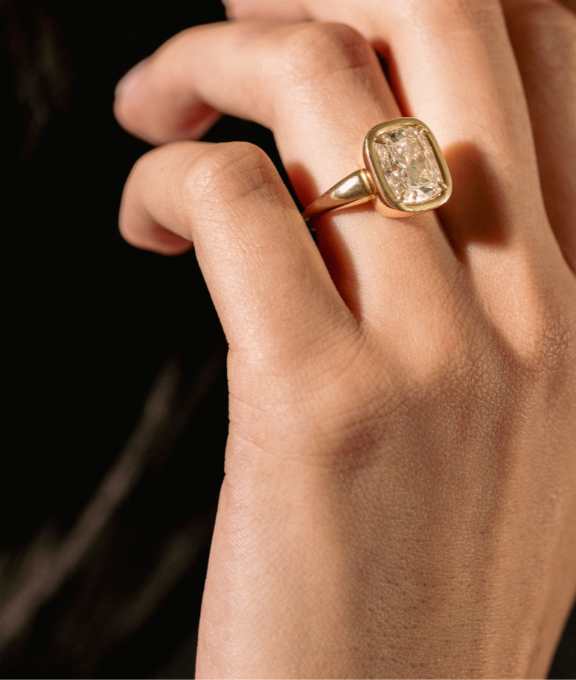
Bezel settings have been gaining significant ground heading into 2026. A thin metal rim wraps around the diamond instead of prongs, creating a smooth, low-profile look. This works especially well for cushion cuts, as the bezel closely follows the rounded corners, giving the ring a sculptural, modern feel. It also protects the stone’s edges.

A bezel wraps the cushion's rounded corners in a thin metal rim, creating a sculptural, low-profile look that feels modern, like on our Finest Bezel Set Engagement Ring With Elongated Cushion Cut Diamond.
3-Stone
A 3-stone setting pairs the center cushion with side stones, often tapered baguettes or shields. We offer 3-stone cushion designs with shield-side stones and other accent options that add dimension without overwhelming the center diamond.

A three-stone setting pairs the cushion center with complementary side stones adding dimension and visual balance without pulling attention away from the center diamond, which you can see on our Three Stone Engagement Ring With Mixed Cushion Cut Diamonds.
East-West Orientation
Turning a cushion cut on its side so it sits horizontally across the finger is a highly requested layout. Zendaya’s engagement ring, a reported 5.02-carat cushion-cut set east-west, led to a notable increase in searches for this orientation after the 2025 Golden Globes.
Our Lasso setting features this exact layout on a rounded band with a comfort fit. The east-west position makes the stone appear larger across the finger, giving the ring a look that feels intentional and modern.

Turning a cushion cut sideways so it sits horizontally across the finger has become one of the most searched engagement ring orientations heading into 2026. This subtle move is iconic and is shown on our East West Half Bezel Solitaire Engagement Ring With Elongated Cushion Cut Diamond.
What Celebrities Are Wearing and Why It Matters for You
Three high-profile cushion cut engagements have put this shape at the center of what people are searching for heading into 2026.
Zendaya’s ring features a 5.02-carat cushion-cut stone set east-west, in a design believed to have been crafted by London-based jeweler Jessica McCormack. Miley Cyrus confirmed her engagement in December 2025 with a 4 to 5-carat cushion-cut set east-west in a thick 14k yellow gold bezel.
Taylor Swift announced her engagement to Travis Kelce in August 2025 with an elongated cushion-shaped old mine-cut stone set in a chunky 18k yellow gold band, with experts estimating the stone at 7 to 12 carats.
All three rings feature chunky gold bands and unconventional settings, which align with the demand for bold, sculptural engagement-ring metalwork.
2026 Trends That Pair Well With Cushion Cuts
Chunky gold bands are popular right now, and gold prices sitting at record highs have made substantial gold settings feel luxurious and worth the investment. Vintage-inspired and Art Deco styling is in demand, with milgrain borders, filigree, and old mine cuts attracting buyers who want something with character.
Warm-toned and champagne diamonds are also picking up interest as more couples move away from the strict D to F colorless range and embrace stones with gentle brown or yellow hues.
Mixed metals, such as white and yellow gold, add contrast and versatility to a ring. And the elongated cushion has specifically positioned itself as the next go-to shape for people who have been wearing ovals and want something with a similar finger coverage but a softer, more textured sparkle.
How to Choose a Cushion Cut With Confidence
A cushion cut rewards you when you pay attention to proportions, pick a color grade that matches your metal, and choose a setting that works with the stone’s soft geometry rather than fighting it. Because there is no GIA cut grade to fall back on, working with a team that evaluates each stone individually makes a real difference.
Our concierge process walks you from setting selection through diamond choice to final production, with every ring handcrafted by our team of generational artisans in Los Angeles. Every ring includes complimentary resizing, polishing, and repairs for as long as you own it, and every diamond and gemstone is ethically sourced using recycled metals.
You can visit our showroom in Austin, TX, by appointment, or work remotely through our concierge process with free insured shipping. If you are considering this shape, be specific about your preferences and work with experts who can guide you through the process.



Leave a comment (all fields required)