




The Diamond Color Scale From D to Z & What Each Grade Means
Before the letter scale, dealers sold diamonds by name. River meant the most colorless stones, and a pale yellow stone was a Cape. Blue white was used so loosely that the U.S. Federal Trade Commission moved to stop its misuse.
GIA and the American Gem Society started building a color standard in the 1930s. Richard Liddicoat first taught the finished system to jewelers in 1953. It started at D so its grades couldn’t be confused with the A and AA labels older systems gave their best stones.
The scale has 23 letters. They describe body color, most often yellow, and a diamond’s letter is its color grade among the 4Cs.
Color Grading at GIA
At GIA, color is graded on a loose diamond. The stone goes table-down into a white tray inside a viewing box, under daylight-equivalent fluorescent lamps, with the room lighting kept low. A grader looks through the pavilion facets from 12 to 15 inches away, without magnification.
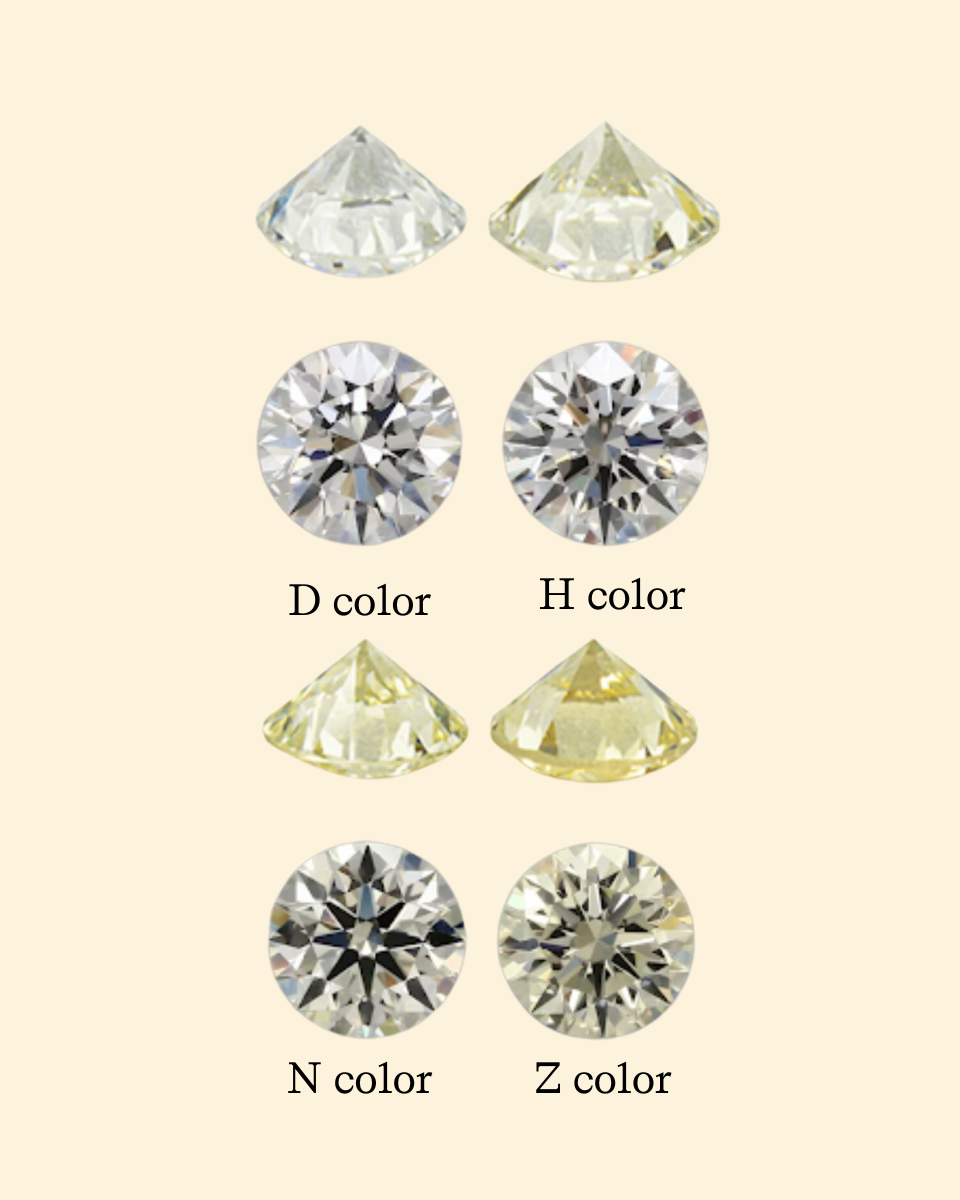

At GIA, color is graded on a loose diamond. The stone goes table-down into a white tray inside a viewing box, under daylight-equivalent fluorescent lamps, with the room lighting kept low. A grader looks through the pavilion facets from 12 to 15 inches away, without magnification.
Next to the stone are master diamonds, reference stones of known color. Each master marks the least-color edge of its grade. A diamond that matches the G master is a G, and one with a little more color than the G master but less than the H master is also a G. A letter is therefore a narrow range, so two G diamonds can differ by an amount small enough that it usually takes a trained grader to see.
GIA collects independent opinions from several graders, none of whom can see earlier opinions, and finalizes the grade once enough of them agree. In 2001, the lab began counting its own color-measuring instrument as one of those opinions, with at least one grader required to agree with it.
The letter leaves out fluorescence. Graders assess color before testing the stone for fluorescence, so they work without knowing its strength.
Rounds are graded table-down only. For a fancy cut, the stone is turned with its long axis at about 45 degrees to the grader. That angle averages the color seen through the ends, where it is strongest, with the color along the sides. From Q down, GIA adds a face-up look for fancy cuts to account for the extra color they show face-up at that end of the scale.
The Grades, Band by Band
GIA groups the 23 letters into five bands.
| Band | Grades | How GIA describes it |
|---|---|---|
| Colorless | D, E, F | The most chemically pure diamonds on the scale. |
| Near colorless | G, H, I, J | Color often unnoticeable except to trained graders. |
| Faint | K, L, M | Color still difficult for an untrained eye to see. |
| Very light | N to R | Color visible to an untrained eye in larger stones. |
| Light | S to Z | Color visible in stones of many sizes, distinctly yellow or brown. |
D, E & F
GIA keeps no D master stone. Any diamond with less color than the E master is a D, so the top grade has no reference stone. All three letters appear virtually colorless, which can make it hard for a grader to place a stone between two masters.
G Through J
Gray diamonds in this band still receive an ordinary letter, as they do from E, and brown ones can be compared against GIA’s brown master set, which starts at G.
K, L & M
From K, a GIA report describes brown and gray stones in words. A brown diamond in this band is reported with its letter plus “Faint Brown,” as in “M Faint Brown.” A gray one receives the words alone, with no letter. Yellow diamonds keep a plain letter through Z.
N Through Z
N is the last single letter on a GIA report. Toward this end of the scale, telling neighboring grades apart means judging tone and hue as well as color amount, and single-letter calls add little to how these stones are valued. From O down, reports give two-letter ranges such as “S-T range” or “Y-Z range,” with master stones at O, Q, S, U, W, and Y. Brown stones read “Very Light Brown” through R and “Light Brown” from S to Z, and gray stones take the same words without a letter.


Why Some Diamonds Are Yellow, Brown, or Gray
Nearly every diamond on the scale contains nitrogen. In one large GIA study of D-to-Z stones, 99.06% were Type Ia, the nitrogen-bearing type. Over geologic time and at high temperature, that nitrogen gathers into defects in the crystal. The main one, three nitrogen atoms beside a vacant spot, absorbs some violet and blue light, and the stone looks yellow as a result. Gemologists call these cape features, after the old trade name for pale yellow stones from South Africa’s Cape Province.
The 0.83% of stones in that study with no measurable nitrogen, Type IIa, take their color from a different flaw. Natural plastic deformation bent their crystal lattice and left clusters of vacancies behind, and those clusters give a brown tint. Deformation can tint nitrogen-bearing stones as well, and about 5% of all D-to-Z diamonds are brown. Gray in most natural diamonds traces to something else again, clouds of dark, often graphitic, inclusions.
The split between nitrogen-bearing and nitrogen-free stones also limits treatment. A high-pressure, high-temperature process the trade calls HPHT can reduce brown and gray in Type IIa diamonds and a small number of other types. Most Type Ia stones can’t be whitened this way. When GIA detects the treatment on a natural diamond, the report puts an asterisk after the color grade and names the process under Comments.
Color in Lab-Grown Diamonds
Colorless and near-colorless lab-grown diamonds are Type II, with no detectable nitrogen, and growers work to keep it that way. Those who grow diamonds under high pressure and high temperature add metals such as aluminum or titanium to capture nitrogen before it reaches the crystal. The other method, known as CVD for chemical vapor deposition, builds diamond in layers from a carbon-bearing gas, and some of those stones come out brown.


The brown can be a trade-off. A grower may choose a faster recipe that leaves a brown tint and then reduce it with HPHT treatment, which can be quicker or cheaper than growing a colorless stone directly. It is the same process that whitens brown Type IIa natural diamonds. Since 2020, about 80% of the CVD diamonds submitted to GIA have gone through it after growth. More than 95% of lab-grown diamonds entering the market now fall within a narrow range of color and clarity.
IGI grades lab-grown color on the D-to-Z scale, with the stone upside down and viewed through the side. Its reports use its own names for some bands, such as “Slightly Tinted” for K to M, and can name the growth method and note post-growth treatment in the comments section. GIA stopped giving lab-grown diamonds letter grades in October 2025 and now describes them as Premium or Standard.
GIA has recorded temporary color changes in some CVD stones after exposure to light or heat, all of them fully reversible. CVD diamonds that were graded more than once, months or years apart, showed no systematic change in color grade.


The End of the Letter Scale
The letters end at Z for yellow and brown diamonds. A stone with more color than GIA’s Z boundary master is graded as a fancy color, and from that point the face-up view alone decides the grade. For these colors, fancy grading begins at Fancy Light, and gray diamonds join the fancy scale at the same point. GOODSTONE sets canary yellow diamonds in solitaire and three-stone rings, cut as radiants, ovals, emerald cuts, and elongated cushions.
A pink or blue diamond leaves the letters much sooner. Those colors are rare enough in diamonds that GIA acknowledges even a slight tint, and once the color reaches the depth of the G master, the stone is described in colored-diamond terms such as “Faint pink” or “Faint blue.” By that rule, a pink stone as pale as a G yellow is already off the letter scale.
The terms on a GIA colored diamond report are Faint, Very Light, Light, Fancy Light, Fancy, Fancy Intense, Fancy Vivid, Fancy Dark, and Fancy Deep. Fancy Intense and Fancy Vivid stones generally sell for more.
Grading Stones That Are Already Set
A letter grade on a GIA Diamond Grading Report requires a loose stone. A mounting can hide part of the diamond and influence how its color and clarity are judged, and it makes an exact carat weight hard to measure. Testing a loose stone also lets GIA check for treatment without damaging the diamond or the setting.
Before the 1980s, GIA graded mounted diamonds and reported their color as a range of two or three grades. Its Jewelry Report takes that approach today for natural D-to-Z diamonds, estimating a color range as far as the mounting permits. IGI also grades set stones on its lab-grown jewelry reports, again as far as the mounting allows.
An heirloom ring, or one bought already set, can get an exact GIA letter once a jeweler removes the diamond from its setting and submits it loose.