




How a Diamond Is Cut & What the Cutter Trades for Weight
Planning a rough diamond for fair proportions, when excellent ones were possible, can raise its yield, the share of the crystal’s weight left after polishing, by as much as 15%. The polished stone then sells for less per carat. GIA’s cut grade measures the result on standard round brilliants in the D-to-Z color range. Brightness, fire, and scintillation, three of its seven components, describe the face-up view. Weight ratio and durability make up the design, and polish and symmetry grade the finish. Shape is the outline. GIA gives no oval or pear a cut grade.
From Rough Crystal to Polished Stone
Optical scanners measure a rough crystal and map its inclusions before a planner marks it for cutting. Every plan trades proportions against weight. One degree on a facet angle can change the finished weight by about 1%.


Optical scanners measure a rough crystal and map its inclusions before a planner marks it for cutting. Every plan trades proportions against weight. One degree on a facet angle can change the finished weight by about 1%.
Few diamonds are cleaved now. Most rough is sawn, by blade or by laser, and bruting then grinds the sawn piece against a wheel charged with diamond grit and water until its outline is round. That rounded edge is the girdle, the narrow band between the crown above and the pavilion below.
Traditional blocking takes about three hours to form a pavilion’s main facets, and a coning machine does it in about 15 minutes. The remaining facets are polished on a scaife, a metal wheel turning at up to 4,000 rpm, traditionally cast iron charged with diamond powder in olive oil. A polisher working by hand finishes the eight pavilion mains before the 16 lower-half facets. Automated polishers reverse the order. A 1-carat round spends about two hours on the wheel.
Weight comes off at every step, mostly as diamond powder. Historically, gem-quality rough has kept about 40% of its weight on average. Lower-grade “near-gem” crystals, cut in volume in India, have kept 15 to 23%.


Where the Extra Weight Goes
Diamond prices jump at round weights such as 1.00 and 2.00 carats. When a crystal would finish a few hundredths under one of those weights at its best proportions, the cutter can keep enough extra weight to reach it.
Some weight has to stay at the edge regardless. Marcel Tolkowsky’s 1919 book Diamond Design worked out a round brilliant’s proportions on a knife-edge girdle, one with no thickness at all. An edge that thin is at extreme risk of chipping.
A girdle can also be left thicker than needed. Two round brilliants can look the same size face-up at 0.61 and 0.71 carat when the heavier one has the thicker girdle, and that stone costs more with no gain in face-up size. GIA’s system lowers the grade of diamonds that keep excess weight in an extremely thick girdle, a steep crown, or a deep pavilion.
Painting and digging out keep weight through the angles of the half facets beside the girdle. Painting tilts the upper or lower halves toward the neighboring bezel or main facets. Digging out tilts them the other way, toward each other. Either change blurs the junctions between facets and can reduce a stone’s brightness and pattern. GIA rates painting and digging from negligible to severe, and a moderate rating or worse can lower the cut grade.
How GIA’s Grade Counts Weight
Weight ratio compares a round brilliant’s weight with its diameter. A stone can have too much weight for its width or too little. GIA calculates the ratio against a reference diamond with a 57% table, a 34.0° crown angle, a 40.7° pavilion angle, and a 2.5% girdle, which is set at 1.00. Excellent rounds most commonly come in between 1.02 and 1.05. Near 1.08 or 1.09, a stone reaches the border between Excellent and Very Good. The border between Very Good and Good falls near 1.16 or 1.17. The ratio itself doesn’t appear on a GIA report.


A round with a 53% table, a 34.5° crown angle, and a 40.8° pavilion angle can grade Excellent with a 2.5% girdle and a total depth of 62.5%. A second round with the same table and angles, a 4.5% girdle that ranges from Slightly Thick to Thick, and a total depth of 64.2% grades Very Good. Its face-up appearance may equal the first stone’s. The extra weight for its diameter keeps it at Very Good, and so does its medium culet, one size past the Excellent limit.
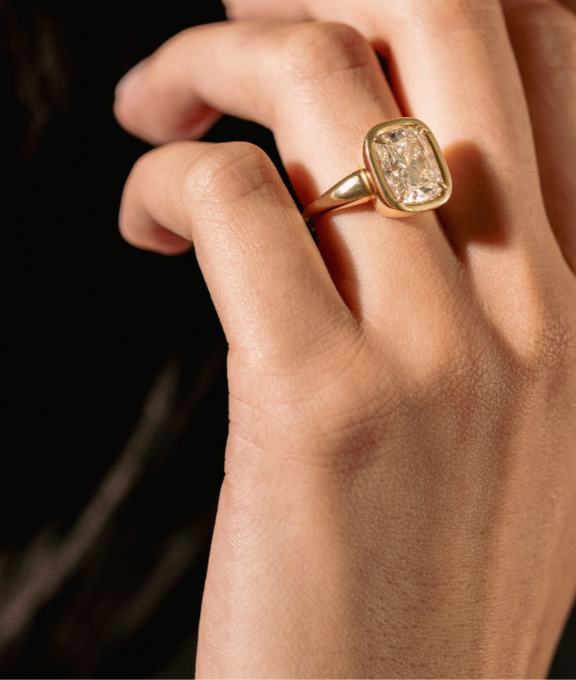
Durability covers the girdle’s thinnest point. If that point is Very Thin or Extremely Thin, the cut grade can go no higher than Very Good. GIA counts a shallow crown against durability only when the girdle is also very thin. For a girdle thin enough to chip, GIA suggests a bezel setting, which surrounds the stone’s edge with metal. GOODSTONE bezel-sets the center stone in its Penumbra engagement rings, including round and marquise outlines.


The Proportions Diagram & Its Rounding
A GIA report on a round brilliant includes a scaled profile of the stone with 10 measurements, from table size and crown angle down to culet size and total depth. Most are averages of several readings, rounded to a fixed step. Table size is reported to the nearest 1% and total depth to the nearest 0.1%. The crown angle is rounded to the nearest 0.5° and the pavilion angle to the nearest 0.2°. Star and lower-half lengths go to the nearest 5%.
GIA grades from the rounded figures. Two rounds with matching rounded proportions and matching girdle and culet descriptions get the same grade on proportions. A pavilion measured at 41.26° is reported as 41.2°, and one at 41.31°, within measuring tolerance, is reported as 41.4°. On one set of proportions, with a 56% table and a 36.5° crown angle, that step moves the estimate from Excellent to Very Good.
Manufacturers have learned to use the rounding rules to reach high cut grades while keeping more weight. Some Excellent reports show a measured total depth above the 63.0% limit. The limit applies to the depth GIA calculates from the rounded proportions, and the measured figure printed on the report can differ by up to 0.8 percentage points. Cutting that close to a step also risks a measurement rounding the wrong way and costing the stone a grade.
GIA publishes the range each measurement must fall within for a round to be eligible for a grade.
| Measurement | Excellent | Very Good |
|---|---|---|
| Table size | 52 to 62% | 50 to 66% |
| Crown angle | 31.5 to 36.5° | 26.5 to 38.5° |
| Pavilion angle | 40.6 to 41.8° | 39.8 to 42.4° |
| Star length | 45 to 65% | 40 to 70% |
| Lower-half length | 70 to 85% | 65 to 90% |
| Crown height | 12.5 to 17.0% | 10.5 to 18.0% |
| Total depth | 57.5 to 63.0% | 56.0 to 64.5% |
| Girdle thickness | 2.5 to 4.5% | up to 5.5% |
Culet size has two categories, "None to Small" and "None to Medium".
The Very Good limits allow a girdle up to 5.5% of the diameter and a total depth up to 64.5%, room a cutter can fill with weight. A round inside every Excellent range can still grade lower. GIA also judges how the measurements combine, and the interplay between table size and crown and pavilion angles matters most.
The girdle appears twice on the report. The percentage is measured at the eight thick points where the bezel and main facets meet. The verbal range, such as Thin to Medium, is judged by eye at the thin points between them, where the girdle usually measures about 1.7 percentage points less. Polish and symmetry can each be one grade below the cut grade without lowering it, so an Excellent cut needs both at Very Good or better.
GIA’s free Facetware estimator, which requires registration, takes six of these measurements and returns an estimated cut grade. The six are table size, the crown and pavilion angles, the star and lower-half lengths, and girdle thickness. GIA’s own grade can differ from the estimate when its measurements of the stone differ from those entered.
Cut Assessments Beyond GIA’s Round Grade
A GIA report on an oval or any other fancy outline gives no overall cut grade. It grades polish and symmetry and records the stone’s measurements. A simplified proportion diagram describes the girdle.


IGI’s cut grade for loose fancy outlines works in four steps. A stone needs Very Good polish and symmetry or better to be considered for Excellent. Next, its proportions must qualify, followed by requirements specific to its outline, including the girdle. The last step is a gemologist’s judgment of light return, which does not assess fire or scintillation.
On lab-grown rounds, GIA’s Premium tier requires an Excellent cut and its Standard tier at least Very Good. A stone that misses any Standard minimum receives no GIA assessment.
The American Gem Society’s laboratory graded cut on a scale from 0 to 10, with 0 at the top, and closed at the end of 2022, merging its operations into GIA. GIA now offers the AGS Ideal Report as a light performance supplement to its own grading report. It is issued electronically, with a printed copy available for an added fee. Painting and digging out can leave a stone’s symmetry grade untouched and still lower its AGS light performance grade.