





How Diamond Carat Weight Is Measured & What the Number Means
A diamond sold as ½ carat can weigh 0.45 carat. Federal guidance on jewelry advertising treats the fraction as a range and expects the seller to say the weight is not exact and to state the range or tolerance used.
On a GIA grading report, the stone’s weight would be printed to two decimal places, from a weighing several places finer.
Set in a ring, a diamond can no longer be weighed on its own. A reliable weight for it then comes from a record made while it was loose, such as a grading report.
The Metric Carat
A metric carat is 200 milligrams, or a fifth of a gram. Five carats make 1 gram. The trade divides each carat into 100 points of 2 milligrams and calls a 0.25-carat stone a 25-pointer. Karat with a K is a separate unit that counts gold purity in 24ths. A 24-carat diamond, spelled with a C, weighs 4.8 grams.


The 200-milligram carat dates from October 1907, when the fourth General Conference on Weights and Measures adopted it in Paris. Before then, the carat differed from country to country. In the United States, weight makers used slightly different values. The American carat came nearest to 205.3 milligrams and was usually divided in binary fractions, down to 1/64 of a carat. On July 1, 1913, the Bureau of Standards and the customs service switched to the metric carat and its decimal hundredths. A committee of the leading gem firms moved nearly every dealer in the country to it on the same day. A diamond weighed at 1 carat under the old U.S. unit equals about 1.03 metric carats.
The name comes from the carob tree. Early gem traders used its seeds as counterweights on handheld balances. Weighed in a 2006 study, carob seeds turned out no more uniform in mass than the seeds of 63 other species. By eye, people can tell apart carob seeds that differ in weight by about 5%, and the study’s authors proposed that the seeds used as weights were picked out that way


Weighing a Loose Diamond
At GIA, a submitted diamond is weighed near the start of grading, on an electronic micro-balance. The lab calibrates and services its balances more strictly than the manufacturers recommend. Temperature and humidity in the room are controlled. An optical device measures the stone’s dimensions and proportions separately.
Weighing to the thousandth of a carat is the trade standard. GIA weighs to the hundred-thousandth, two places further, partly so the weight can serve as one of the stone’s identifying characteristics. In 1913, the Bureau of Standards asked for gem balances that could read at least 0.01 carat.
Lab-grown diamonds have essentially identical physical properties to natural diamonds, so equal weights of the two occupy equal volumes. A ruby is denser, with a specific gravity of 4.0 against diamond’s 3.52, and a 1-carat ruby is the smaller stone.
Two Decimal Places & the Rounding Rule
A GIA report prints carat weight to two decimal places, as in 0.71 or 1.34 carats. To get there from the thousandth, GIA rounds up to the next hundredth only when the thousandth digit is a 9. A stone weighing 1.769 carats is reported as 1.77, and one weighing 1.768 carats as 1.76. A diamond reported as 1.00 carat therefore weighs at least 0.999. One weighing 0.995 to 0.998 carat, which ordinary rounding would bring up to 1.00, is reported as 0.99. Natural diamonds rise in price per carat at popular weights, which GIA gives as 0.25, 0.50, 0.75, and 1.00 carat, and most of all at 1 carat. A thousandth of a carat can move a reported weight across that last step.


Weight on an IGI Report
IGI grades both natural and lab-grown diamonds and also weighs each stone first, on scales calibrated to at least four decimal places. Its reports print the weight to two decimal places, though IGI’s published account of its grading process does not say how it rounds. Laboratories can differ in their standards and processes, so per-carat price comparisons are most reliable between stones graded at one laboratory.
Before a stone goes back to its owner, IGI weighs it again and checks it against the finished report. The report also gives the stone’s measurements in millimeters.
Carat Weight in a Listing
The Federal Trade Commission’s guides for the jewelry industry call any misrepresentation of a diamond’s weight unfair or deceptive. They also spell out what a stated weight can cover.
- Decimals. A weight given to two places should be accurate to the last place, so “.30 carat” covers 0.295 to 0.304 carat. A weight given to one place should be accurate to the second, as in “.5 carat” for 0.495 to 0.504.
- Fractions. In the FTC’s example, “½ carat” can mean anything from 0.45 to 0.54 carat. The notice that the weight is not exact belongs close to the fraction, and a catalog repeats it on every page with a fraction, with the option of referring to a chart of the ranges.
- Points. A weight in points should also appear as a decimal, as in “25 points or .25 carat.”
In the FTC’s examples, decimal figures follow ordinary rounding. On that basis, a 1.00-carat listing covers 0.995 to 1.004 carats. GIA reports the bottom of that range, 0.995 to 0.998, as 0.99.
Center Stone Weight & Total Carat Weight
Total carat weight, written ctw or tcw, is the combined weight of every diamond in a piece. A ring with a 0.84-carat cushion center and 0.40 carat of smaller diamonds in its halo has a total weight of 1.24 carats. With other gems included, it becomes the total gem weight.


GOODSTONE lists its single-point prong studs by the weight of each stone with the pair’s total beside it, so a “.50ct (1.00 ctw)” pair is two half-carat diamonds.
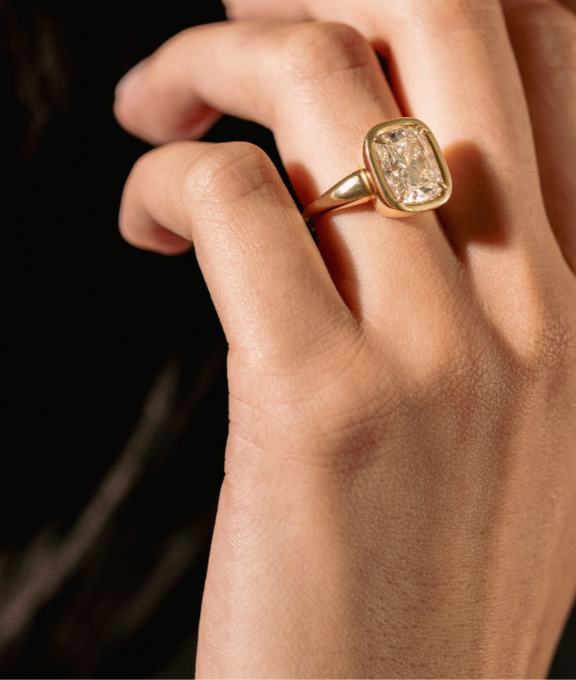
A ring set with melee totaling 2.15 carats costs far less than a solitaire with a single 2.15-carat diamond, since price per carat climbs with the size of the individual stone. A 1.00-carat center with two 0.15-carat side stones totals 1.30 carats and typically costs more than that center with six 0.05-carat side stones, which also total 1.30. Listed only by total weight, a ring leaves the center stone’s weight unstated. If the center stone has a grading report, the report lists the weight to the hundredth.


Estimating the Weight of a Set Diamond
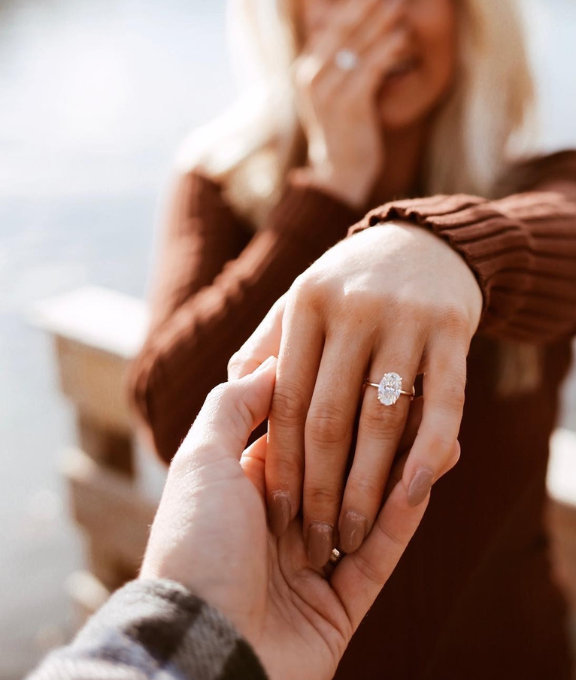
GIA issues its Diamond Grading Report only for loose stones. A mounting makes it difficult to determine exact carat weight.
Diameter alone does not fix the weight of a round diamond. A 6.5mm round brilliant weighs 0.986 carat at one set of proportions and 1.066 to 1.154 carats at four heavier ones. In those heavier sets, the crown and pavilion angles are steeper and the girdles thicker. Even with every proportion measured, a calculated weight can differ slightly from the balance reading, because of rounding and small variations in symmetry.
Those examples span about 0.17 carat and cross the 1-carat line. A set 6.5mm round whose proportions cannot be fully measured has at least that much uncertainty in its weight.
Appraisals & Jewelry Reports for Set Pieces
The American Society of Appraisers’ guidelines for gem and jewelry appraisals require describing a diamond’s weight as actual, estimated, or calculated. They also ask the appraiser to state the tolerances in measuring or weighing and any grading limits a mounting imposes.


IGI’s published sample appraisal describes a set round brilliant measuring approximately 6.25 to 6.33 by 4.05mm. Its weight is given as 1.05 carats, estimated by formula, and a comment notes that it was graded as the mounting permits.
GIA’s Jewelry Report, offered for pieces set only with natural D-to-Z diamonds, provides an estimated total carat weight and the weight of the whole item, metal included.