





A Closer Look at Taylor Swift’s Elongated Old Mine Cut
Taylor Swift’s engagement ring features an elongated old mine-cut diamond, a cushion-shaped antique stone most experts estimate at 8-10 carats, set in a hand-engraved 18-karat yellow gold band. Travis Kelce designed the ring with New York jeweler Kindred Lubeck of Artifex Fine Jewelry, and the couple shared their news on Instagram on August 26, 2025. The cut is older than today’s styles, and that is part of why people have not stopped looking at it.

Taylor Swift's engagement ring has given antique cushion stones their biggest mainstream moment in a decade.
What Taylor Swift Is Wearing
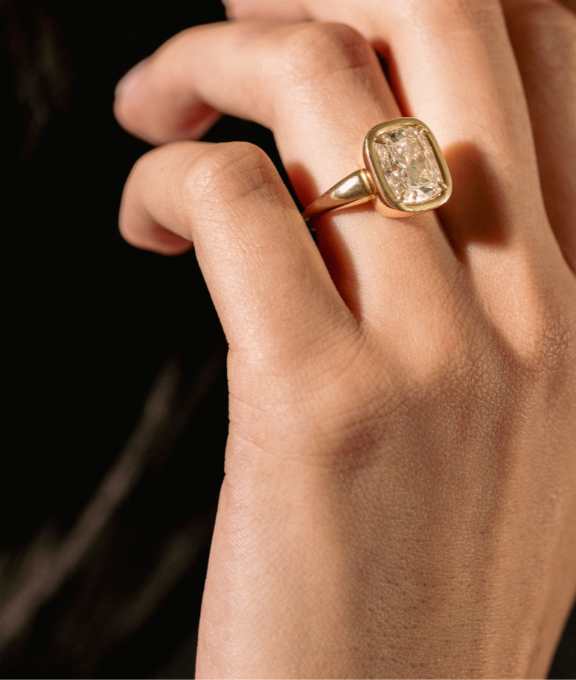
Swift’s ring is an old mine brilliant-cut diamond with an elongated cushion style, set in 18-karat yellow gold with hand engraving and a low-profile bezel, and supported by four corner prongs. The center stone is the focal piece, and the band carries fine engraved detail that gives the gold the soft texture you see when you zoom in on the announcement photos.
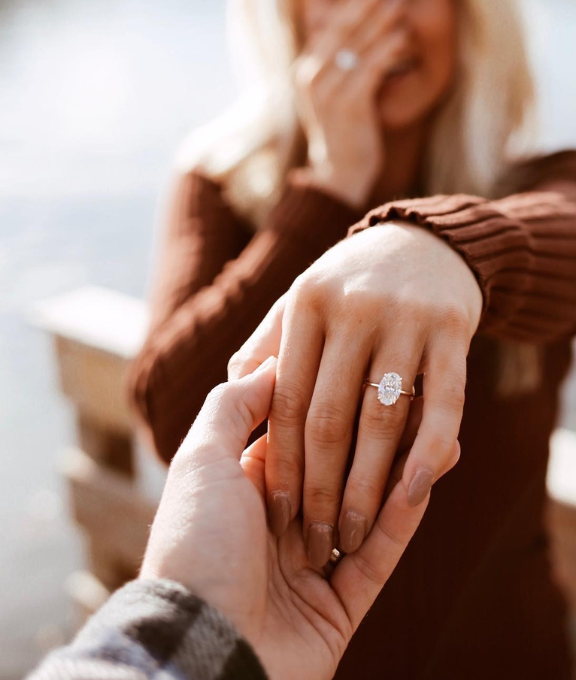
The proposal took place in the back garden of Kelce’s home in Lee’s Summit, Missouri, where he built a floral display around a gazebo. The Instagram caption, “Your English teacher and your gym teacher are getting married,” appeared on August 26, 2025. The first close-up frame, showing her hand resting on his shoulder in the rose garden, has since circulated among jewelry editors and gemologists.
Carat estimates from named experts cluster between 8 and 10 carats. Grant Mobley, the editor at Only Natural Diamonds, described the ring as an approximately 10-carat antique elongated cushion in a gold bezel setting with hand-engraved 18-karat goldwork. The team at Today.com spoke with six jewelers who placed the stone in roughly the same range, and CNN Style reported a similar read. One outlier, surfaced by The Hollywood Reporter, suggested the diamond could be as large as 13 carats, but most of the trade press has settled at the 8 to 10 figure as the working estimate.
Value estimates vary because no one outside the couple and Lubeck has a grading report to work from. The same panel of six jewelers and The Hollywood Reporter placed the ring somewhere between $400,000 and a little over $1 million, depending on the diamond’s color, clarity, and natural origin. Fox Business cited a $550,000 figure that has circulated widely in lifestyle coverage. The honest answer is that without a GIA report, every published number is guesswork from photographs of a moving hand.
A few outlets have noted small bezel-set accent diamonds along the band, which would be consistent with Lubeck’s signature work. The overall silhouette reads as a large, soft pillow shape with quiet sparkle along the gold beneath it. The yellow gold choice is also worth noting, since most modern engagement rings default to platinum or white gold. Yellow gold warms an antique stone and lets the diamond’s fire read against a friendlier backdrop, which is one of the reasons antique-leaning designers recommend it for old mine cuts.

Swift's ring features an elongated antique cushion diamond in a low-profile bezel with four corner prongs, set on a hand-engraved 18-karat yellow gold band that gives the gold a soft, textured quality visible even in announcement photographs.
Who Designed the Ring?
Kelce designed the ring in collaboration with Kindred Lubeck, the New York City jeweler behind Artifex Fine Jewelry. Lubeck does her own hand engraving on every piece, which is the source of the textured gold detail visible on the band.
“Mass producing is wholly against the ethos of the brand,” Lubeck told Vogue. She has said that no two of her pieces are identical. In an exclusive interview with Today.com, she confirmed that Kelce came to her with a vision and worked through the antique stone selection and the engraving plan with her over time. The result is a one-of-a-kind ring, giving antique cushion stones their biggest mainstream moment in a decade.
“I didn’t know what I would want, but he did somehow,” Swift said about the ring on Heart Breakfast. She added that she had previously shown Kelce pieces by Lubeck and that he remembered. That detail aligns with how Lubeck describes her clients, who find her on Instagram and through the world of antique-stone collectors before commissioning a custom piece.
Lubeck has since launched a small Artifex Bridal capsule, with 25 rings released in April 2026, and plans to recreate the drop quarterly. Vogue covered the launch on April 9, and the capsule does not include Swift’s design, by Lubeck’s own choice.

Travis Kelce designed the ring in collaboration with New York jeweler Kindred Lubeck of Artifex Fine Jewelry.
What Makes a Diamond an Old Mine Cut?
An old mine cut is an antique diamond cut that was the dominant style from the early 1700s through the late 1800s. Key features include 58 facets, a cushion-shaped outline, a high crown, a small table, a deep pavilion, and a large open culet. Most of those features run opposite to what you’d see in a modern round brilliant.
The 58-facet count is the same as on a modern round, but the proportions land differently. The crown sits taller, the table at the top is smaller, and the bottom of the stone runs deeper toward an open culet, which is the small flat facet at the base. When you look down through the table, the culet is visible, often as a small dark dot or a tiny window in the center of the stone. GIA’s 4Cs guide describes this as one of the easiest ways to identify an antique stone in a photo.
The “Old Mine” name itself comes from the trade. By the late 1800s, jewelers used the phrase to refer to colorless or near-colorless diamonds from older mines in India and Brazil, in contrast to the newer African production that was redefining the diamond market. The cut and term predate the technology that produced the modern round shape.
These diamonds were hand-cut, and cutters worked from rough stones with simple tools and trained eyes, aiming to keep weight rather than chase calibrated geometry. No two old mine cuts are alike because the symmetry is approximate, and outlines vary. Some are nearly square, others are rectangular, and a few have one corner that softens differently from the other three.
Modern grading systems, such as GIA’s polish and symmetry scales, were built for precision-cut stones, so antique cuts often score lower on those grades even when the diamond is exquisite. The grading reads the math, not the personality.
Old mine cuts are increasingly rare in larger sizes. Many were recut into modern shapes during the 20th century to satisfy the round-brilliant boom, which means original old mine cuts above 2 carats are uncommon, and stones in the 8 to 10 carat range are exceptional finds. Sotheby’s described Taylor Swift’s diamond as the “Holy Grail” of antique stones for that reason.

An old mine cut features 58 facets in a cushion-shaped outline, with a high crown, small table, deep pavilion, and a large open culet visible as a small dot or window at the center of the stone.
How an Elongated Old Mine Cut Differs
An elongated old mine cut is one whose outline is longer than it is wide, typically with a length-to-width ratio of 1.15 to 1.30. Some stones extend to nearly 1.40, which is the upper limit for elongated cushions.
An old mine-cut square sits at roughly 1.00 to 1.05, while a 1.10 ratio appears slightly elongated for an antique cushion. Once you pass 1.15, the silhouette reads clearly as a pillow stretched along one axis, and Swift’s diamond does that. From the announcement photographs, the stone runs longer along her finger than across it, a proportion most antique-stone editors picked up on within hours.
Elongation shows that the stone follows the line of the finger, giving the eye a longer surface to rest on. It can make a hand look more slender, and at the same carat weight, an elongated stone often appears a little larger than a square or round of equivalent weight, since more of the rough sits on the surface area at the top of the stone rather than down in the depth.
The trade-off is that elongated antique cuts are harder to find because cutters in the 1700s and 1800s did not usually aim for stretched silhouettes. They were keeping weight from the rough, and a square or near-square outline was the easiest method available. Genuine antique elongated old mines are uncommon, which is part of what makes Swift’s ring a serious collector’s piece.

An elongated old mine cut has a length-to-width ratio of roughly 1.15 to 1.30, giving it a stretched pillow silhouette.
Candlelight Sparkle and Why It Looks Different
Jewelers and collectors often call old mine cuts “candlelight diamonds” because cutters tuned their proportions for the warm, low light of 18th- and 19th-century rooms, rather than the bright electric light used in most modern cuts. The result is a different kind of sparkle on screen and in person.
A modern round brilliant maximizes scintillation, and the sharp white flashes you see when light hits the table and bounces back. An old mine cut leans toward fire, which is the dispersion of light into spectral colors. Under candle or low ambient light, the chunky facets throw broad rainbow flashes, and the dark center created by the open culet draws the eye in. Erstwhile and Natural Diamonds both describe this as a softer, more romantic light pattern, and that language has carried into trade coverage of the Taylor Swift ring.
There is a practical effect on photographs and video. A modern round brilliant in flash lighting can look almost glassy, while an elongated old mine cut holds a softer glow with occasional saturated color flashes. Camera flashes do not erase the ring’s character.
The visible cut is the detail that sometimes surprises modern shoppers. Some people see it as a flaw on first look, since modern cuts hide the culet to keep the table clean. The culet is the focal point of an antique cut. It is a small architectural element at the heart of the stone, and to collectors, it is a feature, not a defect.
Old Mine Cut vs. Modern Cushion and Old European
The old mine cut is the ancestor of the modern cushion, and a sibling to the old European cut, but each shape reads differently on the hand.
A modern cushion cut is a precision-cut, computer-modeled stone with a softer corner shape than a round, a much larger table, and a tiny culet. It sparkles like a round, with the white-light brilliance you see in current shop windows. An old mine cut is the antique parent of that look, with the cushion outline preserved but a smaller table, a higher crown, a deeper pavilion, and the open culet that gives it its candlelight character.
The old European cut, dominant from roughly 1890 to 1930, took the next step by going round. The bruting machine, allowing cutters to rotate two diamonds against each other to round the girdle, made round outlines feasible at scale. Old European cuts share many of the proportions of an old mine, including the high crown and small table, but the outline is circular. They are the visual bridge between the old mine and the modern round brilliant.
For those inspired by Swift’s ring and shopping for something similar, “antique cushion,” “old mine cushion,” and “elongated old mine cut” are the three search terms that will give you the right results. A “modern cushion” will look related at a glance, but the table size, culet treatment, and facet pattern will look different in person.
It helps to ask a jeweler if a stone is an original antique or a modern antique-style recut, as retailers sell both under similar names. Original antique stones carry light-handling quirks and a small piece of history, while modern recuts can deliver a cleaner version of the same silhouette at a lower price point.
Why the Look Resonates Right Now
The interest in old mine cuts and elongated antique cushions is part of a trend toward historical stones with character, and Swift’s ring has increased this interest. Pinterest searches for “old mine cut engagement ring” rose 800% from January through August 2025, and Google search interest for “old mine cut” increased by roughly 900% year-over-year, according to Queensmith and The Zoe Report.
Other recent celebrity rings have gone in a similar direction. Zendaya wore an east-west set of 5-carat antique cushion-cut diamonds from Tom Holland earlier in 2025, and Zoey Deutch received a 4-carat antique-style cushion. Both rings indicate a preference for hand-cut stones that vary in design and show a bit of the maker’s process and the diamond’s history, rather than calibrated stones that look similar on camera.
Part of the appeal is sentimental, while another is visual. A 10-carat diamond cut by hand in the 1800s would have passed through a cutter’s hands at a simple bench, shaped with a few basic tools and candlelight, sending color across a dim room. Seeing that same stone on a singer’s hand at football games creates a quiet sense of continuity.
Visually, the cushion design softens the geometry, the elongation flatters the finger, and the open cutlery keeps the stone from appearing glassy under modern light.
Buyers can achieve a similar look at a more accessible scale by choosing a lower-carat stone. An elongated old mine cushion in the 1.5- to 3-carat range, set in a gold bezel, captures much of the same effect without the seven-figure price tag. The cut, proportions, and lighting define the look, while size adjusts the overall presence.

Pinterest searches for old mine cut engagement rings rose 800% between January and August 2025, and Google search interest climbed roughly 900% year-over-year.
Frequently Asked Questions
What is an old mine-cut diamond?
An old mine cut is an antique diamond cut that was popular from roughly the early 1700s through the late 1800s. It has 58 facets like a modern round brilliant. Still, the proportions are different, with a cushion-shaped outline, a high crown, a small table, a deep pavilion, and a large open culet visible through the top of the stone. A cutter cut each one by hand, so no two are exactly alike.
How many carats is Taylor Swift’s engagement ring?
Most jewelry experts estimate the center diamond at between 8 and 10 carats. Grant Mobley of Only Natural Diamonds suggested approximately 10 carats, and a six-jeweler panel polled by Today.com landed in the same range. An estimate from The Hollywood Reporter puts the stone closer to 13 carats, but the 8-to-10 figure is the consensus across most trade coverage.
What is the difference between an old mine and a cushion cut?
An old mine cut is the antique, hand-cut ancestor of the modern cushion cut. Modern cushions are precision-shaped with larger tables and tiny culets, so they sparkle like a round brilliant. Old mine cuts have smaller tables, taller crowns, deeper pavilions, and a large open culet, giving them softer, more colorful light behavior than a modern cushion.
Why are old mine-cut diamonds called candlelight diamonds?
Cutters tuned the proportions of old mine cuts for the warm, low light of 18th- and 19th-century rooms, when candlelight was the main light source. Their chunkier facets show more fire, which is the spreading of light into rainbow color flashes, and they look especially good in dim ambient light. The nickname stuck because the cut looks alive in conditions where modern cuts can fall flat.
Are old mine-cut diamonds rare?
Original old mine-cut diamonds in larger sizes are increasingly rare. Many were recut into modern shapes during the 20th century to chase the round-brilliant trend, so untouched antique stones above 2 carats are uncommon. Stones in the 8 to 10 carat range, like the one in Swift’s ring, are unusual enough that Sotheby’s called them the “Holy Grail” of antique diamonds.
Do old mine-cut diamonds have a culet?
Yes. Old mine cuts are known for a large, open culet, which is a small flat facet at the bottom of the stone. When you look straight down at an old mine-cut diamond, the culet usually appears as a small dot or window at the center, making it one of the easiest ways to recognize an antique cut at a glance.



Deja un comentario (todos los campos son obligatorios)