





How Are Lab-Grown Diamonds Made? HPHT vs CVD
When General Electric announced the first reproducible lab-grown diamonds in 1955, they cost double what De Beers charged for mined stones. The new diamond entered the market as the expensive option.
Lab-grown diamonds are made by one of two methods, and both methods begin with a small diamond seed. HPHT crystallizes carbon around the seed inside a press that recreates the pressure and heat of the earth's mantle. CVD grows the crystal layer by layer from carbon-rich gas in a plasma chamber. Both produce real diamond.

Lab-grown diamonds share the same beauty, brilliance, and crystal structure as natural diamonds, but their creation follows a different path.
What Is a Lab-Grown Diamond?
A lab-grown diamond is pure carbon in the same crystal structure as a mined diamond, with identical hardness and optical behavior. The only difference is origin, meaning where the crystal formed. In 2018 the US Federal Trade Commission removed the word natural from its diamond definition, confirming in regulatory language what gem labs had measured for decades. Simulants are another category entirely.
That difference of origin produced two manufacturing traditions. The industry spent decades arguing over which one makes the better stone. The argument matters to a buyer for one reason. Each method leaves characteristic traces in the finished diamond, and knowing those traces is more useful than knowing which side won.

A lab-grown diamond is chemically and optically identical to a natural diamond, with the same hardness and ability to reflect light. The difference lies in its origin, not in the qualities that make a diamond beautiful.
How Does HPHT Grow a Diamond?
HPHT is the older of the two methods, and it works by reproducing the conditions under which diamond forms in the mantle. A small diamond seed goes into a press together with a carbon source, usually graphite, and a metallic catalyst, most often nickel, cobalt, or iron. Published figures vary across sources, and ranges of roughly 1,300 to 1,600°C at pressures around 5 to 7 GPa cover most accounts.
The catalyst melts under these conditions and dissolves the graphite. Carbon then migrates through the molten metal toward the cooler seed and crystallizes onto it as diamond. The mechanism resembles dissolving a solid in hot liquid and letting it recrystallize, executed here at pressures near 1.5 million pounds per square inch.
The belt press came first and still runs in older plants, and the cubic press and the BARS design account for newer production. Equipment cost is the shared trait. An HPHT press is a large capital purchase with output per machine limited by chamber size.
HPHT remains the usual route for melee, the small accent stones under about 0.10 carat, and for vivid fancy colors such as yellows. It also serves as a treatment step. High pressure and heat can permanently remove brown tints from diamonds grown by CVD, and more than half of CVD goods pass through that step after growth. Those press conditions let growers introduce boron or nitrogen on purpose, which explains the method's dominance in fancy-color production.

HPHT recreates the intense heat and pressure found deep within the Earth, allowing carbon to crystallize around a diamond seed.
How Does CVD Grow a Diamond?
CVD takes the opposite approach to pressure. Thin diamond seed plates go into a vacuum chamber, and the chamber is filled with a carbon-rich gas, typically methane diluted in hydrogen. Microwaves heat the gas to roughly 900 to 1,200°C and ionize it into a plasma.
In the plasma, carbon atoms leave the gas and deposit onto the seed surfaces. Hydrogen does most of the work of keeping the plasma stable and etching away non-diamond carbon, while methane supplies the carbon itself. The crystal grows one atomic layer at a time. Growth time therefore sets size, and a batch runs for weeks.
The equipment is smaller and cheaper than an HPHT press, and one chamber can grow many plates at once. That cost difference explains why CVD became the higher-volume method for gem-quality goods. The method also produces crystals of high purity, including Type IIa stones, a category that covers only about 2% of natural diamonds.
Layer-by-layer growth has consequences of its own. Because the crystal builds in sheets, slight mismatches can develop between layers inside the lattice. These mismatches produce an optical effect that no clarity grade records.

CVD takes a different approach, growing diamonds layer by layer inside a specialized chamber filled with carbon-rich gas.
How Did Lab-Grown Diamonds Develop From 1797 to 2018?
The scientific premise dates to 1797, when Smithson Tennant demonstrated that diamond is pure carbon, building on combustion work Antoine Lavoisier had published two decades earlier. Once diamond was known to be a common element in an uncommon arrangement, making one became an engineering problem with known inputs.
CVD arrived first. W.G. Eversole achieved the first reproducible CVD growth in 1952, though only as thin films with no gem application. HPHT won the race to a real diamond two years later. On December 16, 1954, a General Electric team working from Percy Bridgman's pressure research ran a mixture of carbon and iron over seed diamonds at about 1,250°C and 50,000 atmospheres, and Herbert Strong found the crystals the next morning. GE announced the result in 1955.
The early stones were industrial grit, and the early economics invert everything a modern buyer assumes, with GE's output priced as specialty industrial material rather than a cheap substitute. It took seventy years of manufacturing improvement for lab-grown diamond to become the discount option.
Gem quality arrived in stages. The first gem-quality lab-grown diamond dates to 1971. Japanese labs improved CVD growth rates through the 1980s, and De Beers began its own CVD research late in that decade. Gemesis and Apollo Diamond moved gem-quality stones toward the jewelry market in the 1990s and 2000s, with Gemesis building early production on HPHT and Apollo growing by CVD from the start.
The regulatory endpoint came in 2018 with the FTC ruling, and gem-quality scale arrived through CVD in the decade that followed. Each transition in that history was driven by equipment cost and production volume, not by physics. The method debate buyers inherit is the residue of that manufacturing history.

What began as an effort to understand diamond's carbon structure eventually became a technology capable of producing beautiful, gem-quality stones.
Which Method Is Better, HPHT or CVD?
Neither method is inherently better, though that flat answer conceals useful detail. The question survives because sellers market one method against the other, and buyers repeat the framing in forums. Well-grown stones of either type are visually identical to each other and to mined diamond. Distinguishing one method from the other requires gemological equipment. Quality varies more by grower than by method, and forum regulars describe inventories ranging from poor to pristine within both methods. The actionable position is screening. Each method has characteristic defects, and a buyer who knows them can check for them on video before committing money.

Neither growth method guarantees a more beautiful diamond. Exceptional stones can come from both HPHT and CVD, making the quality of the individual crystal more important than the technology used to create it.
The Brown Tinge and Strain Lines That CVD Leaves
Industry education sources estimate that 80 to 90% of CVD diamonds grow with a brown or gray tinge, caused by vacancy defects in fast growth. The brown can be corrected after growth. It reaches buyers mainly in goods that skipped the correction step.
Strain is the subtler problem. Layer-by-layer growth creates small lattice mismatches, and the mismatches scatter light as strain-induced birefringence. The stone looks fuzzy or milky. The effect hurts scintillation most, with fire and brilliance affected after it. Strain lines are not inclusions, so the clarity grade does not record them. A screening guide documents a 2.16ct G VS1 with visible strain beside a crisp 1.56ct E VS1. The clarity grade treats the two stones as equals, which is why the video check described below decides the purchase.
The Blue Nuance and Metal Inclusions That HPHT Leaves
Boron contamination gives some HPHT diamonds a faint blue or steel-gray cast, classified as Type IIb. The cast can appear face-up in daylight even on a stone graded colorless, because color grading is performed table-down. Color-sensitive buyers treat the tinge as a dealbreaker. Other buyers seek the effect on purpose.
The metallic catalyst leaves a second trace in the finished stone. Flux metal can survive growth as pinpoint inclusions, and in rare cases enough metal remains to make the stone faintly responsive to a magnet.
Why Two Working Jewelers Give Opposite Answers
Professionals who screen stones daily disagree about the methods. Diamond Screener, an education service built around defect screening, prefers HPHT because HPHT growth lacks strain fuzziness. Diamond Ateliers, a bespoke workshop producing 80 to 100 rings a month, recommends mostly CVD for clarity stability. Both positions come from handling large volumes of stones. Typical grade ranges differ slightly between methods, with most CVD goods grading VVS2 or VS1 for clarity and HPHT goods more often grading VS1 or VS2, while both methods produce D to F colorless stones.
The disagreement converges on the same practice the forums use. A buyer who had already paid for an HPHT VVS1 D stone posted in panic after reading about blue nuance, with a trip deadline and no time to exchange. A veteran member checked the certificate number and answered that the stone had no blue nuance. The community's answer to the method question is a video and a second pair of eyes.
Does the Method Matter in a Custom Ring?
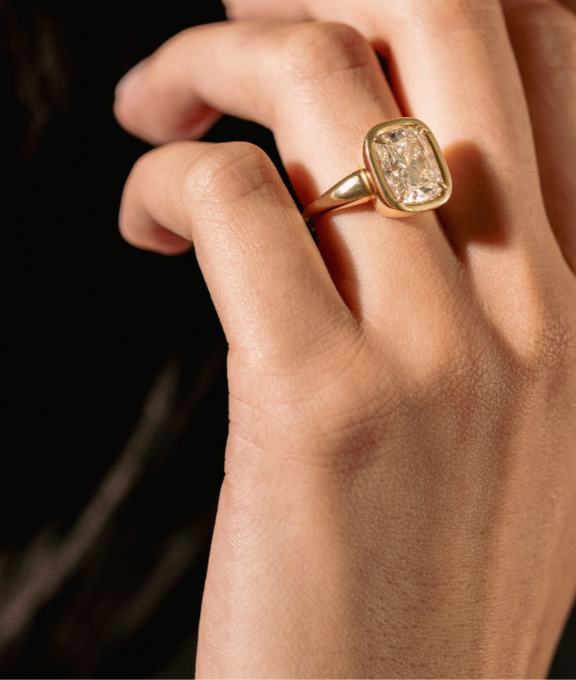
The choice between methods becomes concrete when a buyer commissions a custom ring, because that is the point where stone screening happens. GOODSTONE includes lab-grown diamonds in its custom engagement ring work, and its designers screen candidate stones with the client on video. Checking those stones for strain and tinge, and reading the report's method and treatment notes, is the same work described above, done with professional support before any deposit is committed.
One limit applies to jeweler and client equally. No jeweler can identify the growth method by looking at a finished stone, and neither can the client. The grading report carries that information. The screening process works from the report and from high-resolution video, and nobody's unaided eye substitutes for either.
A client choosing between two 2ct lab-grown stones gains nothing from picking a method in advance. What matters is how the individual stones grew, and that difference appears on video long before it appears in any grade.

Choosing a lab-grown diamond for a custom engagement ring is about finding the stone that performs beautifully, regardless of how it was grown.
How Does the Certificate Report the Method?
Grading reports disclose the growth method, and IGI and GIA both record it along with any post-growth treatments. The identification behind that line rests on several tests used together. Fluorescence under long and short wave ultraviolet contributes one part of the result. Spectroscopy and growth-pattern imaging contribute the rest. No single instrument separates a lab-grown diamond from a mined one on its own, so labs cross-reference results before issuing a report.

Growth method, post-growth treatments, and gemological testing provide important insight into the stone's origin and characteristics.
Frequently Asked Questions
Are lab-grown diamonds real diamonds?
They share the chemical composition and crystal structure of mined diamonds and reach Mohs 10 hardness. Formal confirmation came in 2018, when the FTC removed the word natural from its diamond definition.
Is a lab-grown diamond the same as moissanite or cubic zirconia?
They belong to different categories. Moissanite and cubic zirconia are simulants that only resemble diamond, with different chemistry and lower hardness, while a lab-grown diamond is carbon in the diamond crystal structure.
How long does it take to grow a lab diamond?
Growth runs roughly two to six weeks depending on size and method. A CVD batch producing 4mm crystals, enough for about 1ct polished, takes one to two weeks, and 5mm crystals for about 2ct polished take a few days more.
When was the first lab-grown diamond made?
W.G. Eversole achieved the first reproducible CVD growth in 1952, though only as polycrystalline thin films. General Electric's first reproducible HPHT diamonds followed on December 16, 1954, and those first stones were industrial material of about 0.00075ct.
Do lab-grown diamonds test as real on a diamond tester?
Both HPHT and CVD diamonds register as diamond on standard thermal testers. A minority of HPHT stones with high metallic content can mis-test as moissanite on cheap handheld testers.
Are lab-grown diamonds magnetic?
Some HPHT diamonds are faintly magnetic because of metallic flux trapped during growth, while natural and CVD diamonds are not.
What is HPHT treatment on a diamond?
It is a post-growth process that applies high pressure and high temperature to alter color permanently. Roughly 75% of CVD diamonds receive HPHT treatment after growth to remove brown coloration. Natural diamonds receive it too, to lighten brown tones. Treated stones carry a disclosure note on their grading reports.
Which method makes bigger diamonds?
CVD scales more readily to large, high-purity crystals and accounts for most large gem-quality goods. HPHT dominates production of melee under about 0.10ct and of vivid fancy colors. Both methods can produce stones above 2ct.
Are lab-grown diamonds cheaper than natural diamonds?
An Indian market filing puts comparable lab-grown stones at 30 to 50% below mined equivalents, and US retail guides cite similar or wider gaps. The gap comes from supply chain economics and production volume.
Does the certificate say if a diamond is CVD or HPHT?
IGI lists the growth method and any treatments in the report's additional information section, and GIA reports specify the method as well. A buyer checking a listing can confirm the method from the report number alone.




Deja un comentario (todos los campos son obligatorios)