





Step Cut vs. Brilliant Cut Diamonds: How the Facets Change the Look
A woman who traded her round diamond for an emerald cut kept wiping the table of her new ring, cleaning it over and over, waiting for a sparkle that never came back the way she remembered, though nothing was wrong with her stone. The facet layout underneath it was handling light in a new way. That layout determines how a ring looks on a hand, and it splits every diamond into two families that treat light in almost opposite ways.

Two diamonds can share the same shape and still interact with light completely differently.
Step Cut vs. Brilliant Cut
Every diamond you look at belongs to one of two cutting styles, and the difference starts with the shape of the small windows ground into the stone. Brilliant cuts use triangular and kite-shaped facets that radiate outward from the center of the diamond, so light hits dozens of angled surfaces at once. Step cuts use long, narrow, rectangular facets laid in parallel rows that run alongside the girdle, descending the crown and the pavilion like a staircase. The names come straight from the geometry.
The brilliant family includes the forms most people picture first, among them the round, the oval, the pear, the marquise, the cushion, and the princess. The step family is smaller, holding only the emerald, the Asscher, and the baguette. A third group borrows from both. Once you know which family a stone belongs to, most of how it behaves on the hand becomes easy to predict.

The difference between brilliant and step cuts begins with the facets.
Brilliant Cut Facet Mechanics
The Facet Layout
A standard round brilliant has 57 or 58 facets, with 33 on the crown above the girdle and 24 on the pavilion below it. The 58th is a tiny culet facet at the very bottom point, left off many counts because you cannot see it when the ring is on a hand. Those facets are cut as triangles and kites that fan out from the center of the table, each one angled to catch light and send it back toward your eye.
The modern angle math behind the round goes back to Marcel Tolkowsky in 1919, whose calculations aimed the pavilion facets so the most light returns through the top.
The Resulting Sparkle
A brilliant cut has so many small facets at so many angles that it breaks incoming light into a busy spray of white sparkle and colored flashes. Gemologists split that effect into three parts. Brilliance is the white light that returns through the top of the stone, fire is the light that gets broken into its range of colors, and scintillation is the lively flash that moves across the surface as the hand tilts.
The round returns more scintillation than anything else and looks restless and alive under almost any lighting. Ovals, pears, marquises, cushions, and princess cuts share the same faceting principle, so they sparkle in a similar busy manner even as their outlines differ.
The Step Cut Facet Layout
A step cut throws away that busy spray and does the opposite. Its facets are long and rectangular, stacked in parallel rows that taper from the girdle toward the center, so light travels across broad, open planes, encountering only a few angles. Light plays more slowly, sweeping flashes of bright and dark that the trade calls the hall of mirrors. There are fewer places for the eye to catch a sparkle, so the look is glassier and calmer. You can also see deeper into the stone.

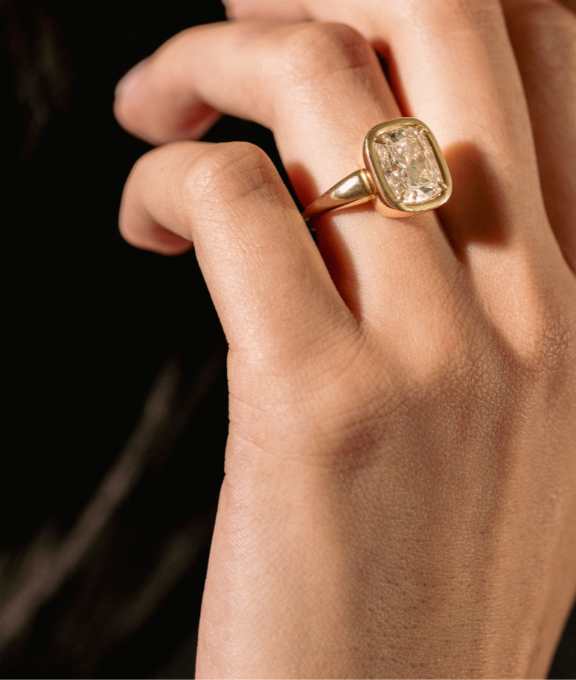
Step cuts replace fast sparkle with broad, measured flashes of light, as seen on our beautiful and architectual Three Stone Engagement Ring with Shield Side Stones and an Emerald Cut Diamond.
The Emerald Cut
The emerald is the step cut most people know, a rectangle with cropped corners and rows of facets running parallel to the girdle. A modern emerald usually has around 57 or 58 facets, though the count is not fixed the way it is for a round. Cutters add or drop step rows depending on the rough, so antique and non-standard emerald cuts can run as low as roughly 49 facets. The long, open table gives the emerald its glassy, architectural look and showcases a stone with good length and a bright, open center.

The emerald cut's elongated shape and broad step facets create clean corridors of light, allowing the beauty and transparency of the diamond itself to take center stage.
The Asscher Cut
The Asscher is the emerald’s square cousin, cut with cropped corners and a deeper pavilion that draws toward a small culet. Its concentric rows create a windmill of four dark blades that seem to spiral inward, along with a square-within-a-square pattern called the endless hallway. Look straight down into a well-cut Asscher, and you fall into that layered depth, like a view down a deep well. It rewards a very clean stone because that layered symmetry puts any flaw on display.

The Asscher cut brings step-cut geometry into a compact, symmetrical silhouette, as seen on the Split Shank Solitaire Engagement Ring with Tilted Asscher Cut Diamond.
The Baguette Cut
The baguette is the smallest of the three, a narrow rectangular step cut with straight tiers and only about 14 facets. You rarely see it as a center stone. Its job is support, flanking a larger diamond or lining a channel-set band or an eternity ring, where its clean straight lines frame the main event without competing for attention.

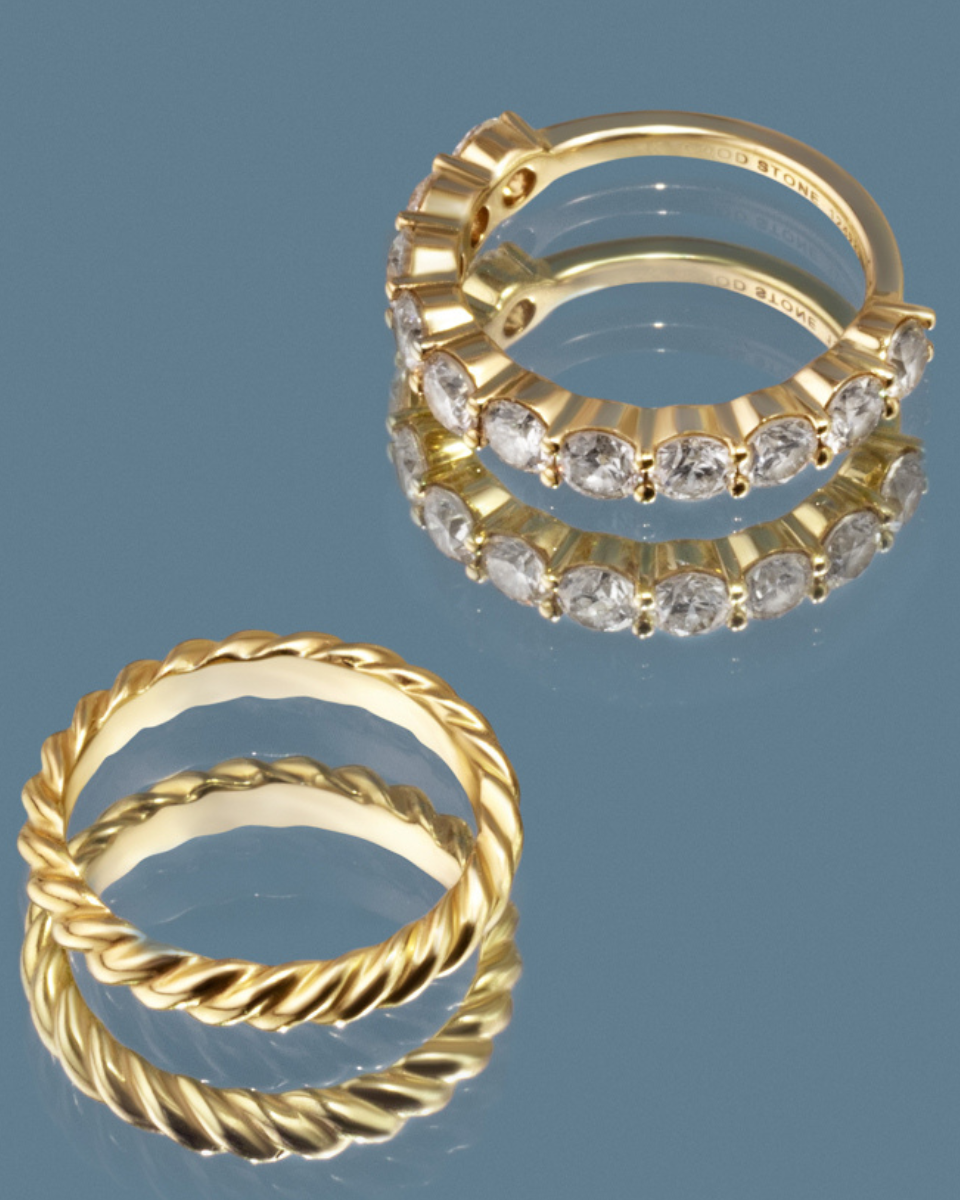
Baguette diamonds bring quiet structure rather than dramatic sparkle, like on our East West Channel Set Baguette Wedding Band.
Sparkle, Clarity, and Color Compared
Sparkle Against Broad Flash
Seen side by side, a round and an emerald behave like two different materials. The round twinkles constantly, throwing small sparks of white and color with every tiny movement. The emerald flashes less often but on a larger scale, big broad bursts of light and dark that switch on and off as the hand tilts.
Photographs and jewelry-store lighting flatter every diamond, so the honest test for a step cut is to move it side to side in ordinary room light and watch how it behaves before deciding. An emerald does not deliver a round’s constant fire, whatever a buyer might expect of it.
Handling Clarity and Color
Here the geometry has real consequences for the stone you should buy. A brilliant cut’s busy faceting works like camouflage, breaking up light so small inclusions and a faint yellow tint mostly disappear, letting you choose a lower clarity or color grade and still get an eye-clean face.
A step cut does the reverse. Those large open facets leave the inside on open view, so an inclusion or a hint of body color that would vanish inside a round shows plainly, almost like something set under glass. This is why experienced buyers steer them toward a higher clarity, often VS1 or better, along with a stronger color grade to keep an emerald or Asscher looking eye-clean.
The Price Difference
Step cuts come with a small counterintuitive twist on price. Because their long facets keep more of the original rough crystal, a step cut can cost less per carat than a comparable brilliant. The saving is not guaranteed, though, since the same cut that shows every flaw also demands cleaner, whiter rough to look right, and that better material costs more. The two effects work against each other, so a well-cut emerald does not always come out cheaper.
Mixed Cut Diamonds
Some diamonds refuse to sit in either camp. A mixed cut combines both facet styles, most often a brilliant-faceted crown over a step-cut pavilion, and the blend throws a glittering, broken sparkle known as crushed ice.
The one to know is the radiant. Henry Grossbard developed it in the 1970s to solve the exact problem the woman with the emerald ran into. It keeps the cropped-corner rectangle of an emerald outline but fills that outline with brilliant-style faceting, often around 70 facets, so it sparkles far more than a true step cut while holding the elongated silhouette many buyers want. Tilt a radiant next to an emerald of the same outline, and the difference is startling, and the radiant breaks into countless small sparkles the emerald never shows.
The old mine cut comes from the other end of history. It is an early cushion-shaped brilliant from the 1700s and 1800s, hand-cut for candlelight with a high crown, a deep pavilion, and a large open culet. It gives chunky, romantic flashes where a modern round gives pinpoint precision, and it makes a useful counterpoint to modern optimized cutting.

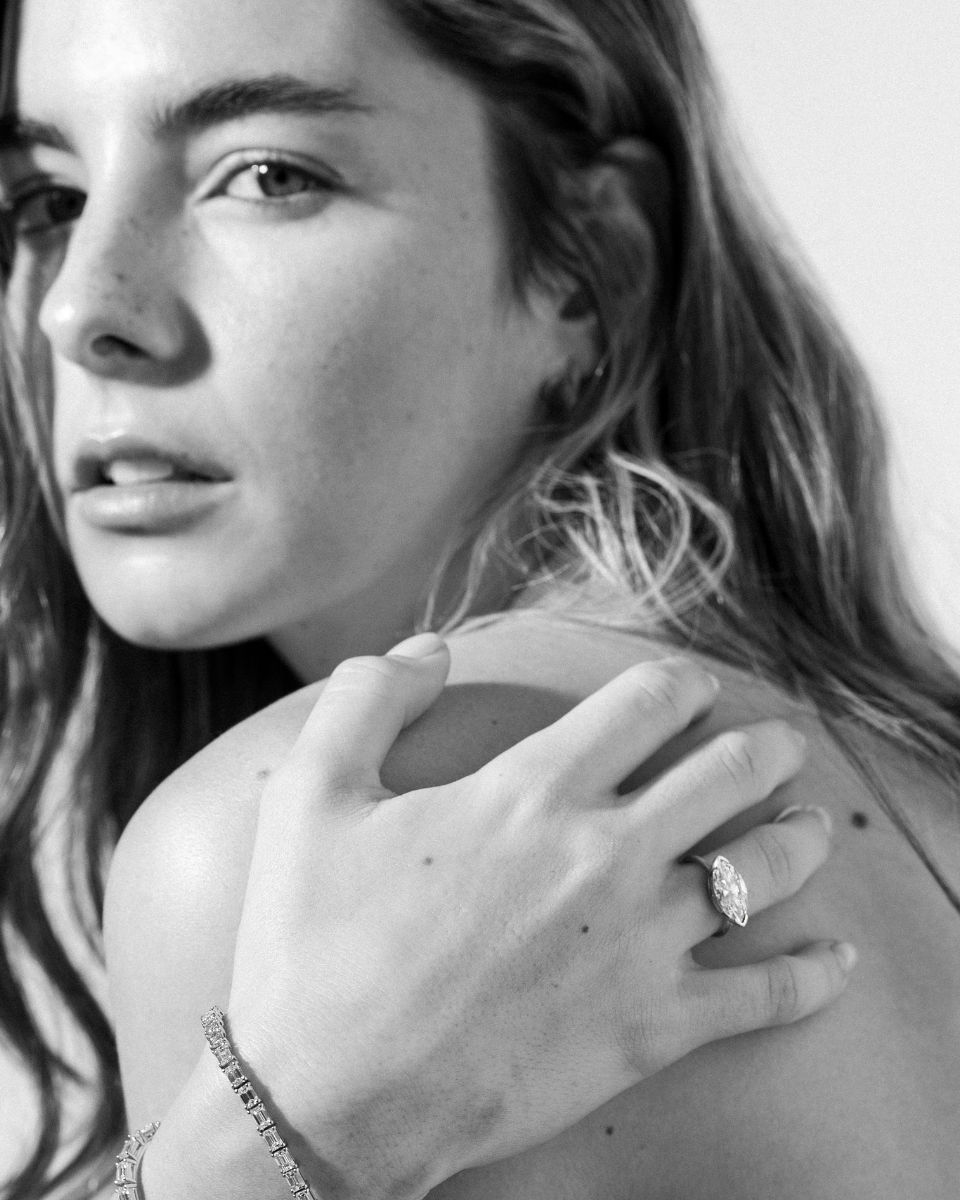
By combining brilliant and step-style faceting, shapes like the radiant offer an architectural silhouette with a livelier, more fragmented sparkle.
Choosing Between the Two Families
Neither family wins outright, and the better way to choose is to start with temperament. A brilliant cut suits someone who wants movement and constant sparkle, a stone that catches the light across a room and forgives a slightly lower grade while doing it. A step cut is the choice for someone drawn to calm, glassy lines and depth over dazzle, who does not mind buying a cleaner, whiter stone to get that look. The elongated emerald and Asscher have been climbing in demand lately for exactly that restrained, architectural mood.
GOODSTONE builds both facet families, the brilliants and the step cuts, across its custom and ready-to-ship rings. Because a step cut shows everything, seeing one in person is close to essential, while a forgiving brilliant is safer to buy sight unseen. A step cut in particular rewards that in-person look, where checking an eye-clean stone and watching its broad flashes in real light tells you what no grading report can. The choice in the end comes down to the kind of light you want on your hand every day, and to picking a stone cut to show it at its best.

Choosing between brilliant and step cuts ultimately comes down to the kind of light you love. Brilliant cuts offer movement and sparkle, while step cuts favor clarity, depth, and quiet flashes that reveal themselves as the hand moves.
Frequently Asked Questions
Which sparkles more, a step cut or a brilliant cut?
A brilliant cut sparkles more. Its many small triangular and kite-shaped facets scatter light into constant white and colored sparks as the stone moves. A step cut flashes rather than twinkles, producing fewer but wider bursts of light across its long, flat facets.
What shapes are step cut diamonds?
The three main step cuts are the emerald, the Asscher, and the baguette. All three use long facets laid in parallel rows rather than the radiating pattern of a brilliant. The baguette is small enough that it is used mainly as an accent stone.
What shapes are brilliant cut diamonds?
The brilliant family includes the round, oval, pear, marquise, cushion and princess cuts. The radiant is usually grouped with them because it uses brilliant-style faceting, though it is technically a mixed cut. What they share is the fan of triangular and kite-shaped facets that produces lively sparkle.
How many facets does a round brilliant diamond have?
A standard round brilliant has 57 or 58 facets, 33 on the crown and 24 on the pavilion. The 58th is a tiny culet facet at the bottom point, and it is usually left out of the count because you cannot see it when the ring is worn.
How many facets does an emerald cut diamond have?
A modern emerald cut usually has around 57 or 58 facets, but the number is not fixed the way it is for a round. Cutters add or remove step rows depending on the rough, so antique and non-standard emerald cuts can run as low as about 49 facets.
What is the endless hallway effect in an Asscher cut?
It is the layered depth you see looking straight down into a well-cut Asscher, where the concentric square rows form a square-within-a-square and four dark blades that seem to spiral inward like a windmill. The cropped corners and deep pavilion create that sense of falling into the stone. A very clean Asscher shows it best, since the tight symmetry keeps any flaw in plain sight.
What clarity should I choose for an emerald or Asscher cut?
Because step cuts reveal flaws that a brilliant would hide, a higher clarity, VS1 or better, is the safer choice for emerald and Asscher cuts. The large open facets show inclusions clearly, so paying for a cleaner stone helps keep the diamond looking eye-clean. A stronger color grade helps for the same reason.
Do brilliant cuts hide color better than step cuts?
Yes. The scattered light in a brilliant cut masks a faint yellow tint, so a slightly lower color grade can still face up white. A step cut’s open facets show body color plainly, so step cuts usually call for a better color grade to look their whitest.
Are step cut diamonds cheaper than brilliant cuts?
Sometimes, per carat, because step cutting preserves more of the rough crystal instead of grinding it away. That saving can disappear, though, since step cuts need cleaner, whiter rough to look right, so better rough costs more. They are not automatically cheaper.
Is a radiant cut a step cut or a brilliant cut?
A radiant is a mixed cut. It has the cropped-corner outline of an emerald but brilliant-style faceting inside, so it sparkles far more than a true step cut. Henry Grossbard developed it in the 1970s for people who wanted the emerald silhouette without giving up fire.
What are baguette diamonds used for?
Baguettes are small, narrow step cuts with about 14 facets, used mainly as accent stones. They flank a center diamond or line a channel-set or eternity band, framing the main stone rather than standing on their own. Their straight tiers give a clean, linear look alongside a larger center.



Leave a comment (all fields required)