


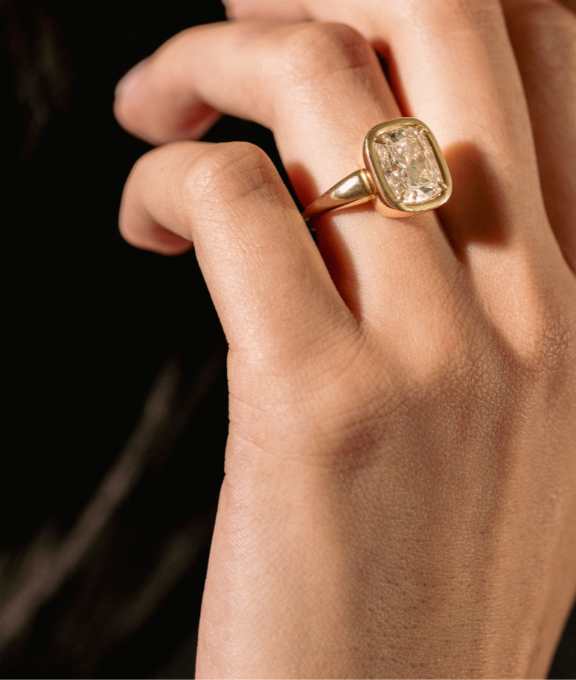




How Cut Quality Affects Sparkle
You might think all diamonds sparkle the same way, but the truth is more complex. The way light moves through a diamond depends entirely on how precisely that stone was cut.
A certificate grade tells you something about a diamond, but it won't reveal everything about how that stone performs in real life.
Around 55% of all round brilliant diamonds receive an Excellent grade from the GIA, yet industry assessments show that at least half of these diamonds wouldn't pass expert scrutiny.
This gap between grades and actual performance shapes every decision we make when selecting stones.

Cut quality, not carat, determines how a diamond actually sparkles.
The Mathematics Behind Light Performance
Cut quality relies on specific proportions that determine how light enters and exits a diamond. For round brilliant diamonds seeking maximum sparkle, depth should measure between 59% and 62.9%, according to established cutting standards. The table percentage performs best within 53% to 58% for well-proportioned round brilliant cuts. Crown angles work optimally within 33.5 to 35.5 degrees, while pavilion angles should range from 40.6 to 41 degrees, based on comprehensive cut quality research.
These measurements represent mathematical relationships that control light behavior. When proportions fall within these ranges, light entering through the crown reflects off the pavilion facets and returns to the viewer's eye. Move outside these parameters, and light escapes through the sides or bottom, creating dead zones that reduce brilliance.

Brilliance isn’t accidental. It’s engineered through exact angles and proportions.
Why Excellent Grades Vary So Much
The GIA evaluates brightness as the total internal and external reflection of white light, fire as the dispersion of light into colors, and scintillation as the pattern of light and dark areas plus sparkle during movement. These three components combine to create what you see when you look at a diamond. But here's what many people don't know: GIA does not grade light performance directly, which explains why two Excellent-graded diamonds can look completely different side by side.
AGS takes a stricter approach. For a stone to achieve AGS Ideal zero for light performance, the diamond's brightness, fire, and contrast must all rate zero, meaning the diamond stays bright from edge to center with high brightness while minimizing light leakage. This tighter evaluation method means AGS Ideal represents a narrower performance band than GIA Excellent.

Not all “Excellent” diamonds perform equally. Light performance isn’t graded the same way everywhere.
Reading Between the Certificate Lines
Very Good cut diamonds tend to leak substantial amounts of light, according to multiple independent diamond analyses. This light leakage directly affects the diamond's ability to return light to your eye. The difference might not always be obvious to someone unfamiliar with diamonds, but place a Very Good next to an Excellent cut under proper lighting, and the performance gap becomes apparent.
Price differences follow these performance variations. Excellent cut diamonds represent the top 3% of all diamonds produced, with manufacturing improvements gradually increasing this percentage. Top-tier Excellent cuts typically command about 10% higher prices than comparable Very Good cuts, a premium that reflects both the increased manufacturing difficulty and superior light performance.
The Hidden Factor of Optical Precision
Even within the same cut grade category, optical precision and facet alignment create performance variations. AGS Ideal and GIA Excellent cut grades do not account for optical precision, and if you want the best light performance, you should look for hearts and arrows super ideal cut diamonds, according to advanced cutting analysis. Any variation in facet structure increases light leakage, which demonstrates why precision cutting matters beyond meeting minimum grade requirements.
The distinction between meet-point symmetry and optical symmetry affects performance substantially. Optical precision refers to the degree of precision that facets are polished on the diamond's surface. Some Excellent-graded diamonds display uneven light return patterns when examined closely, even though their basic facet alignment meets grade requirements.

Meet-point symmetry earns the grade. Optical precision creates the sparkle.
Tools That Reveal True Performance
ASET imaging uses colored filters to show how diamonds interact with light from different angles. Red indicates the brightest areas that attract light from above, while green shows light return from indirect sources that aren't as bright, according to AGS light performance documentation. Black and white tones in an ASET image indicate light leakage, while blue represents contrast, creating a visual map of the diamond's optical efficiency.
Idealscope imaging provides complementary information through a simpler color scheme. The 10x magnifying lens lets you see light return patterns where red indicates light return, black shows contrast, and white reveals light leakage. These tools let educated buyers independently verify cut quality beyond what certificates show.

ASET and IdealScope let you verify sparkle with your own eyes, not just a report.
Real-World Examples of Proportion Impact
A GIA Excellent cut diamond's Idealscope image can reveal moderate light leakage, shown as light pink and transparent sections under the table facet, sometimes with a transparent window visible. This demonstrates that Excellent grades encompass a range of actual performance levels. Two diamonds with identical grades perform quite differently when examined through reflector scopes.
Consider specific examples: a diamond with a 36.5-degree crown angle is super steep by professional standards. Round brilliant cut diamonds rarely perform well under diffused light with crown angles steeper than 35.5 degrees. On the other end, a shallow crown angle of 33.5 degrees throws light away and creates substantial obstruction. These proportion extremes create visual problems that no amount of carat weight or color grade can overcome.

Same grade. Different sparkle. IdealScope reveals the difference.
The Depth and Table Relationship
Depth percentage should typically stay between 59% and 62.5%, as this measurement determines how deep the diamond sits relative to its width. Diamonds that are too shallow or too deep leak light, which reduces their overall brilliance. Deep diamonds hide weight in the pavilion where it doesn't contribute to face-up size. Shallow diamonds sacrifice light return for apparent size, creating a poor trade-off.
Table percentage works together with depth to control light behavior. A 57% table paired with 61% depth creates different performance than a 59% table with 63% depth, even if both combinations receive identical grades. The specific relationship between these measurements determines how light moves through the stone.
Understanding Crown and Pavilion Angles
When combined with ideal overall proportions, an ideal crown angle disperses maximum light, also referred to as a diamond's fire, making the crown angle an extremely important aspect in a diamond's proportions. Subtle pavilion angle differences create substantial impacts on the diamond's face-up appearance. Steep pavilion angles produce dark areas under the diamond's table, while shallow pavilion angles make the diamond appear foggy.
The interplay between these proportions creates either harmony or discord in light performance. A diamond with a 34.5-degree crown angle paired with a 40.8-degree pavilion angle performs differently than one with a 35.5-degree crown and 41-degree pavilion, even if both receive Excellent grades. The specific combination determines if the diamond emphasizes white light return or colorful dispersion, and if light reflects evenly or creates dead zones.

Fire, brightness, and balance come down to crown and pavilion angles working together.
Polish and Symmetry Matter More Than You Think
The difference between Excellent, Ideal, or Very Good polish can be hard to detect without magnification. The polish grade affects the diamond's luster and influences depth of field. Symmetry refers to how well the diamond's facets align and intersect with one another, which affects how uniformly light travels through the stone. Perfect meet-point symmetry ensures that light pathways remain consistent across all eight sides of the diamond.
These finish grades add measurable value to performance. Poor polish creates microscopic surface irregularities that scatter light before it enters the stone. Imperfect symmetry causes light to bounce unpredictably inside the diamond, reducing the organized return that creates brilliance.

Polish is surface. Symmetry is structure. Performance needs both.
The Science Behind Modern Grading
The GIA's cut grade system uses a predictive computer model to estimate a diamond's brilliance based on interrelated specifications. This model derives from evaluating 70,000 individual diamond observations where numerous people in various lighting conditions viewed diamonds with different cut specifications. This extensive observational foundation ensures that cut grades correlate with actual human perception rather than purely theoretical calculations.
Yet even sophisticated computer modeling has limitations. Researchers conducting exploratory testing to compare computer-modeled predictions of brightness and fire with observations by experienced trade observers found that the observers generally agreed with each other but in many cases not with predictions. This human element explains why visual inspection and reflector scope imaging remain essential supplements to laboratory grades.
Making Informed Decisions
Start with cut grade as a filter but then examine actual proportions listed on certificates. Compare table percentages, depth percentages, crown angles, and pavilion angles against the optimal ranges rather than accepting any Excellent grade as equivalent. When possible, request ASET or Idealscope images to verify light performance, looking for even distribution of red indicating strong light return and minimal white zones that would indicate leakage.
A diamond with proportions at 57% table, 61% depth, 34.5-degree crown angle, and 40.8-degree pavilion angle will outperform one graded identically but cut to 59% table, 63% depth, 36-degree crown, and 40-degree pavilion. The difference might not appear on the grade but becomes obvious when comparing the stones side by side or examining their reflector scope images.

Cut grade is the starting point. Proportions tell the real story.
The GOODSTONE Difference
At GOODSTONE, we prioritize these performance characteristics because cut quality determines a diamond's personality more than any other factor. Two diamonds with identical carat weight, color, and clarity grades will look dramatically different if one exhibits superior cut precision while the other meets only minimum requirements for its grade.
The better-cut stone appears larger due to optimal light return, shows better color dispersion creating more fire, and maintains brilliance across varying lighting conditions. These real-world performance advantages justify the careful attention to proportion specifications and light performance verification that separates exceptional diamonds from merely adequate ones. We believe you deserve a diamond that performs beautifully in every light, from candlelit dinners to bright outdoor celebrations. That's why we look beyond the certificate to find stones that truly sparkle.




Leave a comment (all fields required)