





How to Pick a Diamond Color Grade Without Overpaying
Most shoppers end up paying more for diamond color than necessary. Color grades can make higher letters seem more important than they really are, and the prestige attached to D often pushes buyers toward it.
Once a diamond is set in a ring and worn, the visual difference between a D and a G is minimal for most people. The price difference, however, can be substantial.
Looking closely at how color grading works, how it interacts with a stone’s shape (such as a round or radiant cut) and setting, and where real value sits in the market can help buyers spend more wisely while still choosing a diamond that looks exceptional.
How the GIA Color Scale Works
The GIA grades diamond color on a scale from D to Z. D is at the top, representing a completely colorless stone, and Z is at the bottom, with visible yellow, brown, or gray tones. Between those endpoints, 23 total grades are grouped into five subcategories:
- Colorless (D through F)
- Near colorless (G through J)
- Faint (K through M)
- Very light (N through R)
- Light (S through Z)
The grading itself is precise. A trained observer compares the diamond against a set of master stones under a standard light source in a controlled viewing environment. The observer’s color vision has been tested and verified as normal. Equipment maintenance, viewing geometry, and methodology all follow strict consistency requirements. This rigor makes a GIA grading report an industry benchmark for evaluating diamonds.
Within the D through J range, color distinctions are so subtle that they are often invisible to an untrained eye. The differences are measurable in a lab, but tend to disappear once the diamond is set.

Understanding how color grading actually works, and how it interacts with shape, setting, and metal, makes it possible to choose a beautiful diamond without paying for a distinction you'll never see.
The G Through J Sweet Spot
Near-colorless diamonds, graded G through J, accounted for 56.59% of the market in 2022 and are projected to maintain this position through 2030, according to industry reports. A strong balance of appearance and value drives this prevalence.
A G or H color diamond, when viewed on its own rather than side by side with a D color stone, will appear colorless to almost everyone. An estimated 95% of people cannot tell the difference between a G and a D once the diamond is mounted in a ring. And the price gap is considerable.
A 1-carat natural diamond in G or H color, with VS2 clarity and Excellent cut, generally ranges from $4,000 to $6,000. The same specifications in D color can cost $6,500 to $9,500. This represents a 20% to 50% price increase for a distinction that is rarely visible once the diamond is worn.
For those considering lab-grown options, a 1-carat lab-grown diamond with G color, VS2 clarity, and excellent cut ranges from $700 to $1,500, based on 2025 to 2026 market averages.
GOODSTONE offers both natural and lab-grown diamonds, providing flexibility based on budget and preferences. After the first mention, we/our/us will refer to the brand.

Within the D through J range, the distinctions between grades are measurable in a lab but tend to disappear entirely once the diamond is set in a ring.
Shape Changes Everything
The shape of a diamond affects how much body color shows through, and many buyers overlook this.
Round Brilliant
With 58 facets designed to maximize light return, the round brilliant is the most forgiving shape for hiding body color. Those small, angled facets scatter light in a way that makes underlying warmth very hard to spot.
Round brilliant diamonds are particularly effective at masking color due to their facet pattern. G or H color is typically suitable in a round brilliant without noticeable compromise.

The round brilliant's 58 facets are specifically designed to maximize light return, and that same light scattering makes it the most forgiving shape for concealing body color.
Step Cuts
Emerald and Asscher cuts work differently. Their large, open table facets act like windows into the stone, and any warmth or tint becomes more visible. If you prefer a step cut and want a white-looking diamond, you will generally need to go up at least 1 or 2 color grades compared to what you would choose in a round brilliant.

Emerald and asscher cuts have large, open table facets that act like windows into the stone, making any warmth or tint noticeably more visible than it would be in a brilliant cut.
Fancy Shapes
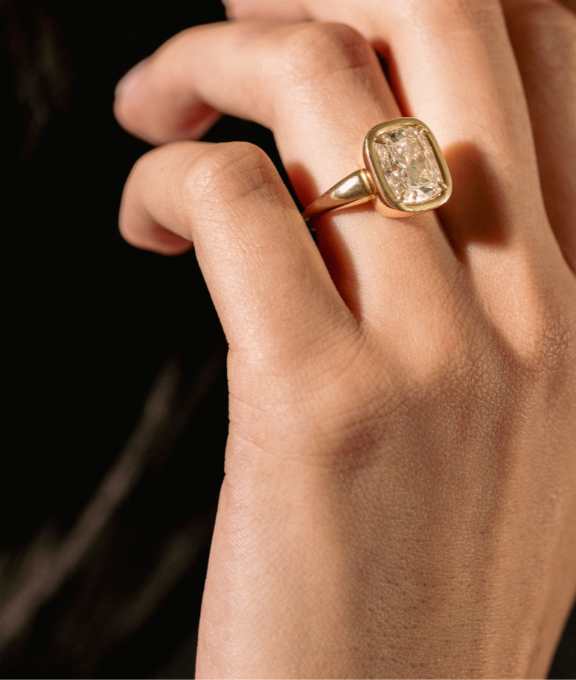
Pear and marquise shapes can concentrate color at their pointed ends, so careful grade selection matters there. Radiant cuts, with their 70 brilliant-cut facets, do an excellent job at concealing both color and inclusions. Cushion and princess cuts fall in a similar category, as their faceting patterns tend to mask color well.
Let the Metal Do Some Work
The metal you choose for your setting creates a real optical effect on how the diamond’s color reads.
Platinum and white gold complement diamonds in the D through H range because the cool silver tone of the metal reinforces the diamond’s whiteness. For diamonds graded I through K, yellow gold is a smart pairing.
The warmth of the gold blends with whatever slight tint the diamond carries, and the stone can appear to draw its color from the setting rather than from within. Rose gold works similarly for stones in the I through K range, adding a warm blush that makes any residual warmth look intentional.
This is one of the simplest ways to save money. A K color diamond in a yellow gold setting can look nearly as white as an H color diamond in platinum, and the price difference between those two grades is meaningful.
Carat Weight and Color Visibility
Larger diamonds show their color more prominently than smaller ones. A 2-carat J color diamond will appear warmer than a half-carat diamond at the same grade simply because there is more surface area for the eye to pick up on.
Here is a reasonable guideline. For diamonds under 1 carat, I or J color (even K) can work well. At 2 carats, aim for G at minimum. At 3 carats, F becomes the safer choice. Adjusting your color expectations to your target carat weight helps you avoid overspending on smaller sizes or underspending on larger ones.

Larger diamonds show body color more prominently because there's simply more surface area for the eye to detect.
Using Fluorescence to Your Advantage
About 25% to 35% of diamonds submitted to the GIA over the past decade show some degree of fluorescence, and in over 95% of those cases, the fluorescence is blue. Since blue sits opposite yellow on the color wheel, blue fluorescence can actually make yellowish diamonds appear whiter.
GIA research found that lower-color diamonds with medium to very strong blue fluorescence may look up to one color grade better because the blue neutralizes the yellow.
The trade sometimes discounts diamonds in the D through H range with blue fluorescence by 10% to 15% because of a belief that fluorescence causes a hazy or oily look. But according to GIA’s own fluorescence study, fewer than 0.2% of fluorescent diamonds submitted to them actually show that effect.
The average person in that study could not tell a fluorescent diamond from a non-fluorescent one. So, for near-colorless or faintly colored stones, fluorescence can be a genuine bargain.

Blue fluorescence can actually make yellowish stones appear up to one color grade whiter by neutralizing warm tones.
Cut Quality Matters More Than Color
Cut should be prioritized above all else. A well-cut diamond maximizes light return and sparkle, which downplays any body color in the stone. We exclusively offer diamonds of Excellent cut grade, and our gemologists evaluate each stone to that standard.
A higher cut grade requires more skill and precision during the crafting process. It has the added benefit of making a diamond appear larger than its actual carat weight while minimizing the appearance of inclusions.
Our diamond color guide indicates that color differences within a single grade can alter a diamond’s value by 10% or more. Pairing a strong cut with a smart color choice compounds your savings.

A well-cut diamond maximizes light return in a way that actively downplays body color, making cut the single most impactful place to put your budget.
The Formula That Saves You Money
A G or H color diamond with an Excellent cut, set in a complementary metal, provides a result that is nearly indistinguishable from a D or E color stone except under laboratory conditions. The near-colorless range remains popular for its balance of appearance and value.
Pick a color grade that matches your carat weight and shape, pair it with the right metal, and put your remaining budget toward cut quality. That is how you get a beautiful diamond without paying for a grade you cannot see.



Leave a comment (all fields required)