





How to Get a Big Look From a Modest Emerald Cut
Carat weight is a measure of weight, and with an emerald cut it says surprisingly little about how large the stone looks on the finger. Two stones can both weigh a full carat and still cover different amounts of skin, because depth decides how much weight rests near the top where the eye sees it. A modest emerald cut can wear like something heavier once its proportions and setting are chosen for face-up size.

With an emerald cut, thoughtful proportions and the right setting can give a modest stone significantly more presence on the hand.
Carat Weight vs. Face-Up Size
An emerald cut is a step cut, made with fewer, wider facets and less depth than a round brilliant. Less depth keeps more weight near the table, the flat surface on top, and a larger share of the stone shows face-up while less hides in the pavilion below the girdle.
At equal carat, an emerald cut averages about 5% more face-up area than a round, and its long outline covers more of the finger. A 1-carat stone at a classic ratio measures near 6.5mm by 4.5mm. That long face is where the emerald cut earns its signature look, with long parallel flashes down the open table, and a wide, still sheet of light.
Two emeralds of the same weight can still land at different sizes. A shallower 1-carat stone at 6.88mm by 4.80mm and a deeper one at 6.55mm by 4.74mm differ by roughly 6% in face-up area, and one covers more skin for the same carat and often the same price. That 6% is why the face-up measurement, not the carat, is the number to buy on.
One honest limit belongs here. A poorly cut, deep emerald can face up smaller than a well-cut round, so the size advantage depends on proportion and never arrives on its own.

With an emerald cut, face-up measurements reveal how much diamond you actually see and can make two stones of identical weight look surprisingly different.
How to Make an Emerald Cut Look Bigger
Three of the seven laws belong to the stone itself, settled before it is set.
A Longer Length-to-Width Ratio
Divide length in millimeters by width, and you get the ratio. A higher number means a longer rectangle, a lower one a squarer stone. The classic emerald range runs from 1.30 to 1.60, and most shoppers sit around 1.35. A slightly longer 1.40 to 1.50 takes the outline past that average, making the stone sit noticeably longer on the hand for the same weight.
Past about 1.55, the rectangle becomes dramatic but narrow, which can look thin inside a wide band. On shorter fingers, a ratio of 1.45 or higher adds a lengthening line without extra width.

A slightly more elongated emerald cut stretches beautifully along the finger, creating the impression of greater size without adding carat weight.
Face-Up Millimeters Over Carat Weight
The practical rule follows from the ratio. Compare stones by the millimeters you can see. Ask for the length and width in millimeters and the table percentage, then set two candidates side by side. A well-proportioned 0.90-carat emerald can out-measure a deep 1.05-carat one, so a lighter stone with better proportion can look like the larger purchase. Millimeters describe the surface a person sees, while carat only tracks hidden mass. Two stones can both weigh 1.00 carat and still differ a full millimeter in length.

A well-proportioned lighter diamond can cover more of the finger than a heavier stone carrying too much of its weight below the surface.
How to Read Depth Percentage
Depth is the height of the stone as a percentage of its width, and it sets how far the face-up size can go. A lower depth widens the face-up outline, and within reason, a shallower emerald covers more finger. The working range runs from about 61% to 68%.
Above roughly 70%, the stone hides weight and looks smaller than its carat suggests. Below about 59%, light passes straight through the open table, and the center goes watery and see-through, a flaw called windowing. Aim for shallow-ish and stop there, since the same open facets that widen the stone also expose a badly cut one.

Depth determines how much of an emerald cut's weight is visible from above.
Setting Choices for Face-Up Size
Once the stone is chosen, the setting decides how much of its face-up size the eye registers, and the next three laws do most of that work.
A Slim Band and Slender Prongs
A narrow, knife-edge shank leaves nothing beside the stone to compete with, so the center looks larger by contrast. Set the same stone on a wide band, and it visibly shrinks as the metal rivals it for attention.
Prongs follow the same logic. Slender claws cover less of the stone’s edge and leave more diamond in view, while a full bezel, the most secure mount, wraps the girdle in metal that can make the outline look slightly smaller. The choice between them trades a little visible size for security.

A delicate band creates contrast around the center stone, making its outline feel larger and more prominent.
A Thin Halo Around the Center
A halo rings the center stone with small diamonds, widening the outline the eye sees and adding sparkle that a step cut does not make on its own. The emerald’s flash is broad and steady, and a ring of brilliant-cut stones supplies the movement the flat facets skip. Kept thin, the halo enlarges the apparent size without making the ring busy, and, on the other hand, the center can look a size up.
GOODSTONE’s emerald cut collection pairs halo settings with east-west and thin-band mounts, and its custom work lets a buyer scale the halo to the center stone so the added ring enlarges without clutter.

A finely proportioned halo expands the diamond's visual footprint while adding a layer of brilliant sparkle around the emerald cut's broad flashes.
Setting the Stone East-West
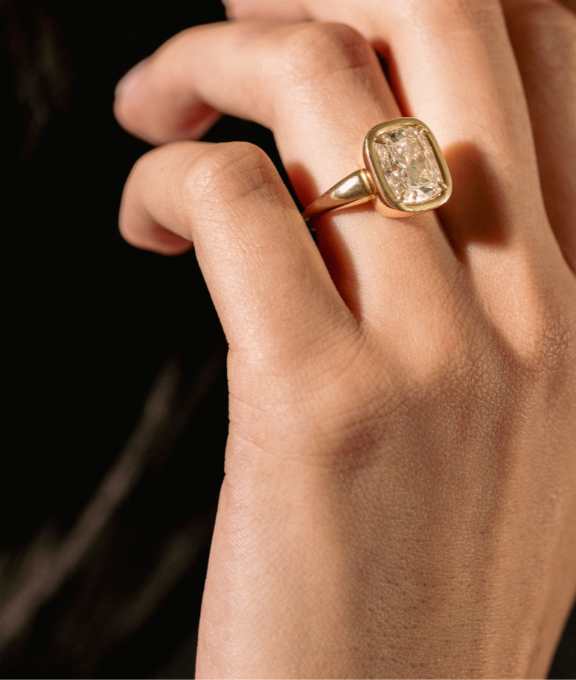
A traditional emerald sits vertically, its long axis running up and down the finger. Turned east-west, that long axis lies across the finger, so the stone spans more knuckle-to-knuckle width and shows a wide band of light where a vertical set would look narrow.
The orientation has grown more popular on engagement rings in recent years. It pairs naturally with a slim band. The horizontal stone already draws the eye outward and needs no heavy metal framing.

Turning an emerald cut east-west changes how the eye reads its proportions.
Stone Quality Over Raw Weight
The last law runs counter to the instinct to chase carats. A step cut’s open facets behave like windows, so any tint or inclusion near the center shows plainly, and a smaller stone that stays eye-clean often looks better on the hand than a larger one with a visible flaw or a warm cast.
Color and Clarity for a Step Cut
Because the flat table hides nothing, color and clarity matter more here than on a brilliant. G color or better keeps the body looking white, with F to G a safe pick in white metal where any warmth would show against the setting.
For clarity, VS2 or better usually looks eye-clean, and VS1 is the safer call on larger stones, where a VS2 inclusion can surface near the open center. Spending the budget on a clean, well-proportioned stone is what lets a modest emerald look expensive.

Emerald cuts put the diamond itself on display, just like the emerald in our Three Stone Engagement Ring With Pear Side Stones and Emerald Cut Diamond.
The Missing Cut Grade
One quirk of the emerald cut shapes how a buyer should shop. GIA assigns an overall cut grade only to round brilliants, so an emerald cut has no independent cut score, and any grade a seller lists is the seller’s own.
That leaves ratio, depth, table, symmetry, and polish as the numbers a buyer checks by hand to judge if a stone will wear large and stay lively. The upside is that those figures, read carefully, separate a modest emerald that wears big from one that disappears.

Without a universal cut grade for emerald cuts, the numbers behind the stone deserve a closer look.
Frequently Asked Questions
Do emerald cut diamonds look bigger than round?
At the same carat weight, an emerald cut usually looks larger face-up, because its shallow step cut fans its weight across a wider table and its long outline covers more finger. The average gain is around 5% more surface area than a round of equal weight. An ideally cut round can occasionally face up larger, so proportion still matters.
What size does a 1 carat emerald cut look like in mm?
A 1-carat emerald cut measures roughly 6.5mm by 4.5mm at a classic ratio and closer to 6.5mm by 5.5mm when squarer. A specific graded example measures 6.68mm by 4.95mm. The exact footprint changes with depth, and two 1-carat stones can measure differently.
What is the best length-to-width ratio for an emerald cut?
The classic range is 1.30 to 1.60. Many buyers prefer 1.40 to 1.50, where 1.40 gives a balanced rectangle and 1.50 a longer, larger-looking silhouette. Ratios past 1.55 look dramatic but can appear narrow.
Does a shallower emerald cut look bigger?
Yes, up to a point. A lower depth percentage widens the face-up outline, and a shallower stone covers more finger for the same weight. Below about 59%, the stone windows and the center look see-through, so aim for roughly 61% to 68%.
What is a good table percentage for an emerald cut?
Around 61% to 69%, with 64% to 65% typical on well-performing stones. A larger, well-proportioned table increases the visible face-up size. Very large tables paired with too little depth can start to window.
Should I prioritize carat or cut for an emerald cut?
Prioritize face-up size and a clean cut over raw carat. Two 1-carat emeralds can differ about 6% in face-up area so that a well-cut lighter stone can out-measure a deep heavier one. Compare the millimeter footprint and table, not the carat number alone.
What clarity do you need for an emerald cut?
VS2 or better usually looks eye-clean on a modest emerald, and VS1 is the safer call once you size up, because the open center magnifies any inclusion in the stone. A clean, smaller stone almost always looks more expensive on the hand than a flawed, larger one.
What color grade is best for an emerald cut diamond?
For a stone meant to look bigger than its weight, hold color at G or better so no warm cast undercuts the impression of size. F to G is the safe pick in white metal. The open step facets hide little, and a grade that would pass in a brilliant can look tinted here. Warm metal buys back a grade or two.
Does a halo make an emerald cut look bigger?
Yes. A halo of small diamonds enlarges the outline and adds sparkle the step cut does not produce on its own. Kept thin, it can make the center stone look a size up without crowding the design.
Does an east-west setting make an emerald cut look bigger?
Setting the emerald horizontally across the finger maximizes finger coverage, and it looks wider and larger than its carat weight suggests. The orientation has grown more popular and pairs well with a slim band. It suits people who want a modern look.
What is windowing in an emerald cut?
Windowing happens when a stone is cut too shallow, and light passes straight through the open table without returning to the eye. The center then looks transparent or glassy where it should look bright. Keeping depth above about 59% avoids it.
Is an emerald cut good for small fingers?
Yes. A ratio around 1.45 or higher keeps the stone proportional on smaller hands and lengthens shorter fingers without adding width. A slim band and slender prongs help the stone look larger on a petite hand.



Leave a comment (all fields required)