





What Nobody Explains About the Diamond Bow Tie Effect
Most people who shop for an oval, pear, or marquise diamond will come across the term “bow tie” at some point during their search. They’ll see it mentioned in forums, hear it from a jeweler, maybe notice it referenced in a YouTube review. And yet, almost nobody explains what it actually means in a way that helps you make a better buying decision.
The bow tie is treated like a flaw you should avoid at all costs or, depending on who you ask, a characteristic you should learn to appreciate. Neither framing gives you the full picture.
The truth sits somewhere quieter, in the details of how light moves through an elongated stone, how cutters make tradeoffs during production, and how grading labs handle something they can’t easily put a number on. This is what the conversation usually leaves out.

The bow tie effect gets mentioned constantly in diamond buying guides and forums, but rarely in a way that actually helps you make a better decision.
What the Bow Tie Actually Looks Like
When you look down at an elongated diamond, you may see a darkened band running across its width, roughly centered. It can look like a faint shadow or a thick, solid bar. Sometimes it breaks into segments rather than forming a continuous line.
GIA’s Fall 2024 study, published in Gems & Gemology (Volume 60, No. 3), described it as an area of dark contrast seen through the table across the width of the stone. The study, authored by Ilene M. Reinitz, Al Gilbertson, Troy Blodgett, and others, confirmed that the elongation found in oval, pear, and marquise diamonds tends to produce a bow tie across a wide range of proportions and faceting styles.
Some bow ties stay visible no matter how the diamond moves, while others brighten and soften with motion.
The cause is simple. A diamond’s facets work like small mirrors, bouncing surrounding light back toward your eye. When your head and shoulders block some of that incoming light, a shadow appears in the stone. The closer your face gets to the diamond, the more visible that shadow becomes.

The bow tie appears as a darkened band running across the width of an elongated diamond, sometimes a faint shadow, sometimes a solid bar, sometimes broken into segments.
Why Grading Reports Don’t Mention It
GIA assigns cut grades to round brilliant diamonds because the round shape allows for standard assessment. Fancy shapes like ovals are far more complex. According to that same GIA research, describing a single symmetrical faceting arrangement for an oval requires 18 parameters, which is three times the number needed for a round brilliant.
When you factor in painting variations, that number can climb to 28 parameters. The math alone makes consistent grading extremely difficult.
Because of this, GIA does not assign a cut grade to any fancy shape diamond. And the bow tie effect is never formally evaluated or mentioned on a GIA grading report. No fancy-cut diamond receives a cut grade from the GIA, period. That means you could buy two oval diamonds with identical grades on paper, and one could have a heavy, persistent bow tie while the other barely shows it.
The International Gemological Institute has taken a different approach. As reported by National Jeweler, IGI now includes cut grades on reports for nine loose fancy shapes, including oval, pear, and marquise. Their grading process includes a step specifically designed to assess features such as bow ties, girdle ranges, and windowing. A pronounced bow tie can lower the grade to Very Good or below in IGI’s system.

GIA doesn't assign cut grades to fancy shapes because their complexity makes consistent standardized grading impractical.
The Cutting Economics Nobody Talks About
Here’s the part most articles skip entirely. Bow ties are often the result of a cutter prioritizing weight over visual performance. Rough diamond material is expensive, and the price a cutter receives depends heavily on the final carat weight. Sacrificing weight to reduce or eliminate a bow tie means less money. So it rarely happens.
If you wanted to fix a bow tie by repolishing, the cost for a 1-carat diamond would range from $200 to $300. And you should expect to lose around 5% to 10% of the stone’s weight in the process. For a diamond in which every fraction of a carat affects the price, that loss adds up fast.
Advanced laser cutting systems have improved angular precision, and computer modeling can now predict bow-tie severity before a cutter starts work. But the crystal structure of each rough stone introduces variables that no software fully accounts for. Complete elimination of the bow tie remains impractical in elongated figures without sacrificing other factors, such as carat weight, outline appeal, or overall brightness.

Bow ties are often the result of cutters prioritizing carat weight over visual performance, sacrificing weight to reduce a bow tie means less money, so it rarely happens.
How Much Bow Tie Is Too Much?
This is where personal preference matters more than any guideline. GIA’s 2024 study found that trade observers showed a wide range of opinions about bow ties. People consistently disliked heavy windowing, but reactions to bow-tie patterns varied widely by regional choices and personal taste. The effect is not universally seen as negative.
GIA itself has acknowledged that a well-cut oval will minimize the bow tie and disperse light more evenly, but some degree of it is always present. When the effect is subtle and balanced, it can add a sense of dimension to the stone rather than detracting from it.
For proportions, industry guidance suggests a depth range of 58% to 63% tends to balance light return well in ovals. Diamonds cut too shallow let light escape and increase shadowing, while stones cut too deep can trap light and produce darker zones.

GIA's 2024 study found that reactions to bow ties varied widely by personal taste and regional preference, it's not universally seen as a flaw, and a subtle, balanced bow tie can actually add dimension to the stone.
Settings That Help Manage Visibility
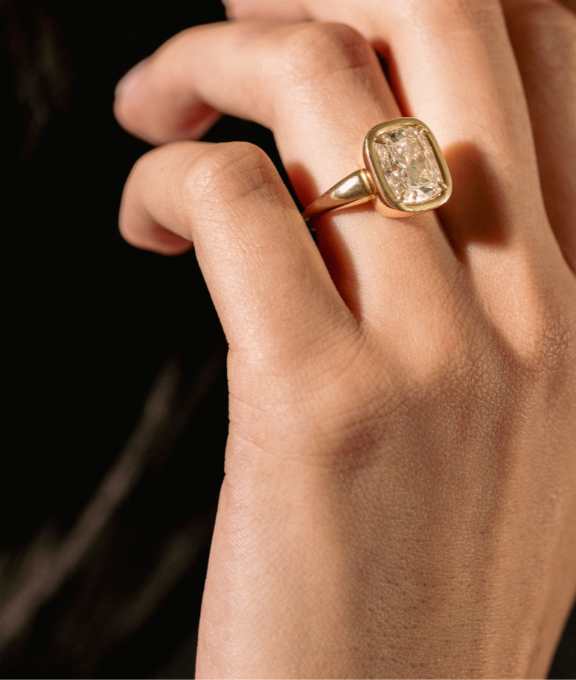
Certain ring designs diminish the visibility of a bow tie in everyday wear. Halo settings, which feature smaller diamonds surrounding the center stone, add brightness around the edges and soften darker areas. Bezel settings use metal to frame the stone, diffusing light entering the stone. Neither option eliminates the bow tie, but both can make it less prominent to the average eye.
Seeing It for Yourself
The most practical advice for anyone buying an elongated diamond is also the simplest: look at the stone in person under different lighting conditions. Showroom lighting is designed to make diamonds look their best. Soft or diffused store lighting can hide a bow tie that becomes obvious once you step outside or bring the ring home.
Requesting a 360-degree video helps when shopping remotely, but it still doesn’t fully replace seeing the stone under natural daylight. Since no grading report tells you how visible the bow tie is, your own eyes are the most reliable tool you have.

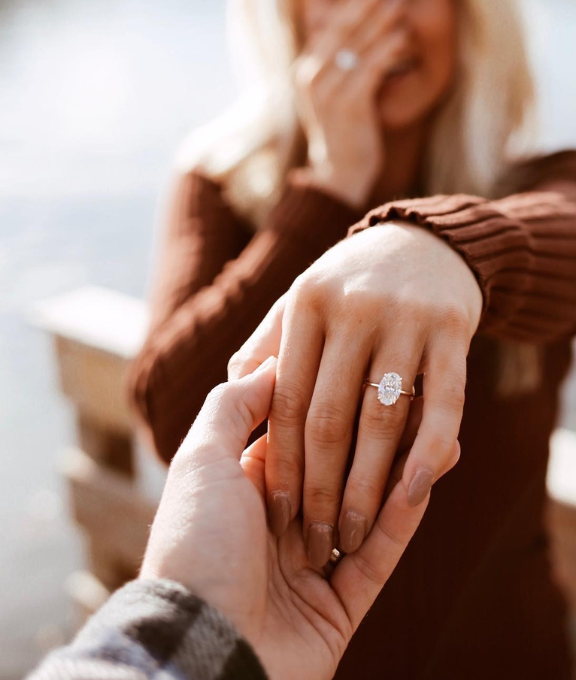
Showroom lighting is designed to flatter diamonds, and a bow tie that's invisible under soft store light can become obvious in natural daylight, making in-person viewing under varied conditions the most reliable evaluation tool available. Our Half Bezel Solitaire Engagement Ring With Oval Cut Diamond looks even better in person.
Working With Someone Who Knows What to Look For
Buying a fancy-shaped diamond based solely on a grading report leaves too much to chance. The numbers on the certificate won’t tell you how the stone actually looks on a hand, in a room, under sunlight. This is where a knowledgeable gemologist makes a real difference.
GOODSTONE’s team provides a personal concierge service that guides buyers through these kinds of decisions. Our gemologists offer diamonds certified by GIA, IGI, HRD, and GCAL, and generational artisans in Los Angeles handcraft every ring. For elongated figures specifically, this guided, hands-on approach fills the gap left by grading reports.
What to Know About the Bow Tie Effect Before You Buy
The bow tie effect is a normal optical occurrence in elongated diamonds. It is not a defect in the traditional sense, and it is not something you can grade on a simple scale. It ranges from barely visible to heavily distracting, and your response to it will be personal.
The best thing you can do is understand what causes it, know that no report will flag it for you, and make sure you see the actual diamond before you commit. That one step, looking at the stone yourself in varied lighting, will tell you more than any certificate ever could.



Leave a comment (all fields required)