





How to Choose a Ring for Someone Who’s Never Worn One
When your partner has never worn a ring, you are choosing without the usual evidence. There is no jewelry box to study and no metal they reach for by habit. You don't know whether they'd prefer a simple solitaire or beautiful three stone ring. The approach that works is to read their taste from what they already live with and to weigh comfort over impressiveness, because a ring that suits their hands ends up on their finger daily, while one chosen to impress can stay in a drawer.

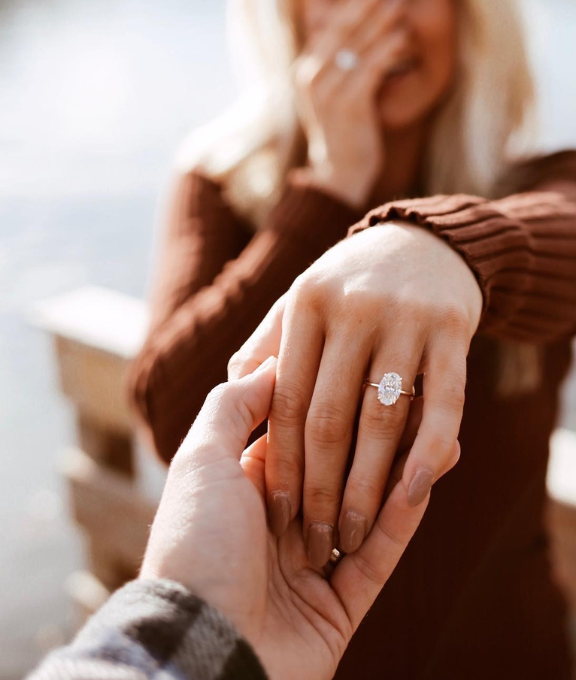
Choosing a ring for someone who has never worn one starts with looking beyond their jewelry box.
How to Read Their Taste in Jewelry
The first question to settle is how much you can observe. Someone who owns no jewelry still surrounds themselves with objects that hold a preference, and those objects are where their taste shows even when their hands are bare. You are looking for a pattern, not a single clue, so gather a few tells before you decide anything.

Watches, glasses, accessories, and the objects a person may choose every day can quietly point toward a ring that feels unmistakably theirs.
How to Read Metal Preference from Everyday Objects
Start with the metal they already live with. The case of their watch, the frames of their glasses, the hardware on a bag or belt, and the fixtures they chose for their kitchen all point one direction or another.
Warm metals like brass and gold suggest yellow or rose gold will suit them. Cool metals like chrome, steel, and silver point toward white gold or platinum. An offhand remark about a friend’s ring often reveals a leaning, and a sibling or close friend can confirm one you have only half-noticed.

Metal preference often shows up long before someone chooses a ring.
How to Match Metal to Skin Undertone
When the object cues are mixed, skin undertone gives you a second read. Look at the veins on the inside of the wrist in natural light. Blue or purple veins indicate cool undertones, which pair well with white gold and platinum. Green veins indicate warm undertones, which pair well with yellow and rose gold. A mix points to neutral undertones and suits any metal. Rose gold flatters the widest range of skin tones, so it is a safe direction when you cannot settle the question any other way.

Warm and cool metals interact differently with the skin, helping narrow the choice to a finish that feels naturally flattering.
How to Match the Setting to Their Hands
For a first-time wearer, the height of the setting matters more than the size of the stone. A ring they can forget about while they work becomes part of the day, and one that catches on things comes off and stays off. How they use their hands through an ordinary day should decide this before any question of sparkle.

For a first-time ring wearer, comfort matters just as much as appearance.
Low-Profile and Bezel Settings for Active Hands
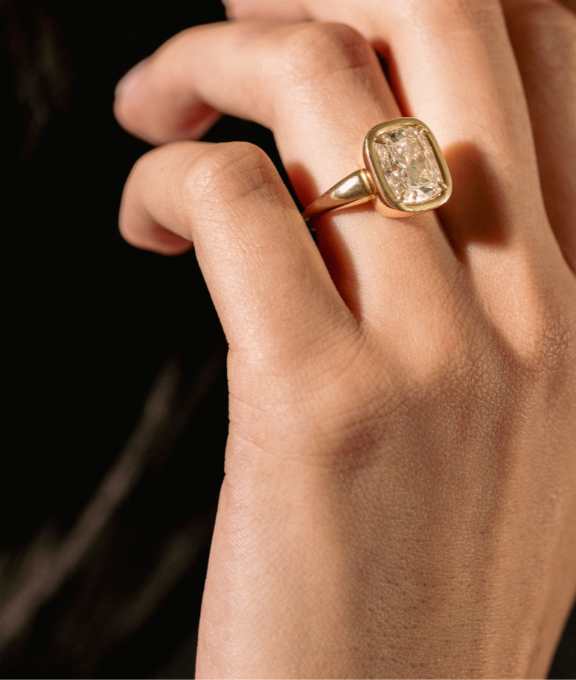
A bezel setting wraps the stone in a smooth rim of metal, so there are no raised prongs to snag on fabric, hair, or a bike glove. The stone rests low and close to the finger, which keeps it stable through a workday, a workout, or an evening of lifting a toddler. Jewelers point people who work with their hands toward these low settings for good reason. Nurses, tradespeople, cooks, and anyone in and out of gloves find that a flush stone survives the day where a tall one gets knocked and bent.

A low-profile bezel set design keeps the stone close to the finger and eliminates raised prongs that can catch throughout the day, like our Finest Bezel Set Engagement Ring With Elongated Cushion Cut Diamond.
The Case for a Statement Setting
A higher setting is not off the table. If the cues you gathered lean bold, with strong frames and saturated color and visible hardware, and their days are not especially hands-on, a raised stone with open sparkle can be right for them. The setting should follow how they live, so read the person in front of you before defaulting to the safest option.

If your partner's personal style is bold and their lifestyle allows it, a more prominent setting can feel just as natural as a pared-back one.
Comfort and Fit for a First-Time Ring Wearer
Fit is when a new wearer decides, in the first week, if they will love the ring or only tolerate it. Most of that verdict comes down to the band’s interior and how you handle the size.
Comfort Fit vs. Standard Fit
A comfort-fit band has a gently rounded interior, so less of the metal touches the skin and the ring slides over the knuckle with less effort. A standard-fit band is flat inside and lies flush against the finger, whereas a comfort-fit band of the same marked size is tighter. For someone new to rings, with larger knuckles, or with fingers that swell during the day, a comfort fit is an easier introduction.

A comfort-fit band softens the inside of the ring with a gently rounded profile, helping it move more easily over the knuckle.
How to Get the Size Right
Finger size is not a fixed number. Fingers swell in the heat and after exercise, and shrink in the cold. The same band can go loose in the morning and snug by evening. Measure at the end of the day, when the finger is at its largest and at a normal temperature, and size up if the reading lands between two sizes.
Getting the size secretly is harder when there is no ring to borrow, so a practical approach is to size a friend’s finger that looks similar and plan on a resize once the ring is on. A jeweler’s finger size guide makes this less of a guess, and resizing afterward is routine.

Ring size changes more than most people realize.
The First Weeks of Wear
Almost everyone new to a ring is aware of it for a while before they stop noticing it. The band can seem heavy or thick enough that the fingers do not quite meet, and the skin underneath can turn dry or red as it gets used to constant contact. People often read that ache as a sizing mistake and rush back to resize, when the likelier cause is a finger still adjusting to something being there.
The comparison people reach for is a new pair of glasses on the bridge of the nose, present and distracting for a few days, then gone from notice. Most report the strangeness fading somewhere between 2 weeks and 2 months of steady wear.
A real metal allergy is the exception worth ruling out, since the nickel in some white-gold alloys can bring redness, itching, or swelling. For skin that reacts, platinum or a nickel-free alloy removes the trigger.

For someone who has never worn one, allowing a little time to adjust can be just as important as getting the size and setting right.
The Safe Default When Cues Run Out
Sometimes there is genuinely nothing to read, no adjacent cues and no friend who knows their taste. When you reach that point, the safest move is to choose for wearability and keep the design open to change. A streamlined low-profile band or a simple metal band holds up through work and workouts, and it pairs easily with another band later if their taste comes into focus.
The usual way this goes wrong is choosing for impressiveness over habit. Rings go unworn for one recurring reason, a ring picked to look impressive that does not match how its owner uses their hands.
About 77% of people report some involvement in picking their own ring and 46% shop for it together, yet most still describe the proposal itself as a surprise. Bringing them into the decision, even loosely, lowers the odds of a ring nobody wears. With roughly 1 in 4 people less than very happy with their ring after living with it, an easy path to change makes sense from the start.
Building the ring to order keeps that path open. GOODSTONE designs rings one-on-one with a designer, and a hesitant buyer can weigh a low-profile setting against a statement one before the design is locked in. When you are buying for a partner who has never worn a ring, that room to change course counts for a lot. A plain band, chosen this way, is a legitimate ring and often the one worn daily.

When there are few style clues to follow, simplicity and wearability are the safest place to begin.
Frequently Asked Questions
How do I choose a ring for someone who doesn’t wear rings?
With no jewelry to study, read their taste from what they already own, like the metal on a watch or the palette of their home. Weight comfort and a low-profile setting over size, since a ring that fits how their hands move is the one they reach for. When you cannot read a preference at all, a simple, wearable band is a sound default.
What ring setting is best for someone with an active lifestyle?
Low-profile settings, including bezels, are the standard choice for active hands. The stone stays flush with the finger and has no raised prongs to snag on fabric or bend against hard surfaces. This makes them well suited to healthcare work, the trades, lifting, or hands-on parenting.
What is the difference between comfort fit and standard fit rings?
A comfort-fit band has a rounded interior, so less metal touches the finger, and it slides over the knuckle more easily. A standard-fit band is flat inside and rests flush, so it fits tighter than a comfort-fit band of the same marked size. Comfort fit is the more forgiving choice for daily, all-day wear.
How do I figure out my partner’s ring style without asking?
Watch the metal they wear on a watch or glasses, look through their saved and liked posts online, and note any offhand comments they make about other people’s rings. A close friend or sibling can often confirm a leaning without giving anything away. You are building a picture from several small cues, and no single one settles it.
What metal color suits my skin tone?
Warm undertones are flattered by yellow and rose gold, while cool undertones are flattered by white gold and platinum. Neutral undertones suit any metal. Rose gold flatters the widest range of skin tones, which makes it a safe choice when you are unsure.
How can I tell if I have warm or cool undertones?
Look at the veins on the inside of your wrist in natural light. Blue or purple veins point to cool undertones. Green veins point to warm undertones, and a mix suggests a neutral undertone. Skin that tans easily often leans warm, while skin that burns often leans cool.
When is the best time to measure ring size?
Measure at the end of the day, when the finger is at its largest and at a normal room temperature. If the reading lands between two sizes, size up so the ring slides on and off without a hard tug. Avoid measuring when the hands are cold or right after a workout.
How do I secretly get my partner’s ring size?
With no ring of theirs to borrow, size the finger of a friend whose hands look similar, or ask that friend to help discreetly. You can also choose a size close to the estimate and have it resized once the ring is on. Resizing a plain band or a low-profile setting is routine for a jeweler.
Is it normal for a new ring to be uncomfortable at first?
Yes. First-time wearers often report the ring feeling heavy or achy during the first few days, along with some dryness or redness as the skin adjusts to constant contact. The sensation usually fades with steady wear, much like getting used to a new pair of glasses.
How long does it take to get used to wearing an engagement ring?
For people who have not worn rings before, the usual range is 2 weeks to 2 months of daily wear. Many say the turning point comes when their hand starts to seem bare without it. Wearing it consistently speeds up the adjustment.
Is a plain band an acceptable engagement ring?
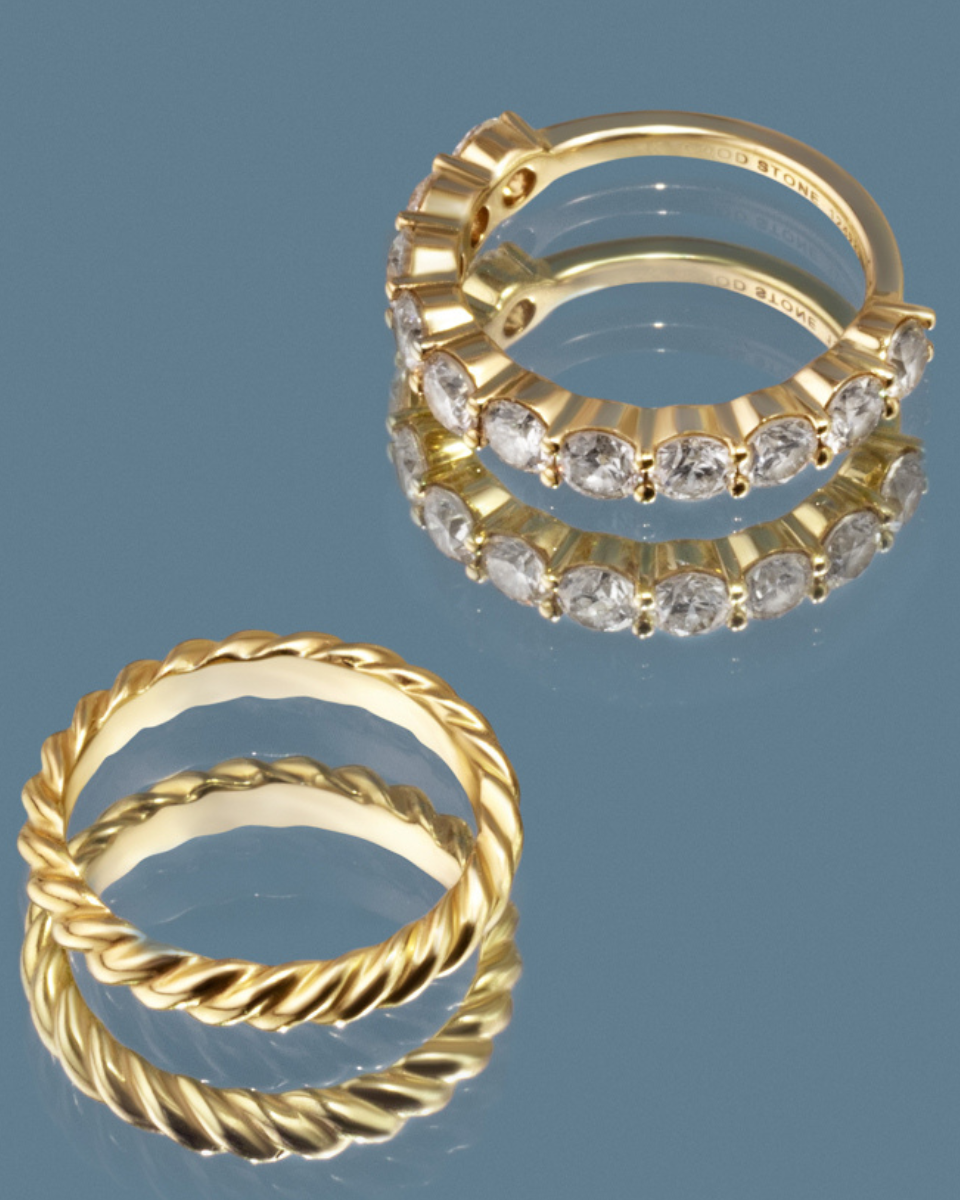
Yes. Simple metal bands and eternity bands are practical, well-liked choices for people who do not usually wear jewelry, and there is no rule that an engagement ring must hold a single large stone. A band that ends up on the hand every day often serves better than a statement ring left in its box.



Deja un comentario (todos los campos son obligatorios)