


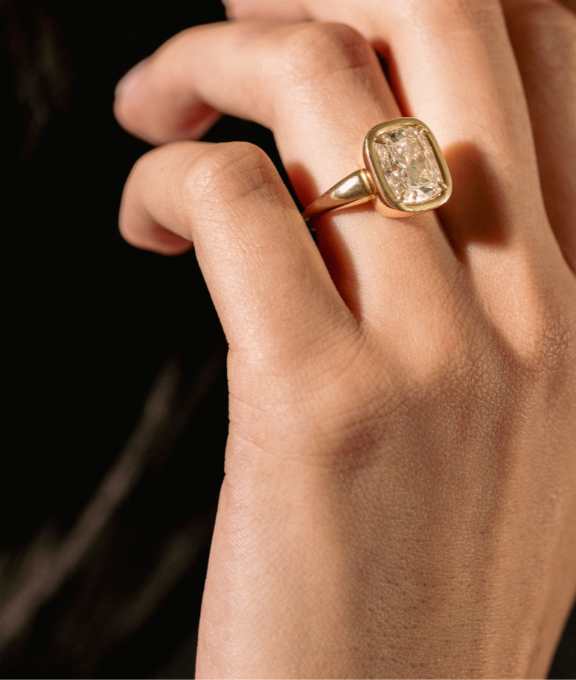




How to Buy a Lower-Clarity Diamond That Still Looks Eye-Clean
A VS2 diamond can cost 10% to 20% more than an SI1 of the same carat, color, and cut, and in a brilliant cut the SI1 can look identical from the top. That gap is where a careful buyer saves.
The grade letter hides the fact that matters most. Two SI2 round brilliants with the same letter can look nothing alike. One shows a black crystal you catch at a glance, while the other hides its inclusions so well a loupe barely finds them. What makes a diamond eye-clean is the inclusion itself, which the letter cannot show you.

The right SI stone can appear completely clean to the naked eye, allowing you to invest more of your budget in the details you can actually see.
The Eye-Clean Standard
Eye-clean describes a diamond with no inclusions visible to the naked eye when you hold it face-up at arm’s length. It is a trade term, not a lab grade. No laboratory prints “eye-clean” on a report, because grading happens under 10× magnification, where a grader hunts for characteristics you will never see with the naked eye.
The trade’s working definition is precise. A stone is considered eye-clean when a person with normal vision sees no inclusions from 6 to 12 inches away, in daylight or fluorescent light, when looking straight down at the top.
That distance is the whole point. A ring rests at arm’s length on a finger, far from a jeweler’s loupe. An inclusion that dominates a magnified photo can vanish once the stone is set and worn. The grade tells you what a grader found at 10x, while eye-clean tells you what you will meet across a dinner table. Those two answers part ways more often than first-time buyers expect.
Flawless and internally flawless stones charge a premium for a cleanliness no eye can register. Very slightly included stones rank lower and look clean in nearly every case. The slightly included grades, SI1 and SI2, can deliver the same face-up look for far less, as long as you check the individual stone and do not trust the letter.

A diamond can contain natural inclusions on its grading report while still looking beautifully clear from every normal viewing distance.
How to Read a Clarity Plot
A full report includes a plotting diagram, a map of the inclusions and blemishes the grader found. Learning to read it turns clarity from a gamble on a letter into a decision you control. The diagram looks technical at first glance, though it has only a few pieces of information, and once you know them you can screen a stone in under a minute.
The Two Maps and the Color Code
The plot shows the diamond twice. The left drawing is the crown, the view from the top as you look down at the face. On the right is the pavilion, the underside that a setting hides. Red marks show inclusions, the internal characteristics locked inside the stone, while green marks show blemishes on the surface. Red matters most for eye-cleanliness, since the internal characteristics under the table are the ones your eye catches first. A written line on the report names the grade-setting inclusions, and you can match the drawing to those words.

A clarity plot maps the diamond from both above and below, showing where each characteristic sits within the stone.
Key Inclusion Symbols
Each symbol names a kind of characteristic. A crystal appears as a solid red circle, a small mineral trapped inside the diamond as it formed, and it can be colorless, white, or black. A cloud appears as a group of tiny dots, a cluster of pinpoints that can look hazy when dense.
A feather is a red line with a slight curve, an internal fracture in the stone. A needle is a thin straight line, and a pinpoint is a single dot. Five symbols cover the vast majority of what you will find on an SI report, and the one with the most risk to appearance is a dark crystal.

Crystals, clouds, feathers, needles, and pinpoints each interact differently with the stone, making the type of characteristic just as important as the clarity grade itself.
Position on the Plot
An inclusion’s position decides its visibility as much as its type, and one drawn under the center of the table sits in the most exposed zone on the whole stone, lit and framed by the facets around it. The same inclusion out near the girdle, the thin edge where crown meets pavilion, is far harder to catch and easy for a setting to cover.
Two stones can show the same symbol at the same size and grade, and the one with its inclusion at the edge will look cleaner every time. This is why the plot beats the grade. The letter compresses the number and severity of the characteristics into one verdict, while the map shows the single thing the letter cannot, which is where the characteristic lies.

Where an inclusion sits can matter more than how large it is. Characteristics near the edge are often far less noticeable than those directly beneath the table—and may disappear completely once the diamond is set.
Safe Inclusions Versus Risky Ones
Not all inclusions threaten the look of a stone equally, and knowing which to accept is the core skill of buying down in clarity. The report gives you enough to sort a candidate into keep or pass before you ever request a photo.
Inclusions Worth Accepting
The friendly characteristics share a pattern. Transparent or white crystals set off to one side or near the girdle rarely register face-up, because they let light through and stay away from the bright center. Small feathers that stay fully internal, away from the edge and any point, do not affect its appearance or wear.
A scatter of several tiny inclusions is usually safer than one large characteristic in the middle, where no single mark is big enough for the eye to lock onto. A report that describes light, spread-out features like these at SI1 or even SI2 points to a strong candidate for an eye-clean stone at a friendly price.

The best lower-clarity diamonds often contain characteristics that blend naturally into the stone.
The Dark Crystal Problem
A dark or black crystal is the one inclusion that undoes an otherwise good stone. Black carbon contrasts against the diamond’s brightness, so the eye finds it far more easily than a pale characteristic of the same size, and once you know it is there, you keep glancing back to it. The worst spot for it is directly under the table, where the surrounding facets show it off.
Buyers who regret an SI purchase almost always name the same culprit, a black crystal near the center that the grade never warned them about. When you see a crystal symbol under the table, check its color in a photo first, and if it is dark, move on.
Feathers, Chips and Durability
A few characteristics threaten more than looks. A feather that reaches the surface, crosses the girdle, or ends in a pointed corner raises the risk of chipping, especially on cuts with sharp points. A feather that stays small and fully internal is a low concern. What matters is where it falls on the plot. Chips and cavities that break the surface belong on the avoid list outright, both catch-points for damage and visible notches.
A large or dense cloud deserves a second look, because a heavy cloud can dull a stone’s transparency and give it a faint milky cast even when no single inclusion shows. The report comment sometimes notes that a grade rests on clouds not drawn on the map, a signal to ask for a video.
How to Check a Diamond Is Eye-Clean
The mistake that trips up SI buyers happens on a screen. A 360-degree video zoomed to 40x makes every feather and crystal look alarming, and buyers panic at characteristics they would never catch in daylight. The fix is to judge the stone as it will be worn, at 6 to 12 inches, well back from the magnification the software allows. Zoom out, hold the phone at reading distance, and look at the face-up view another person will see.
A good video does most of the work an in-person look would. Spinning the stone lets you check the inclusions from every angle and confirm the grade-setting characteristic is where the plot said it would be. Retailers that show high-resolution video for each stone let you do this screening from home.
GOODSTONE offers a diamond search that pairs each stone’s report with a 360-degree video, and its designers will examine a candidate with you during a consultation, which comes close to holding the diamond yourself. When a stone looks clean at reading distance across a full rotation, the grade beneath it no longer matters.

Magnified imagery can make even a beautiful diamond look heavily included. The more useful test is to view the stone as it will actually be worn, face-up, in natural light, and from a normal viewing distance.
Cut and Setting as Concealment
The right cut hides an inclusion before you spend an extra dollar on clarity. A round brilliant scatters light across a dense field of small facets, and that busy return camouflages the kind of small characteristic an SI1 or SI2 has, which is why rounds look eye-clean at grades where other cuts do not. Oval, cushion, pear and radiant cuts share much of that forgiving quality.
Step cuts are the opposite case. An emerald or Asscher cut has a wide-open table and long, straight facets, with nowhere for an inclusion to hide. Those stones need a higher grade, often VS2 or better, to look eye-clean, and buyers who drop clarity in a step cut to save usually notice the characteristic every time they look down at the stone.
Setting closes the last gap. An inclusion out near the girdle can disappear under a prong, a bezel, or the edge of a halo, so a stone whose only meaningful characteristic sits at the perimeter can be mounted to cover it entirely. Points on cuts like the princess and marquise want a V-prong, which protects the corner where a feather would both show and be at risk of chipping.
Thinking about the setting while you shop, and not after, is the overlooked move here. A peripheral inclusion can be designed around, making placement on the plot part of the buying decision.

Busy faceting disguises subtle inclusions, while strategically placed prongs or a bezel can conceal characteristics near the diamond's edge.
The Value of Buying Down in Clarity
Dropping from VS to SI is the easiest way to keep money in your pocket without changing the look of the ring, once you can read a plot. An SI2 typically costs about 10% to 15% less than a comparable SI1, and an SI1 is priced well under a VS2 of matching carat and color.
On a 1-carat round in the G-color range, the move from SI1 to SI2 can be several hundred dollars, and that spread widens as the stone grows, since larger stones magnify every characteristic and deserve closer inspection.
The method does not change for lab-grown stones. Laboratory diamonds are graded on the same clarity scale from flawless to included, so the same plot-reading and eye-clean logic applies to both.
Retailers that offer lab-grown alongside natural stones, GOODSTONE among them, let you apply the same screening criteria to both and choose based on look and budget. The buyer who learns to read a plot stops paying for a cleanliness only a loupe can see, and puts the savings toward more carat or a better setting.

The smartest clarity grade is often the lowest one that still looks completely clean to your eye.
Frequently Asked Questions
What does eye-clean mean for a diamond?
Eye-clean means no inclusions are visible to the naked eye when you look at the diamond face-up from a normal distance. It is a trade term, since laboratories assess clarity only at 10× magnification and never print “eye-clean” on a report. A stone can be eye-clean at a lower grade and still show characteristics under a loupe.
Can an SI1 diamond be eye-clean?
In most cuts, an SI1 is eye-clean because its inclusions are small enough to go unnoticed by the naked eye at normal viewing distance. Confirm it on the individual stone before you assume it from the grade. A round brilliant at SI1 is one of the safest value picks.
Can an SI2 diamond be eye-clean?
An SI2 may or may not be eye-clean, and the answer depends on the type, size, and placement of its inclusions. Inspect every SI2 stone by stone. A scatter of pale crystals can look clean, while a single dark crystal under the table will show.
Can an I1 diamond ever look eye-clean?
A smaller I1 in a brilliant cut can sometimes look clean face-up, but I-grade stones have inclusions that show at 10× and often without magnification. Eye-clean I1 stones are uncommon, and they need careful video or in-hand checking before you commit.
What is the diamond clarity scale from best to worst?
The full scale is Flawless, Internally Flawless, VVS1, VVS2, VS1, VS2, SI1, SI2, then I1, I2 and I3. That is 11 grades in six named categories. Every grade is judged under 10x magnification.
What clarity grade is best for value?
SI1 and SI2 are widely called the value sweet spot, since many are eye-clean at a lower price than VS or VVS. The savings hold only if you verify each stone individually and do not rely on the grade alone. A round brilliant gives you the best odds at these grades.
How much cheaper is SI2 than SI1?
An SI2 usually costs about 10% to 15% less than a comparable SI1 of the same carat and color. The gap grows as carat weight rises. On larger stones, the difference can reach into four figures.
Is VS2 always eye-clean?
Round brilliant diamonds at VS2 and above are eye-clean in nearly every case. Step cuts and rounds over 3 carats at VS2 should be checked one by one, since open facets and larger size make inclusions easier to see. The grade is a strong signal at VS2 but not a guarantee for every cut.
What clarity do you need for an emerald cut diamond?
An emerald cut has a wide-open table that shows inclusions easily, so it generally needs a VS2 or higher to look eye-clean. Rounds can work at SI1 or SI2 where an emerald cut would not. The same is true for the Asscher cut, which shares the open step-cut face.
From how far away do you judge if a diamond is eye-clean?
The trade standard is looking at the diamond face-up from about 6 to 12 inches, in daylight or fluorescent light, with normal vision. That is the distance a ring is worn and seen. A characteristic that only appears under a loupe does not count against eye-cleanliness.
Are lab-grown diamonds graded on the same clarity scale?
Yes. Lab-grown diamonds are graded on the same Flawless-to-I3 clarity scale as natural diamonds. The same eye-clean method of reading the plot and checking the stone applies to both.




Deja un comentario (todos los campos son obligatorios)