





A Guide to Stacking a Wedding Band & Engagement Ring
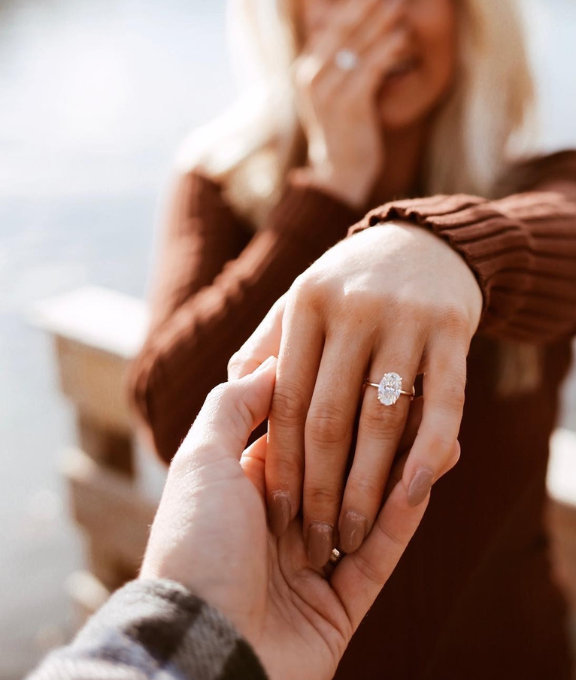
On the wedding morning, the engagement ring moves to the right hand. The left ring finger goes bare so the band can slide on first. After the ceremony, the engagement ring returns and rests above the band.
That ten-minute maneuver produces the stack most wearers keep for decades. The order decided that morning fixes how the two rings sit against each other for the life of the stack, and it controls whether sizing, photos, and daily comfort go smoothly on the day itself.
The first decision is which ring goes on the finger at all.

From the order they're worn to the way their shapes and proportions complement one another, thoughtful stacking creates a look that feels effortless and personal.
Which Goes On First, the Wedding Band or the Engagement Ring?
The Western convention places the wedding band on the left ring finger first, nearest the palm, so the band rests closest to the heart. The engagement ring stacks on top of it, nearer the knuckle. The ceremony logistics explain the origin of the arrangement. The engagement ring moves to the right hand before the vows, leaving the left finger bare for the band, and moves back on top afterward. Repeated daily for decades, the order becomes habit.
The reasoning behind the order is older than the rings. Roman-era belief named a vena amoris, a vein of love running from the fourth finger of the left hand directly to the heart. Henry Swinburne's 1686 Treatise of Spousals is among the earliest written references to a vein passing from that fourth finger to the heart. Modern anatomy disproves the vein, and the symbolism survives the disproof anyway.
The convention is also cultural rather than universal. Russia, Germany, Poland, Norway, and Greece all place wedding rings on the right hand. The traditional order is a default with roughly 1,600 years of precedent behind it. Jewelers who fit custom bands measure for the client's chosen order rather than the traditional one.

Traditionally, the wedding band sits closest to the heart, with the engagement ring resting above it.
Should the Wedding Band Sit Flush or Leave a Gap?
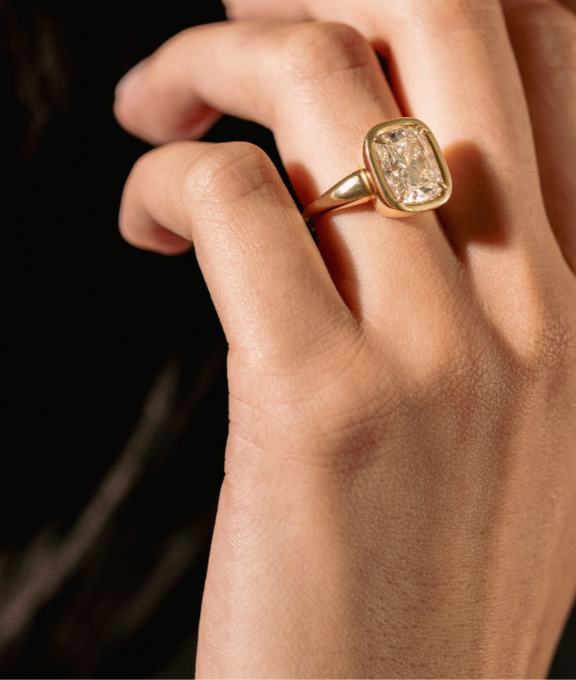
Setting height controls the fit, and style operates inside whatever room it leaves. A high-set solitaire leaves room beneath the head, and a straight band slides in flush against the shank. Low baskets and hidden-halo baskets block the band at the base of the stone. Bezels near the finger and cathedral shoulders do the same. The result is a gap, and no straight band at any price closes it. Settings intentionally engineered with elevated or open galleries are the exception. On those designs the gallery height is fixed in production. A straight band can rest flush without a custom curve.
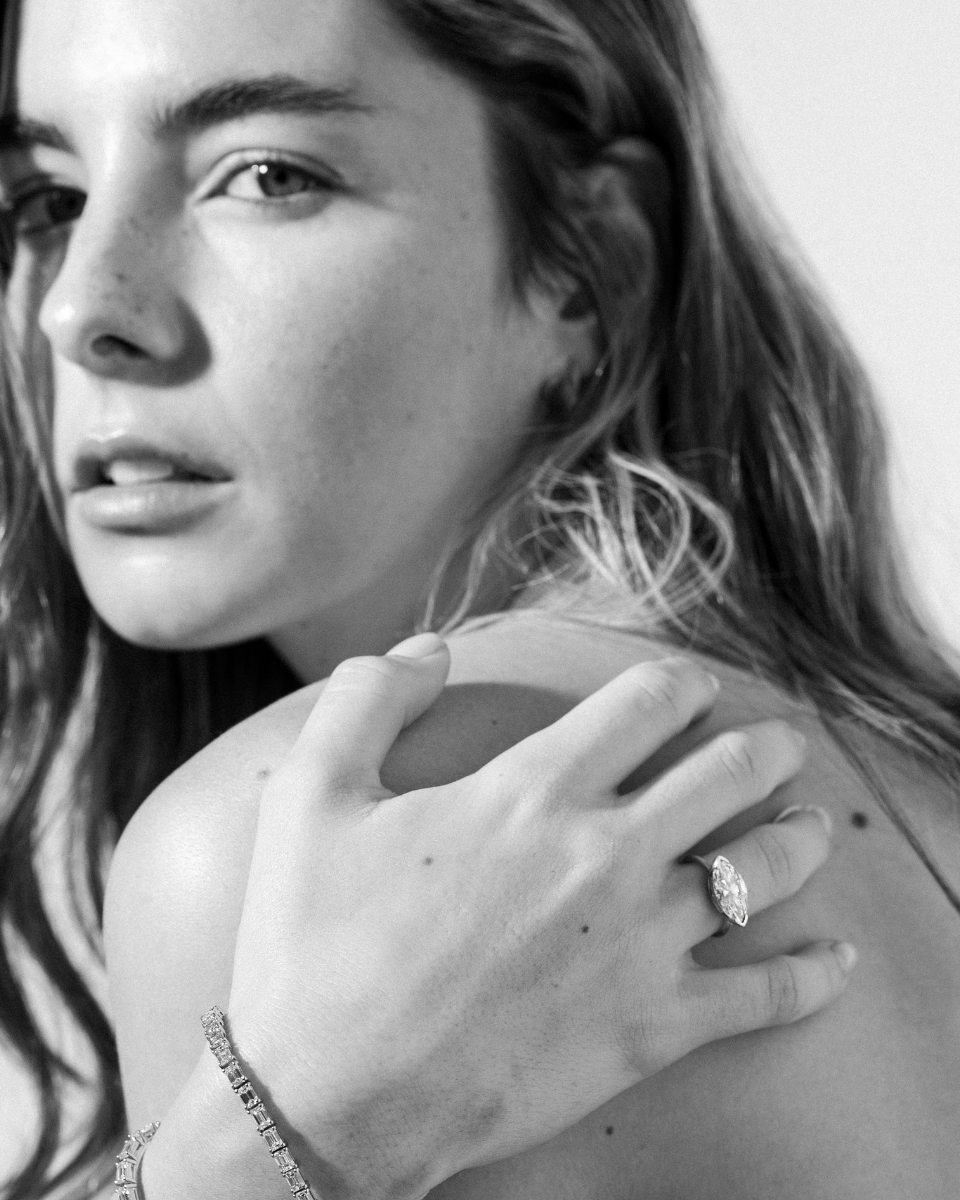
Elongated stones add a second mechanism. An oval, pear, or marquise extends past the shank, so the edge of the diamond meets the band before metal meets metal. The gap widens farther from the finger. Pairing guides for these outlines recommend trying candidate bands in person before ordering.
The gap is a legitimate aesthetic with named defenders. Retail pairing guides describe wearers who prefer a deliberate negative space between band and stone. The functional argument for the gap stands on its own. A band that never touches the engagement ring cannot saw into it. The community calls it sawing, meaning a flush diamond band grinding against the engagement ring's shank.
Decide at purchase. The recurring regret is a straight band bought online for a low-set ring, arriving to a rocking fit and an uneven gap. Every pairing guide leads with the same instruction, which is to examine the engagement ring from the side first. If the head blocks the band, choose the gap deliberately or choose a band built to close it. Both answers are correct, and only an accidental gap fails.

A perfectly flush stack creates a seamless silhouette, while a little negative space can feel just as intentional.
What Wedding Band Styles Close a Gap?
Five band designs recur across every pairing guide. The tradeoffs differ across the five, and the buyer should price in the one that matches how the rings will be worn.
Contoured and Chevron Bands That Follow the Stone's Curve
A contoured band nests against the center stone because its curve is cut to the stone's outline, and the two rings sit together without a gap. The chevron is the V-form subset. Contour guides pair gentle V-curves with ovals and elongated cushions at 2.0 to 2.5mm, and rounds at 1.8 to 2.0mm for a delicate stack.
The tradeoff is solo wear. A curved band is designed around the engagement ring. Worn alone at the gym or on a messy day, it can look incomplete. A straight band works by itself, and buyers who want band-only days should weigh that.
Notched and Open-Gap Bands That Work Around Prongs
Side stones and prongs block a flush fit, and a notched band carries cut-outs that take them. The engagement ring's hardware drops into the notch and the two rings meet flush. An open-gap band formalizes the negative space instead of closing it. Two arms frame the stone and leave air between the rings. The open design suits buyers who like the gap and want it to read as deliberate.
A notched band is cut to the ring it will meet, and the same band against a different ring can fit poorly. The open-gap design, by contrast, works with almost any ring because nothing about it depends on the engagement ring's hardware.
Spacer Bands and Enhancers That Separate Stacked Rings
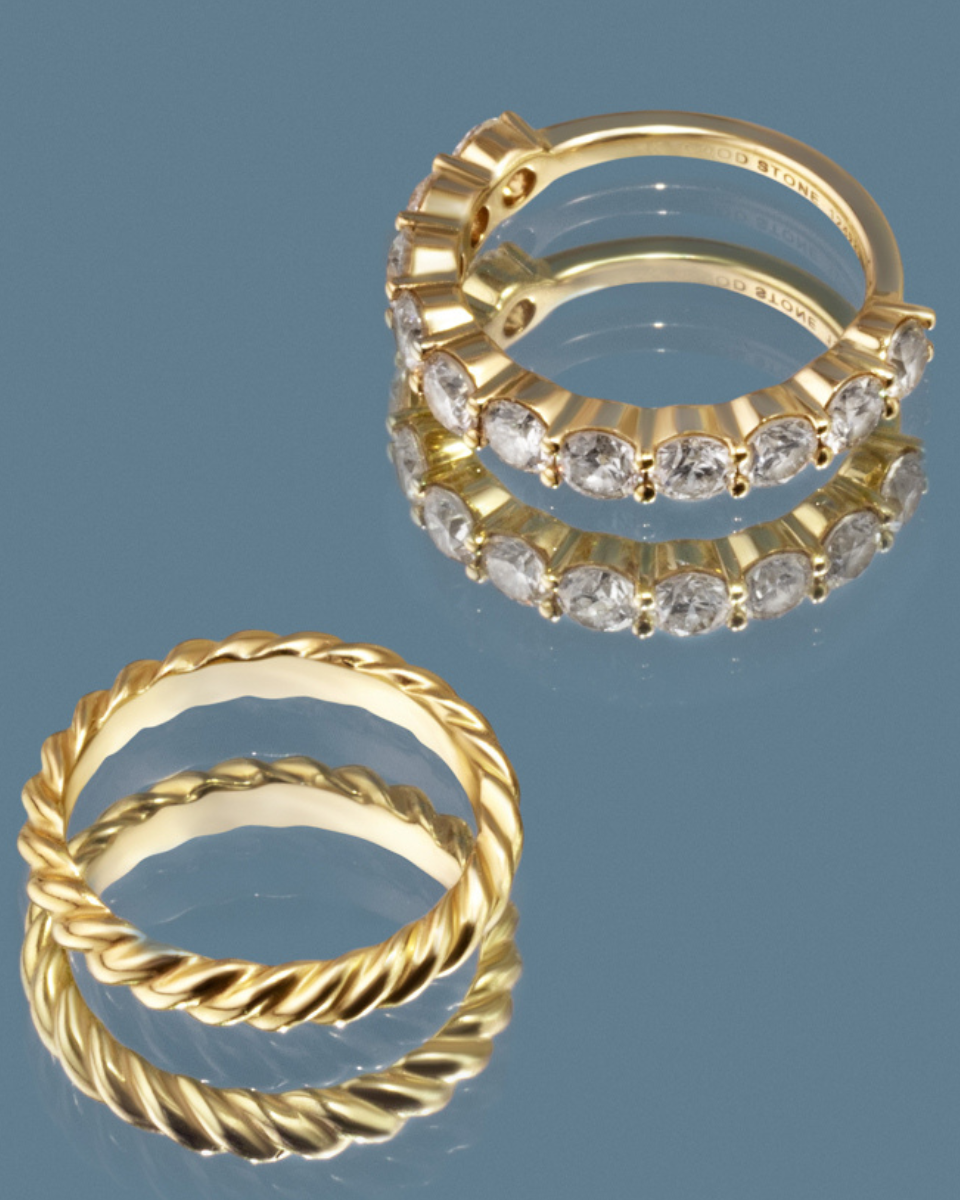
Placed between two diamond-set rings as a sacrificial buffer, a spacer band is a thin plain ring, often near 1mm. It prevents stone-on-stone contact and doubles as a gentle size reducer. A 1mm spacer that looks clunky in the listing photo disappears into the stack. An enhancer, also called a ring guard, surrounds the engagement ring with a two-sided frame. The added width and weight are considerable, and an enhancer is almost never worn alone.
Metal choice matters for the buffer role. A forum wearer chose 1mm hammered argentium silver spacers because silver is soft enough to sacrifice itself against the neighboring gold.
Is a Custom Wedding Band Built Against the Actual Ring Worth It?
Stock contour bands are cut to a generic curve that assumes an average basket flare, and few actual rings are average, so a stock contour can leave a residual gap on one side and pressure on the other. The alternative is a band built against the actual engagement ring. Custom work costs more than a stock contour and carries weeks of lead time, the price of a curve measured against one ring. GOODSTONE measures the contour against the actual ring in the workshop, with prong placement and stone spread entering the measurement as well. The resulting curve matches the basket flare of that specific ring, and the fit is resolved before the ring ever reaches a display tray.

A custom wedding band is designed around the exact proportions of your engagement ring rather than a standard silhouette.
How Should a Ring Stack Be Sized and Balanced?
The reliable width rule uses the engagement ring's shoulder width as the reference point. The wedding band matches it or runs slightly narrower. A third ring added later matches the wedding band or goes narrower still, so the stack tapers slightly away from the center stone. The taper keeps the center stone visually dominant.
Total width is a comfort issue. Three rings at 3-4mm each place 9-12mm of metal across the finger, which wearers notice during extended wear. Narrowing the outer two rings to 2-2.5mm keeps the stack inside a comfortable envelope.
Stacked rings fit tighter than a single ring. Common guidance sizes up a quarter to a half size for a stack, roughly a quarter size for every three or four bands on one finger. The two hands are rarely interchangeable either. Reported measurements put one wearer's left ring finger at 6.25 to 6.5 and the right at a 7. A stack that spun on one hand was unwearable on the other.
Seasonal swing complicates every sizing decision. Fingers shrink in cold and swell in heat. Wearers describe a ring loose in the morning and difficult to remove by a summer evening. A long-term wearer keeps a plastic sizing band for winter and removes it in summer.
Spinning is the most common comfort complaint in the forums. Jewelers answer it with sizing balls or a bridge installed inside the shank. A thin spacer behind the stack also works, and so does a snugger second ring anchoring the first. Years of stacking also wear a thin shank further. One wearer's roughly 1.5mm shank thinned and bent after a couple of years of daily wear, and a re-shank to slightly over 2mm stopped both the spinning and the repairs.

A beautiful ring stack relies on proportion as much as personal style. Balancing band widths, center stone size, and overall comfort allows each piece to complement the next without overwhelming the hand.
Should Stacked Rings Match or Mix Metals?
Matching metals is the classic route. Same metal and tone make the two rings look like one set. Both rings also age evenly, and matched alloys wear evenly where they touch because neither ring is the harder one.
Mixing is a recognized 2024-2026 trend, and the rule across guides is unambiguous contrast. A yellow gold engagement ring flanked by two white gold or platinum bands looks intentional. White gold next to platinum looks like a mistake at close range, where the near-match appears accidental.
The near-match trap tightens as the stack grows. More surfaces in close proximity make slight tonal differences more visible. Mixing also has a wear cost. Platinum is harder than 14k gold, and the softer band wears faster where the rings touch. Anyone mixing metals should inspect the contact points at each prong check.

Matching metals create a timeless, unified look, while mixed metals introduce contrast and a more personal approach to bridal styling.
Do Stacked Rings Wear Each Other Down?
Where Stacked Rings Wear Each Other
Stacked rings wear each other. A wedding band pressed against the engagement ring's prongs thins the prong metal over months and years, and thinned prongs are how center stones come loose. One forum poster reported her band eating away at the base of her engagement ring after about nine months. Another rebuilt the prongs on a semi-eternity band twice before switching to a spacer.
Pavé bands present the highest risk. Most leave the sides of the diamonds exposed. The stones rub directly against the neighboring ring, and diamond-on-diamond contact can chip accent stones along thin girdles. Owners of pavé bands should expect the loss of a diamond or two over thirty-plus years of wear, and yearly prong checks are the standing advice.
Spacers, Channel Settings, and Soldering That Prevent Wear
Prevention comes in three forms:
-
A spacer band absorbs the contact.
-
A channel-set band encases its diamonds, removing the exposed edges.
-
Soldering joins the rings permanently.
Soldering ends spinning and alignment drift while reducing the rubbing wear, but neither ring can ever be worn alone, the combined piece is wider and stiffer on the finger, and later resizing or repair involves both rings at once. Most wearers keep rings unsoldered for flexibility, and jewelers report soldering requests have become uncommon.
How Do You Add a Third Ring Later?
The three-ring stack is an established pattern. An anniversary or eternity band joins at a milestone, with certain landmark anniversaries the common triggers. The wedding band rests at the base and the engagement ring on top, with the eternity band between them. The alternative ordering follows the timeline in the order the rings were received. Guides recommend matching the third ring to the wedding band in width so the taper away from the center stone stays consistent.
Retail and editorial guides now treat the mixed editorial stack, with its combined metals, varied widths, and assorted cuts, as a 2026 trend category in its own right. A third ring in a new metal forces a re-check of the whole stack's coherence, because what worked as a two-ring contrast can become a three-ring near-match.
The foundation-piece advice applies from the first purchase. A simple, versatile first band, plain metal or dainty pavé, works as the base layer for anything added later. A later band that repeats an existing width or metal extends the stack without forcing new decisions. Rebuilding a stack after the fact costs more than planning one, since each added ring changes the balance of the rings already there.

A bridal stack can evolve alongside the milestones it represents. Adding an anniversary or eternity band introduces a new layer of meaning, creating a combination that grows more personal with time.
Frequently Asked Questions
Does the wedding band go on first or on top?
The band goes on first, nearest the palm, with the engagement ring above it nearer the knuckle. In Brazil, couples may begin on the right hand and switch hands after the vows.
Do you wear your engagement ring on your wedding day?
Most brides do. They move it to the right hand before the ceremony so the band can be placed on the bare left finger, then return it above the band afterward. In Jewish ceremonies the ring commonly goes on the right index finger first and moves later.
What hand does the wedding band go on?
The left ring finger is standard in the US and the UK, as in Canada and France. India belongs to the right-hand list, as do Spain and Portugal. The answer depends on where the marriage happens.
Should a wedding band match the engagement ring?
Matching is the lowest-risk route, because same-metal rings develop one consistent patina as they age together, while mixed metals scratch and dull at different rates.
Can you mix metals in a ring stack?
Mixed-metal bridal stacks have risen through 2024-2026, and the pairing works when the contrast is unambiguous. Remember the hardness gap, because platinum measures roughly 4 to 4.5 on the Mohs scale against softer gold alloys and the gold band wears faster where the rings touch.
Is it okay to have a gap between the engagement ring and wedding band?
The gap was the traditional look for decades before flush fits became the retail default. It has precedent as well as function.
What wedding band works with a halo engagement ring?
The halo blocks a straight band, so the answer is a contoured band. When a custom curve is off the table, a thin pavé band is the most universally workable fallback.
How many rings can you stack on one finger?
No hard limit exists, and wearers who pass three often move the overflow ring to the right hand to keep the stack comfortable.
Should I size up for stacked rings?
Measure at the end of the day when fingers are most swollen, and plan on going up, since wider bands also need slightly larger sizing than thin ones.
How do I stop a ring stack from spinning?
A jeweler installs sizing balls or a bridge inside the shank to stop a stack turning. A 90% eternity band reduces spin while preserving resize options, which a full eternity loses.
Can you solder an engagement ring and wedding band together?
Soldering stops spinning and rubbing for good, and it is a permanent answer. Neither ring can be worn alone afterward, and heat-sensitive stones like cubic zirconia must be removed and reset first.
What order do engagement, wedding, and eternity rings go in?
The common convention places the wedding band at the base and the engagement ring on top, with the eternity band between them. Eternity bands also mark the birth of a child in some families, which is frequently when a family starts asking about a third ring.



Leave a comment (all fields required)