





A Beginner’s Guide to Shopping for a Vintage-Inspired Engagement Ring
A vintage-inspired engagement ring is a newly made ring designed to resemble a piece from an earlier era, featuring period details such as milgrain edges, filigree, hand engraving, and antique stone cuts, like Old Euros. It combines the romance of a Victorian, Edwardian, or Art Deco design with the durability of modern metalwork and the precision of contemporary stones.
Most beginners find that the hardest part is learning the terminology, identifying the era they love most, and recognizing which details matter once they begin shopping. The right ring usually comes into focus once those visual differences become familiar and the design language feels familiar rather than intimidating.

For most beginners, the learning curve is really about terminology and recognizing which era's design language resonates most.
Vintage, Antique, and Vintage-Inspired Are Three Different Things
Three terms describe three different ring categories, and knowing them helps avoid confusion. Antique jewelry is at least 100 years old, vintage jewelry is roughly 20 to 100 years old, and vintage-inspired jewelry is newly made in a period style, according to Lang Antiques and Eric Originals & Antiques.
For example, an Edwardian ring from 1908 is antique, while a 1950s ring from your grandmother is vintage. A 2024 ring featuring milgrain, filigree, and an old European-cut stone is vintage-inspired.
Estate jewelry is a fourth term sometimes mentioned and refers to previously owned pieces. An estate ring can be antique, vintage, or only a few years old.
These distinctions matter for practical reasons:
-
A true antique piece carries history and one-of-one charm, but the metal may be thinner from decades of wear, the prongs may need rebuilding, and resizing is limited.
-
A vintage piece is in the middle, often less fragile but still secondhand.
-
A vintage-inspired ring lets you choose the era you love, pick a stone that meets modern grading standards, and have the ring built to your finger size from the start.
Clarity describes vintage-inspired pieces as a way to get the look at a lower cost and with less risk. This works for buyers who want the period silhouette without the restoration work.

Antique jewelry is at least 100 years old, vintage falls between 20 and 100 years, and vintage-inspired pieces are newly made in a period style.
A Quick Walk Through the Major Eras
Four eras shape most vintage-inspired engagement rings seen today: Georgian, Victorian, Edwardian, and Art Deco, with the Retro 1940s sometimes included as a fifth category. Each period carries its own stone cuts, metals, and design language, and learning to recognize those differences is often the easiest way to narrow your preferences.
Georgian (1714 to 1837)
Georgian rings were handmade during the reigns of George I through William IV, according to Antique Jewelry University at Lang Antiques. Key features include rose-cut and old mine-cut diamonds, silver-topped gold mountings, and sentimental motifs such as crowned hearts and ribbons.
The signature technique was the foil-backed stone in a closed-back collet setting, where a thin layer of foil sat behind the gem to brighten it under candlelight. Georgian pieces are rare, fragile, and not suitable for water cleaning, so the era influences vintage-inspired design more often than it is directly reproduced.
Victorian (1837 to 1901)
Victorian engagement rings cover Queen Victoria’s long reign and are split into three sub-periods, according to Walton’s Jewelry and Filigree Jewelers. Early Victorian (1837 to 1860) leans romantic, with serpents, hearts, and flowers. Queen Victoria’s own engagement ring was a serpent.
The mid-Victorian period brought a somber turn after Prince Albert’s death in 1861, with mourning jewelry in jet and onyx. Late Victorian lightens up again with stars, crescents, and gypsy-set bands. Cluster designs originated in this era and are the ancestor of the modern halo. Old mine-cut diamonds, with their cushion outline and open culet, are the period stone.
Edwardian (1901 to about 1915)
Edwardian rings are the lacy, delicate pieces most people visualize when they hear the word “vintage.” Lang Antiques credits the oxyacetylene torch with making platinum workable, which let jewelers build openwork that yellow gold could not support.
Hallmarks include filigree, a twisted wire bent into lace patterns; milgrain, a beaded edge applied with a knurling tool; open lattice galleries, scrollwork, and bow or garland motifs. The signature stone is the old European-cut diamond, a 58-facet round cut with a small table, high crown, deep pavilion, and an open culet that throws broad flashes of fire rather than small white sparkles.
Art Deco (1920s to 1930s)
Art Deco rings moved away from soft scrollwork towards hard geometry, according to VRAI and Berganza. Hallmarks include caliber-cut colored stones, baguettes, emerald and Asscher cuts, pavé borders, and bold contrast between platinum and darker accent stones such as onyx, sapphire, emerald, or ruby.
Caliber-cut stones are small accent gems custom-shaped to fit the setting, while step cuts produce a mirrored effect that prioritizes architectural lines over disco-ball brilliance. Art Deco filigree still appears, but it follows sharp, repeating patterns instead of the soft lace of Edwardian work.
The Retro era of the 1940s is on the edge of vintage. Wartime restrictions on platinum pushed jewelers toward rose and yellow gold, and rings became larger, bolder, and more sculpted. Retro influences appear less often in modern pieces than in the four earlier eras, but they are worth recognizing if you come across one.
The Settings That Make a Ring Feel Period-Correct
A setting feels period-correct when it uses era-appropriate techniques, applied with restraint rather than as decoration sprinkled atop a modern frame. The main techniques are milgrain, filigree, hand engraving, halo or cluster work, bezel and claw prongs, and openwork galleries.
Milgrain is a row of tiny metal beads pressed into the edge of a ring with a knurling wheel. It softens the line where metal meets stone or where two metal surfaces meet, and it is most pronounced on Edwardian and Art Deco pieces. Real milgrain has slight irregularities from the tool, while cast milgrain on cheaper modern reproductions looks uniform and flat. The difference is visible under a loupe.
Filigree involves bending and soldering fine metal wire into open lace patterns, usually inside the ring’s gallery, which is the area beneath the center stone. Whitehouse Brothers describes Edwardian filigree as a defining feature of the era. A vintage-inspired ring with real filigree feels weightless from the side, and you can see daylight through the openwork. Solid metal stamped with a filigree pattern is not the same thing.
Hand engraving cuts a pattern directly into the metal with a graver. Wheat, scrollwork, and ribbon motifs were common in Victorian and Edwardian rings. Engraved details have real depth, and the cut walls catch light with a subtle glint that decoration cannot fully reproduce. A well-made vintage-inspired ring will usually identify hand engraving as part of the design.
Halo and cluster settings trace back to Victorian and Edwardian jewelry. The modern halo is a more symmetrical version of the Victorian cluster ring, while three-stone settings also carry Victorian and Edwardian roots. The familiar “past, present, and future” language came later, layered onto an existing design.
Long claw prongs, double prongs, and split or V-prongs at the corners of fancy shapes all read vintage. Six-prong heads with a tall, modern profile read newer, even on a ring with milgrain on the band. Bezels feel period-correct because closed and partial bezels were standard before the prong style appeared in the late 1800s.
Milgrain, filigree, hand engraving, and openwork galleries are the techniques that give a ring genuine period character. The milgrain on our Blue Sapphire Cluster Engagement Ring With Cushion Cut gives it character, elegance and vintage inspiration.
Stone Choices and How They Shape the Look
The stone you choose captures the period feel of a vintage-inspired ring. The strongest period look comes from antique cuts, like old mine, old European, rose, and antique cushion. Modern round brilliants provide maximum sparkle, and lab-grown antique cuts sit in the middle on price.
Old mine cuts are softly squared cushions with high crowns, small tables, open culets, and 58 hand-cut facets, produced from the mid-1800s into the early 1900s. GIA’s 4Cs blog notes that these stones were designed to perform in candlelight, producing broad flashes of fire rather than the bright white sparkle associated with modern brilliants.
Old European cuts are the round version, with a similar profile and a slightly whiter, more refined look. This was the result of improvements to cutting precision by the late 1800s. Rose cuts, with their flat back and faceted dome, glow softly rather than sparkle, and they suit a romantic, pre-Victorian feel.
Natural antique stones usually come from older jewelry that has been dismantled, recut, or reset into newer mountings. They carry genuine period history, but supply remains limited, and prices rise quickly for larger stones or higher clarity grades. Modern lab-grown old mine and old European cuts are widely available, with several retailers offering them at roughly 50 to 70% less than comparable natural stones.
Lab-grown diamonds are optically and chemically identical to mined ones. The lower pricing comes primarily from differences in production and supply rather than visible performance.
A modern round brilliant paired with a vintage-inspired mounting offers a period silhouette alongside maximum sparkle. The trade-off is visual consistency. Under close inspection, the stone aligns with modern cutting standards, while the setting draws from a vintage era. Some buyers enjoy that contrast, while others prefer the design language to remain fully antique-inspired or modern throughout.
GOODSTONE offers old-mine cut stones and bespoke vintage-inspired settings for those who want to pair an antique-style cut with a custom setting rather than buy ready-made pieces. The same combination is available through specialists, and the stone matters more than where you buy the setting.

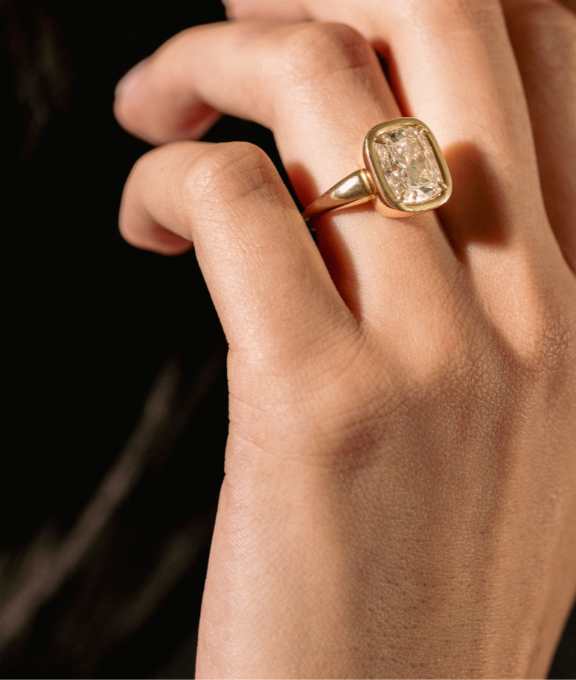
Old mine, old European, and rose cuts deliver the strongest period feel, with their candlelight-tuned proportions producing broad fire, as you can see on our Vintage Ridge Shank Diamond Engagement Ring With Elongated Old Mine Cut Diamond.
Setting a Realistic Budget
The budget conversation starts with what real couples spend, not with a percentage rule. The Knot 2024 Jewelry & Engagement Study reported the average U.S. engagement ring spend at $5,200, down from $5,500 in 2023, $5,800 in 2022, and $6,000 in 2021. The study also revealed that 64% of couples spent under $6,000, while 33% spent under $3,000. Regional averages vary, with Mid-Atlantic couples averaging about $6,900 and Midwestern couples around $4,900.
Vintage-inspired rings span a wide price range, with various details influencing the final cost. Antique-cut natural stones typically sell for more per carat than comparable modern brilliants because supply is limited.
Hand engraving, real filigree, and milgrain add labor and increase the setting price, often by several hundred to a few thousand dollars, depending on intricacy. Platinum costs more than 14k or 18k gold, and a true Edwardian-style ring almost always wants platinum to support the openwork. Custom or bespoke work adds design time and revisions.
A useful baseline is to determine the stone and setting budgets separately. A 1-carat lab-grown old European-cut paired with a hand-engraved platinum setting can reach mid-four figures. A 1-carat natural old European in a similar setting can be double or triple that. Lower-budget vintage-inspired rings often use smaller center stones with strong setting details, which appear more period-correct than a large modern brilliant in a thin band.
Practical Buying Steps and What to Ask
The practical buying steps for a vintage-inspired ring are:
-
Confirm the era reference.
-
Ask for grading on the center stone.
-
Plan for resizing in advance.
-
Decide on bespoke vs. ready-made early enough to avoid longer lead times.
Ask the jeweler which era the design references and the specific details that support that era, such as milgrain consistent with Edwardian work or Art Deco-inspired step cuts. A jeweler who can name the period’s influence and point to the techniques designed within the style, rather than ordering a generic “vintage” cast.
For grading, provide a current GIA report for any natural diamond center stone. A GIA report verifies cut, color, clarity, carat, and proportions, and the GIA Report Check tool lets you confirm the report online. For lab-grown diamonds, GIA and IGI both grade lab-grown stones and produce reports as long as they cover the 4Cs.
Plan resizing before purchase, not after. Most rings can be resized one to two sizes in either direction without issue. Beyond that, the band may weaken, or the design may become misshapen. Eternity bands and rings with stones around the full shank usually cannot be resized, while pavé and channel-set shanks are limited. A customized vintage-inspired piece avoids these issues, which is an advantage of buying a new period-style piece.
Choosing between bespoke and ready-made depends on timing, budget, and the design’s specificity. A bespoke ring usually moves through consultation, sketches, 3D CAD rendering, casting, stone setting, and finishing. Lead times range from 4 to 8 weeks for standard designs and longer for more intricate engraving or custom details.
A ready-made vintage-inspired ring shortens the process to days or a few weeks, but limits how precisely the design can match period-specific details. A true antique ring is unique, with sizing and condition already set when you find it.
A few care notes are worth remembering. Filigree is delicate and can catch on fabric; if your hands are active, a sturdier vintage-inspired design is a better option. Foil-backed Georgian stones cannot get wet, so ultrasonic cleaning is ruled out.
Most other vintage-inspired pieces tolerate mild soap and a soft brush, but ultrasonic cleaning is risky for older mountings and loose prongs. Ask the jeweler what cleaning method they recommend for your chosen design.
Frequently Asked Questions
What is the difference between vintage and antique engagement rings?
Antique engagement rings are at least 100 years old, while vintage engagement rings are roughly 20 to 100 years old. Vintage-inspired rings are newly made pieces designed in a period-specific style, and labels matter when you compare durability, customization options, and price.
What is the difference between Edwardian and Art Deco engagement rings?
Edwardian rings feature delicate platinum filigree, lacy openwork, milgrain edges, and old European cut diamonds, with soft scrolls and bow motifs. Art Deco rings feature bold geometry, step cuts like emerald and Asscher, calibrated-cut colored stones, and architectural symmetry. In addition, Edwardian feels romantic and lacy, while Art Deco feels sharp and geometric.
What is an old European cut diamond?
Old European cuts are round, 58-facet hand-cut diamonds produced from the late 1800s through the early 1900s, and are the signature diamond of Edwardian and early Art Deco jewelry. They feature a small table, a high crown, a deep pavilion, and an open culet. Because the cut was designed for candlelight rather than electric light, it produces broad, softer flashes of fire instead of the tighter white sparkle associated with modern brilliants. Old European cuts are
Can a vintage engagement ring be resized?
Most vintage rings can be resized one to two sizes in either direction without damage, but elaborate filigree, eternity bands, and rings with stones around the full shank are very limited. Antique rings that have already been resized once may not survive a second resizing. Always confirm sizing options before you buy.
What stones look best in a vintage-inspired engagement ring?
Old mine cuts, old European cuts, rose cuts, and antique cushions are the most period-correct stones for vintage-inspired rings. Modern round brilliants deliver maximum sparkle, and lab-grown antique cuts offer the period look at roughly 50 to 70% of the cost of comparable natural antique stones. Match the stone to the era you want the ring to represent.
Why are vintage engagement rings popular right now?
Vintage and vintage-inspired rings rank among the top engagement ring trends because buyers want unique pieces with craftsmanship and history. Sustainability also plays a role, since secondhand stones and metals avoid new mining. Millennial and Gen Z buyers are leading the trend toward period-focused styling over modern minimalism.



Deja un comentario (todos los campos son obligatorios)