




Why Two Tone Engagement Rings Suit More Skin Tones Than One Metal
The standard advice on metal color tells a buyer to pick one family, warm or cool, and commit to it for the life of the ring. A two-tone engagement ring declines that bet. It carries both warm and cool metals in a single piece. It harmonizes with warm, cool, or neutral undertones at once.
The case for it rests on design logic. The upkeep costs that come with it belong in the decision before the deposit.

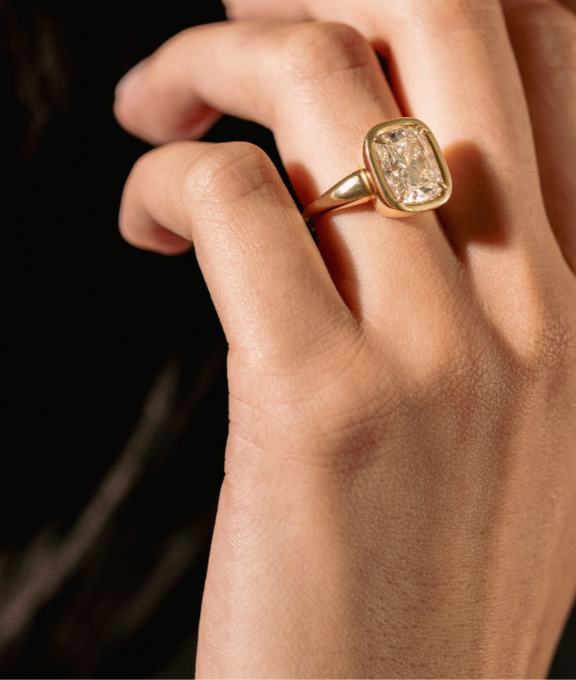
Two-tone engagement rings bring the warmth of gold and the cool elegance of white metals together in a single design.
How Does Metal Color Interact With Skin Undertone?
The jewelry industry's metal-matching system runs on undertone, the stable color temperature beneath surface skin tone. Undertone is warm (golden, peachy, olive), cool (pink, red, bluish), or neutral. It stays fixed across tanning and seasonal color change. Surface tone is therefore the wrong basis for a metal decision. Three standard tests identify the undertone.
-
Greenish wrist veins indicate warm, blue or purple veins cool, and a mixed reading neutral.
-
The jewelry test compares gold against silver at the face and notes which one freshens the skin.
-
The white-paper test reads the skin as golden or rosy against a white sheet.
None of the three tests requires equipment. Buyers can run all of them at home before a showroom visit.
The default mappings follow from there. Warm undertones pair with yellow and rose gold, cool undertones with the white metals (white gold, platinum, or silver), while neutral undertones can wear both families without penalty.
A metal worn against skin throws its own color temperature onto the adjacent surface. Warm metals echo warm undertones, and cool metals echo cool ones. A mismatched metal works against the undertone and the result shows as sallowness, redness, or a gray cast. True yellow gold on cool skin can emphasize redness. Deep warm skin frequently gains visible brightness in gold that it lacks in silver.
Rose gold is the documented crossover case. The copper in the alloy warms the pink enough for warm skin, and the pink reads cool enough for cool skin. That combination makes it the closest thing to a universal single metal. It has one recorded exception. Very fair skin with strong pink or red undertones can find that rose gold echoes the redness it was meant to flatter.
The entire matching system, then, rests on one assumption. The buyer commits to a single temperature family for the life of the ring.

Yellow and rose gold bring warmth, while platinum and white gold offer a cooler contrast, with each creating its own distinctive effect against the skin.
Where Does the One-Metal Rule Break Down?
The first failure is the buyer's own future taste. Metal preference swings with fashion cycles. Forum members who track their own behavior document 180-degree reversals over five to ten years. A poster resetting her ring for the third time described a decade of rejecting yellow gold as dated before converting entirely ("I only purchase gold jewelry now, which is a complete 180 from even 5 years ago"), then wondering what happens when styles turn again. A single-metal engagement ring wagers on one point in that cycle, and the ring outlives the point.
The second failure is the wardrobe problem. A buyer whose watch, bracelets, or other rings split across metals owns a ring that conflicts with half of what she wears daily, a mismatch that is minor per day and permanent across decades.
The third failure is physiological. For some wearers, skin response to metal is absolute in a way the mapping table undersells. Forum accounts include wearers whose skin turns visibly green-toned against white metals and who wear yellow gold exclusively as a result. Separately, nickel allergy rules out many white gold alloys for sensitive buyers. Platinum is alloyed with iridium, ruthenium, or cobalt, never with nickel. It is the safe white metal, with palladium as the cheaper substitute.
Each failure is a case where the correct single metal, correctly chosen, produces a problem the buyer did not cause.

Combining warm and cool metals creates a versatile foundation that complements an existing jewelry collection without limiting future choices.
Why Pair a White Head With a Gold Shank?
The dominant two-tone configuration pairs a yellow or rose gold shank with a white-metal head, meaning platinum or white gold prongs and basket around the center stone. This is often done with a bezel or half bezel. What looks like a styling choice is a functional construction bench jewelers have used for decades.
A white head keeps the center stone reading icy white. Yellow prongs beside a near-colorless diamond throw warmth into the stone and tint its face-up color. The gold shank, meanwhile, delivers the warm look against skin that the buyer wanted in the first place. Each metal goes where its temperature does a job.
The construction also runs in reverse, and the reverse case proves the logic. In one documented set the assignment is flipped. Her center stone is a "P" color antique cut, visibly warm, so it is set in yellow prongs that own and deepen that warmth. The rest of her ring is white to keep the overall look crisp. Yellow prongs serve an identical purpose for light yellow and fancy colored diamonds. Dealer listings use the pairing deliberately to strengthen a stone's color. Metal at the head manages the stone's color, while metal at the shank serves the wearer's skin. A two-tone ring assigns each one separately, while a single-metal ring cannot.

A white-metal setting can emphasize the crisp, colorless appearance of a diamond, while a yellow gold band brings warmth against the skin.
Which Two-Tone Pairing Suits Your Undertone?
Undertone sets the proportion of warm to cool metal.
Warm Undertones That Call for a Gold-Dominant Build
Warm skin takes a gold-dominant build. Yellow or rose gold forms the shank and most of the visible body, and the white component confines itself to the head, where it manages the stone's color without touching the skin story. The wearer gains the practical benefits of the white head and loses none of the warmth her undertone rewards.
A gold-dominant two-tone also handles the crossover case, since the warm buyer who loves the look of platinum gets it in the one location where platinum's coolness never meets skin.
Cool Undertones That Invert the Ratio
Cool skin inverts the ratio. Platinum or white gold dominates the build and yellow or rose gold enters as an accent. The accent can take the form of a gallery rail, an inner band, or detailing on the shoulders. Surrounded and framed by the cool metal, it registers as deliberate design.
The accent placement matters for a second reason. Small gold elements on a cool-dominant ring give the wearer a bridge to gold pieces in her existing collection without exposing her skin to a large warm surface.
Neutral Undertones With the Widest Design Space
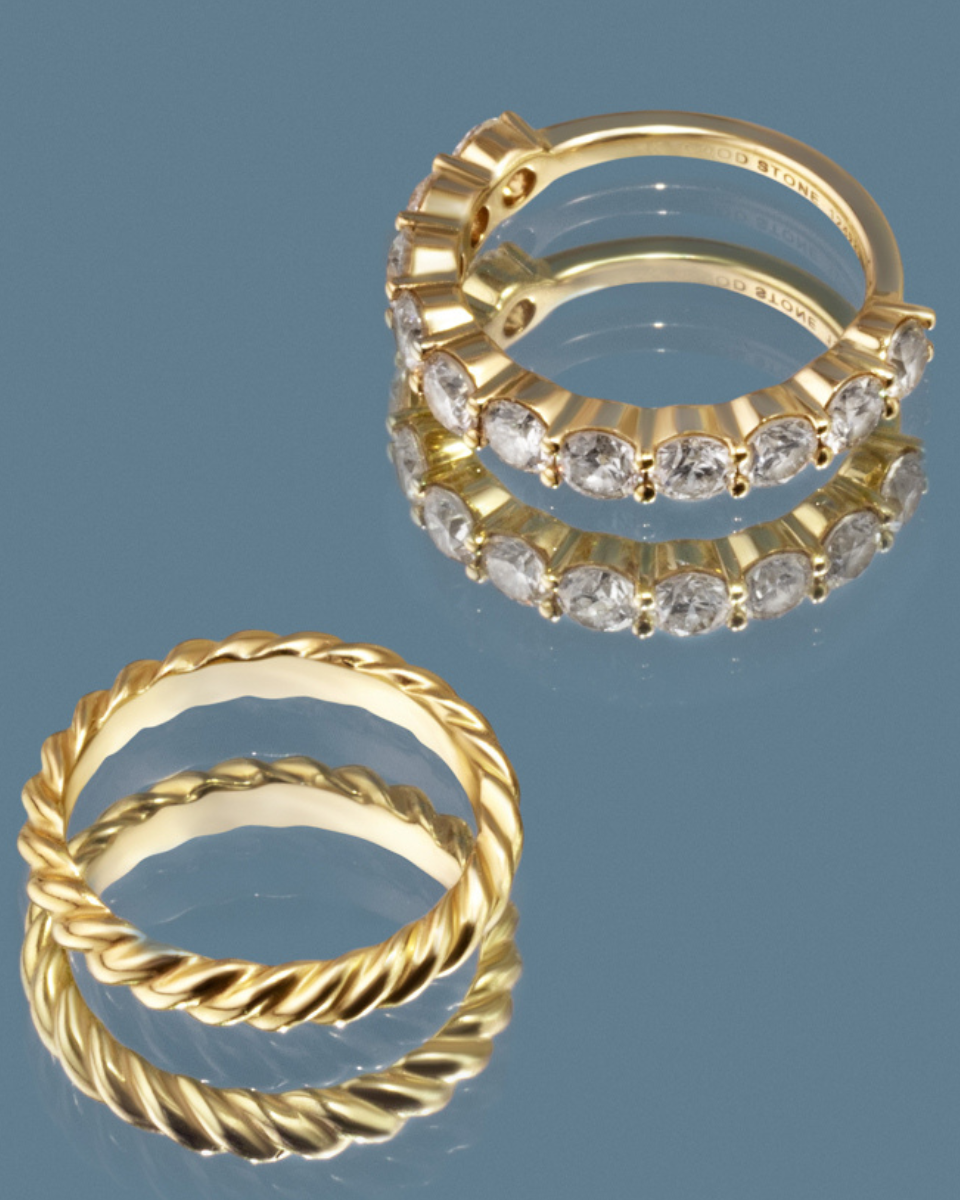
Neutral undertones carry the fewest constraints and the widest design space. Even splits work, including interwoven or braided two-metal bands. Rose gold earns its place here as the bridge component, since its copper-pink mix reads acceptably against both families. The neutral buyer's real decision is wardrobe, and an even split maximizes compatibility with a mixed jewelry collection.
Should You Commission a Custom Two-Tone Ring?
Two-tone design rewards custom work more than most ring categories, since no two buyers share the same undertone, wardrobe, or center stone, and a ready-made two-tone ring fixes those decisions at one common denominator.
GOODSTONE builds mixed-metal custom rings through direct consultations with the designer handling the build, and the consultation format fits the category. The designer places each metal where its color temperature is wanted, sets the proportion against the client's undertone and existing jewelry, and selects the white component with allergies in mind. The catch comes in production. Two alloys in a single build must each be finished correctly where they meet, so custom work runs longer than a single-alloy ready-to-ship ring. Buyers on a fixed date should budget for it.

Custom design allows every metal to be placed with intention, from the prongs surrounding the diamond to the smallest details beneath the setting.
What Maintenance Does a Two-Tone Ring Need?
The two-tone advantage has a price, and the buyer should price it in advance. White gold components need periodic rhodium re-plating to keep their brightness, on any ring, paired or not. Platinum components develop a patina over years of wear, a satin surface some owners like and others actively dislike. Two alloys in one ring also wear at different rates where they meet, and mixed-metal stacks built from separate rings wear the softer metal faster at the contact points.
None of this amounts to a reason to avoid the category, since it is a maintenance schedule that belongs in the purchase decision alongside the design. Plating a ring to change its color after purchase is also possible, for example rose-plating one component, but plating is temporary and demands upkeep of its own.

Understanding how white gold, yellow gold, and platinum wear allows you to care for a two-tone ring while preserving the beautiful contrast that makes its design distinctive.
Will a Two-Tone Ring Date?
Mixed metals are a named top engagement-ring trend for 2026. In men's wedding bands two-tone is described as the fastest-rising style. The construction itself predates the coverage by decades, and the skin-tone logic that recommends it does not depend on the cycle at all. Metal preference will keep swinging between white and yellow. A ring containing both families remains compatible with either end of the swing.
Frequently Asked Questions
Are two-tone engagement rings in style?
Mixed metals are a named top engagement-ring trend for 2026, and in men's wedding bands two-tone is described as the fastest-rising style, though that specific claim comes from a vendor's editorial coverage and the trade publishes no market-share measurement to check it against.
Do two-tone rings cost more?
A two-tone ring prices by its materials and labor like any other ring. The format itself adds nothing. The pattern that adds cost is hand-finished detail work, which raises labor regardless of how many metals the ring contains.
Can a two-tone ring be resized?
Gold and platinum components are both resizable by a competent bench, though the jeweler must match and finish each alloy correctly at its joints.
Is mixing gold and silver jewelry tacky?
It was once treated as a faux pas. Current styling reads an intentional mix as curated, and the operative condition is that the combination looks deliberate.
Can I change my ring to two-tone later?
The common retrofits are resetting the center stone into a white-metal head on the existing gold shank, adding a contrasting spacer band beside the ring, or plating one component in a second color. Plating costs the least of the retrofits and needs periodic re-application to survive. Forum accounts of this retrofit describe working through that menu over weeks of jeweler phone calls before committing.
What is the most popular two-tone combination?
Yellow gold with a platinum or white gold head is the classic pairing, with rose gold and platinum as the contemporary variant and tri-color braided designs confined mainly to wedding bands.
Should my engagement ring match my other jewelry?
There is no requirement that it match. The practical case for two-tone is that it bridges a mixed collection, a gold watch beside silver bracelets, without anything in the combination conflicting. If you mix across separate rings, keep the contrast obvious, since a near-match like white gold against platinum looks accidental.
Does rose gold suit everyone?
Rose gold comes closer than any other single metal. Its copper content warms the pink enough to read both warm and cool. The exception is very fair skin with strong pink or red undertones, where the alloy echoes redness. The copper share varies by alloy. Two rose golds from different makers can therefore read warmer or pinker on the same hand.



Deja un comentario (todos los campos son obligatorios)