





Can a Jeweler Recreate a Ring You Saw Online?
A jeweler can absolutely rebuild a ring you found online, working from a photo and a description of the metal, stone, and size. Whether it be a simple solitaire or three stone. Expect a close match rather than a twin, since a single image hides as much as it shows, and online photos are lit and edited to flatter. The real upside is that a recreation is rarely a straight copy. It is a chance to change what you would change, whether that means a larger stone, a different metal, or a cleaner band, while staying within the rules that govern copying a design.

A ring you love online can often be recreated with remarkable accuracy. The process begins with inspiration and ends with a piece designed specifically for your hand, preferences, and budget.
Turning a Photo Into a Ring
A jeweler does not need the physical ring to recreate it. Working from a photo and a description of the metal, stone, and finger size, they can read the design well enough to build it. The image becomes the starting point for a CAD model, a precise 3D blueprint that captures the proportions, setting style, and stone layout. You review and adjust the model before anything is cast.
Two things make that process more accurate. The first is more photos. One studio shot is rarely enough, so jewelers ask for several angles, even blurry ones, and photos of the ring being worn because each view adds useful detail. The second is scale. A single image provides no reliable size reference, so a dime or ruler beside the original, or a note listing the carat weight and band width, helps prevent the recreation from coming out larger or smaller than expected.

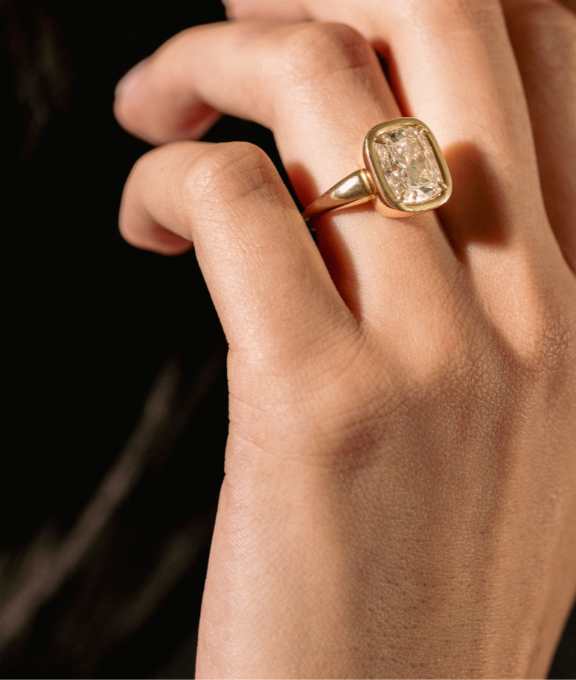
Modern CAD technology allows jewelers to transform reference photos into detailed digital blueprints, as you can see with this Vintage Ridge Shank Diamond Engagement Ring With Elongated Old Mine Cut Diamond that was a custom brought to life.
The Limits of a Single Image
A ring built from a photo comes out closer to the original rather than a perfect match, for two reasons worth knowing.
Material Facts Beyond the Image
A picture shows style and stone layout, but it cannot prove what a ring is made of. Metal purity, gemstone authenticity, carat weight, and appraisal value do not survive in an image. They need testing, paperwork, or a jeweler examining the piece in hand.
A recreation matches the look you can see, not the specifications behind it. If a listing describes a two-carat natural diamond, a jeweler can recreate the appearance but cannot verify that claim from a photo alone.
Retouching and Trick Lighting
The online photo itself is usually the bigger problem because it was made to sell. Retouching can hide solder marks and scratches, warm the metal to a richer color, push the sparkle past life, and sometimes swap in a better stone than the one in the listing. Polished metal reflects its surroundings. Gemstones photograph less consistently, so the same diamond can look flat and gray in one image and dazzling in the next.
Color drift is one of the usual reasons ordered rings disappoint. You picture a warm ruby from the listing, the box arrives, you tilt it toward the window, and the stone in your hand sits closer to garnet than the photo ever let on. The online image works as a reference rather than a promise of the finished ring.
Reading the CAD Before You Commit
Your recreation gets its own preview, the CAD render, and it comes with the same kind of caveat. A render deliberately leaves out hand-added detail. The tiny beads that hold pavé stones are not modeled, and prongs look too tall because they are cast long and trimmed only after the stone is set. Hand-set pavé and the way real light moves through a diamond never make it onto a screen, which is why what arrives carries a fineness the preview could not show.
A good move is to ask the jeweler to place a past render next to a photo of the same finished ring, which helps calibrate what you are looking at. Hold the two side by side, and the gap becomes obvious. The render is flat and gray where the finished band throws light back at you, the modeled prongs blunt where the real ones taper to a polished point.
This stage matters because once you approve the CAD and pay the deposit, the order usually locks. Personalized pieces are often non-cancelable from that point, so the pause before sign-off is your last easy off-ramp. Be sure the render matches your reference before you approve it.

The CAD render is your opportunity to review proportions, structure, and design details before production begins. It serves as the bridge between inspiration and reality.
Recreation as a Chance to Upgrade
The best part of recreating an online ring is that you do not have to copy it exactly. A recreation is the natural moment to change whatever you would change, whether that means a warmer metal, a slimmer band, or a larger center stone. Lab-grown diamonds make those upgrades easier, often allowing a much larger center stone within the same budget. GOODSTONE treats those changes as part of the design process, sizing up the center or changing the metal before the new ring is cast.
One thing to raise early is structure. A center stone much larger than the original may need a new prong head and resetting, which some jewelers bill as a separate line item, so it is worth flagging when you ask for a bigger stone. Many who set out to copy a ring end up with the version they wanted all along rather than the one in the photo.

Recreating a ring does not mean copying it exactly. Many clients use the process to refine proportions, upgrade materials, or create a version that better reflects their vision.
Staying on the Right Side of Copying
There is a line between recreating a look and copying a protected design, and it is easy to stay on the safe side. Recreating a plain, non-branded style found online raises no copyright problem. Antique designs are fair to reproduce in full, and no one owns a generic solitaire or a classic three-stone.
The caution applies to current, distinctive designs tied to a specific brand or designer, which can be protected by copyright, a design patent lasting 15 years, or trade dress that protects a recognizable brand look. A brand name and its signature packaging stay protected even when the underlying style has spread across the industry.
This is why reputable jewelers offer an inspired-by version rather than an exact clone of a branded piece. The accepted approach is to draw on the elements you love, arrange them into a design with its own identity, and be open about the inspiration rather than imply the original brand made it.
For a current designer’s piece, jewelers often follow an informal habit of changing roughly a fifth of the design, more social etiquette than enforced law, and the upgrade choices above usually create that difference on their own.

Distinctive modern designs may be protected by intellectual property laws. Reputable jewelers focus on creating inspired-by interpretations rather than direct replicas.
Cost, Timeline, and the Right Jeweler
Recreating a ring usually starts in the low thousands plus the center stone. Engagement ring recreations usually range from $2,500 to $4,500 before the center diamond, starting around $3,000 at some jewelers, with the price depending on the number and size of stones, the metal, and the finishes. Some shops itemize a design retainer and a separate CAD fee, while others fold both into the total, so it is worth asking how a jeweler handles that.
The timeline is roughly 3 to 8 weeks, with simple designs closer to 3 and most custom rings 4 to 6. The production clock usually starts after you approve the CAD and pay the deposit.
An independent jeweler is usually the better route here, often at higher quality and a fairer price than people expect. Working from inspiration images is exactly how we build a custom ring, with a designer guiding the process in person at our Austin, Texas showroom or via virtual consultation.
Our review-before-production step is the part that suits a recreation, since you confirm the design against your reference and adjust the stone, metal, or size before any metal is cast. This is the checkpoint that keeps a photo-based build from drifting off what you pictured.

Custom recreations vary in price depending on the stone, metal, and level of detail involved. Understanding the process upfront helps set realistic expectations.
From a Screenshot to the Real Thing
If you have a ring saved on your phone, you are closer to owning it than you think. Pull together every photo you can find of it, from any angle, and add a scale reference or the carat and band details if you have them. Bring that to a jeweler and ask for an inspired-by recreation rather than an exact copy if the original is a branded design, then use the CAD sign-off as your checkpoint, the place to catch any mismatch before the order locks.
Treat the whole thing as an upgrade rather than a copy, since this is your chance to make the stone bigger, the metal warmer, or the band exactly right. The ring that arrives will not be the one in the photo. With the right jeweler, it will be better because it was built for your hand rather than a camera.

A saved photo is often all it takes to begin the process. With the right guidance, an inspiration image can become a custom ring tailored specifically to its future wearer.
Frequently Asked Questions
Can a jeweler make a ring from a picture?
Yes. When the physical ring is not available, a jeweler works from a sharp photo and a written description of the metal, stone, and finger size, then builds a CAD model. The result will look similar but not exact. More photos from different angles make the recreation more accurate.
Can a jeweler copy a ring I saw online?
Generally yes for plain, non-branded styles, since there is no copyright issue with recreating a generic design. Reputable jewelers avoid exact copies of current, brand-identified designs and instead offer an inspired-by version. That keeps you safely away from any infringement concern while still getting the look you want.
How accurate is a ring made from a photo?
Close in style but not identical. A photo conveys the design, era, and stone layout, but a single image can be blurry, obscure fine finishes, and provide no reliable scale, so a jeweler fills in the gaps with your description. Providing several photos and a size reference tightens the match.
Is it legal to copy an engagement ring design?
It depends on protection. Copying a copyrighted or design-patented piece exactly can infringe, while antique or generic designs are generally fair to recreate. A brand name and distinctive packaging stay protected as trademark and trade dress. The safe path is an original inspired-by design rather than an exact clone of a branded ring.
What is the difference between a replica and an inspired-by ring?
A replica copies the original down to its measurements and pattern. An inspired-by ring retains the general look while varying materials, proportions, or specific elements, so it stands as its own design. For anything branded or distinctive, the inspired-by route is the one jewelers use.
How much does it cost to recreate a ring from a photo?
Engagement ring recreations usually run about $2,500 to $4,500, plus the center stone, which starts around $3,000 at some jewelers. The price tracks the number and size of the diamonds, the metal, and the finishes. Choosing a lab-grown center can lower the total while letting you size up.
How long does it take to recreate a ring?
Roughly 3 to 8 weeks. Simple designs can be finished in about three weeks, while most custom rings take 4 to 6 weeks. Production starts after you approve the CAD and pay the deposit, so quick, confident sign-off keeps the timeline moving.
Why does my custom ring look different from the CAD render?
A render skips the hand work. The little beads that grip pavé stones are left out, and prongs come up too tall because they are cast long and trimmed only once the stone is set. Once those finishing touches are in place, the ring on the hand usually comes back the more flattering of the two.
Can I use a lab-grown diamond to recreate a ring I saw online?
Yes. Lab-grown diamonds set into any custom design let you reach a larger carat weight within the same budget, which is one of the usual reasons people recreate a ring rather than buy the original. You keep full control over the metal color and the setting detail.
How many photos does a jeweler need to recreate a ring?
More than one. Jewelers recommend several reference shots from different angles, including blurry ones or photos of the ring being worn so that they can reconstruct a fuller CAD model. A scale reference, such as a coin or a ruler, in the frame helps them get the size right.
Do I have to approve the design before the ring is made?
Yes, and you should. Jewelers have you sign off on the CAD before production so you are not surprised by differences, and many take the deposit only after that approval. Once it is approved and paid, a personalized piece often cannot be changed or canceled, so review it carefully first.



Deja un comentario (todos los campos son obligatorios)