





Emerald Cut Diamond Ratios Explained
Many people looking at emerald-cut diamonds initially focus on carat weight and clarity. However, another aspect strongly influences the stone’s appearance.
The length-to-width ratio affects whether the diamond appears more rectangular or square. Even a small change in this ratio, such as a difference of 0.15, can result in noticeably different appearances between two emerald cut diamonds of the same carat weight.
Before selecting a color or clarity grade, consider the length-to-width ratio, as it strongly influences the stone's overall impression.

The length-to-width ratio is one of the most influential factors in how an emerald cut diamond looks.
How the Ratio Works
You get the length-to-width ratio by dividing the diamond's length in millimeters by its width. A stone that measures 8mm long and 5.7mm wide gives you a ratio of about 1.40. The higher that number goes, the more elongated the rectangle becomes. The lower it drops, the closer you get to a square.
For emerald cuts, the classic range is between 1.30 and 1.60. Many buyers prefer ratios between 1.40 and 1.50. A 1.40 ratio is considered the standard emerald-cut proportion, and 1.50 offers a longer silhouette, often chosen for solitaire settings.

The ratio is calculated by dividing the diamond's length by its width, and for emerald cuts the classic range runs from 1.30 to 1.60.
What Each Ratio Range Looks Like
1.25 to 1.35: Compact and Squarish
Stones in this range appear compact and are sometimes chosen for specific styles, though they are less common in modern engagement rings. For those with long, slender fingers, a squarer emerald cut can provide a balanced look without appearing oversized.
1.40: The Classic Proportion
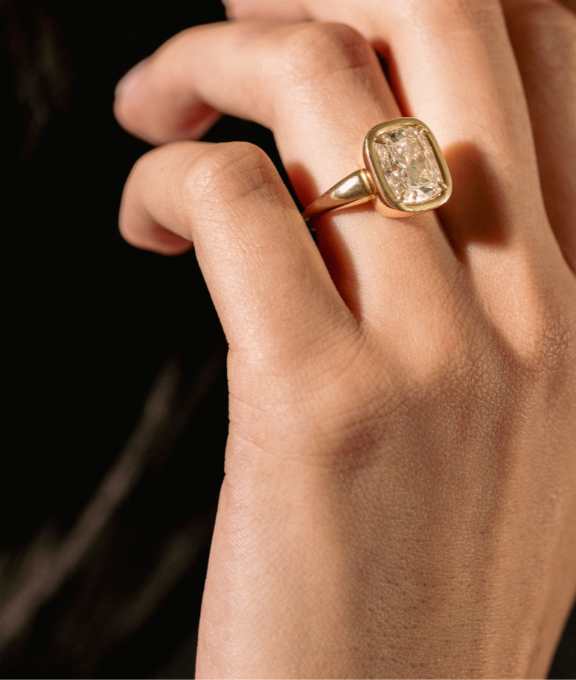
This ratio is commonly associated with the emerald cut. It appears rectangular without seeming stretched, giving the stone a balanced look. For those who prefer a recognizable emerald silhouette without a narrow appearance, 1.40 is a popular choice.
1.50: Noticeably Elongated
At 1.50, the stone appears longer, a proportion often selected for solitaire engagement rings. The added length can create an optical effect, making the diamond look somewhat larger than a version with a lower ratio at the same carat weight.
1.55 to 1.65: Dramatic and Finger-Flattering
Stones in this range have a noticeably elongated appearance and a slimmer profile, though they may look narrow in wider band settings. The way the diamond is mounted can influence how these proportions are perceived.
Recommended Depth and Table Percentages for Emerald Cuts
The ratio describes the shape, while depth and table percentage affect how the stone interacts with light. Two emerald cuts of the same carat weight may look different depending on their proportions.
|
Proportion |
Recommended Range |
What Happens Outside the Range? |
|
Depth Percentage |
61%-68% |
Over 70% of the stone’s weight is hidden in its depth, making it appear smaller. Below 59% can cause windowing, where light passes through the center, and the stone looks glassy. |
|
Table Percentage |
61%-69% |
Balanced light return and proper facet interaction. Tables around 64%-65% are common among well-performing stones. |
Depth and table percentages are part of a diamond’s proportions, but other cut-quality factors also influence its appearance and suitability for certain settings.
|
Feature |
Recommended Specification |
Why It Matters |
|
Girdle |
Medium to Slightly Thick |
Helps protect the edges without adding unnecessary weight. |
|
Culet |
None or Very Small |
Prevents a visible point or opening at the bottom of the diamond. |
|
Polish |
Excellent or Very Good |
Smooth facet surfaces improve light reflection. |
|
Symmetry |
Step-cut facets make asymmetry easy to see. |
Why the GIA Does Not Grade Cut on Emerald Cuts
The GIA assigns a formal cut grade only to round brilliant diamonds. Fancy shapes, including emerald cuts, do not receive an overall cut grade on GIA reports. The reports include assessments for polish and symmetry, but the overall proportional quality of the stone is not graded.
If a cut grade is listed for an emerald cut, that grade is assigned by the seller, not by GIA. GOODSTONE’s gemologists select diamonds for the collection that meet Excellent Cut-grade criteria, narrowing the range of quality for clients.

Any cut grade listed for an emerald cut comes from the seller rather than GIA, making independent evaluation of proportions and visual performance essential.
How Ratio Fits Different Hand Sizes
Finger shape and the diamond’s ratio are related considerations. Those with shorter fingers may prefer a 1.50 or higher ratio for a lengthening effect. Longer fingers may be complemented by ratios between 1.30 and 1.45 without the stone appearing overly elongated.
For smaller hands, a ratio of 1.45 or higher helps keep the diamond proportional without adding excessive width. An emerald cut often appears about 5% larger than a round brilliant of the same carat weight due to its shallower depth and elongated outline.

Shorter fingers tend to benefit from a ratio of 1.50 or higher for a lengthening effect, while longer fingers are often complemented by something in the 1.30 to 1.45 range.
Light Performance and the Hall-of-Mirrors Effect
The emerald cut features alternating bands of dark and light that run vertically through the stone. Well-balanced internal proportions enhance this visual effect.
Advanced gemological analysis suggests that a crown height of 11% to 14% of total depth, paired with a pavilion depth ratio of 42% to 45%, produces the crispest version of that mirror-like pattern.
When proportions fall outside these ranges, windowing may occur, making the center look transparent, or extinction may appear as dark patches. Both effects reduce visual appeal and are best avoided before purchase.

The emerald cut's signature alternating bands of light and dark depend on well-balanced internal proportions.
Where Emerald Cuts Sit in the Market Right Now
Searches for emerald cut diamonds increased 95% from 2020 to 2026, and sales rose 62% over the same period. The shape currently represents approximately 12% of market share, ranking fourth after rounds, ovals, and cushions.
Step-cut stones are recognized for their straight lines and transparent appearance. The east-west setting orientation, in which the emerald cut is positioned horizontally along the band, has become increasingly popular since 2026.

Searches for emerald cut diamonds have risen 95% since 2020, with sales up 62% over the same period, making it the fourth most popular shape behind rounds, ovals, and cushions.
Finding Your Ratio
Selecting a ratio depends on the desired appearance of the stone and the chosen setting style.
A 1.40 ratio is considered classic. Ratios from 1.50 to 1.55 offer more length and a distinct presence. Above 1.55, the profile becomes slimmer and more pronounced. Ensuring depth, table, symmetry, and polish align with the selected ratio is important.
Because the GIA does not provide a cut grade for this shape, our team evaluates each stone individually to ensure consistent standards.



Leave a comment (all fields required)