

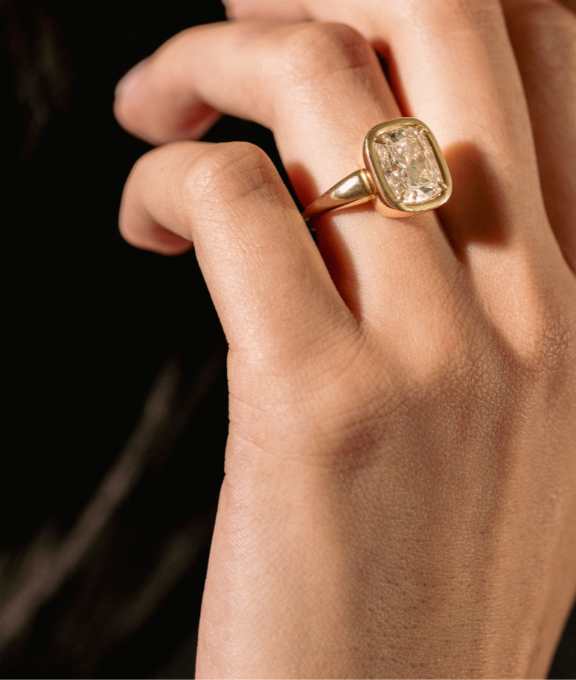
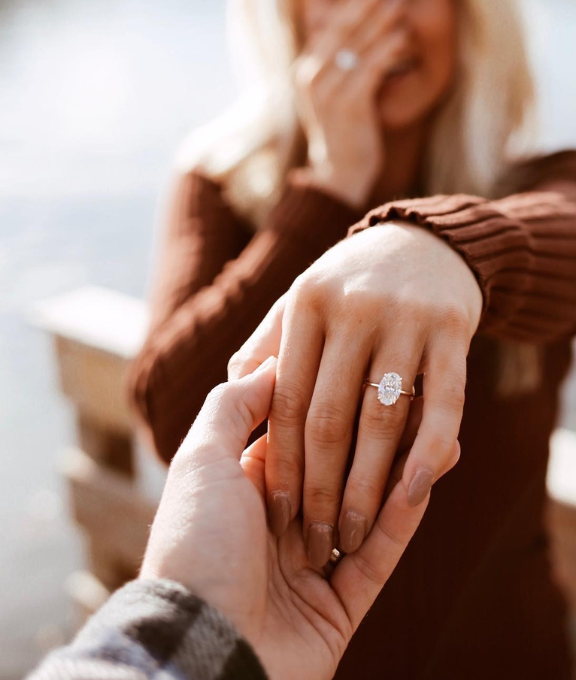


La forma de diamante más popular de todos los tiempos: cuando se cortan perfectamente, los diamantes redondos están diseñados para brillar más que todas las formas con un brillo lo suficientemente intenso como para ocultar las inclusiones hasta cierto punto y mejorar el color percibido (hacerlo blanco).
Can't find the perfect diamond?
talk to an expert
Get a bespoke design from
GOODSTONE that'll last a lifetime.


I couldn't be happier with my engagement ring from Goodstone! The entire team was incredible to work with-from the talented designers to Monica, who guided me through every step of the process. They took the time to make sure every detail was exactly as I envisioned, down to the millimeter, and the final result was absolutely perfect.

Every round-cut diamond in our collection is reviewed internally against our quality standards for symmetry and proportion.
Solitaires range from a thin band to a hidden halo, with three-stone, half-bezel, and pavé options in 14k gold, 18k gold, and platinum within the round-cut engagement ring lineup.
Every ring is handmade from recycled gold at our Los Angeles workshop and ships overnight in a plain FedEx box, fully insured, with an adult signature required upon delivery.
Our round rings include free lifetime resizing, a 30-day return window, and complimentary polishing and prong inspections for as long as you own the ring.

Round brilliants have been the most popular diamond shape since their modern proportions were calculated in 1919. The Asscher cut predates them by 17 years and is less common. Its square outline and step facets create a distinctly geometric look rooted in Dutch diamond-cutting tradition.
Softer edges distinguish the cushion from the round brilliant. The cushion’s rounded corners create a gentler outline, while the round prioritizes symmetry and light return. Rounds typically have stronger resale demand, while cushions appeal to buyers who prefer a less structured silhouette.
Art Deco influence is more visible in an emerald cut, with its step facets, elongated outline, and geometric appearance. The round brilliant relies on a circular shape and balanced light return that remain familiar to most buyers. Emerald cuts draw more attention to their design, while rounds emphasize sparkle.
Shape creates the biggest difference between these two cuts. The round brilliant features a circular silhouette and balanced proportions, while the marquise extends across the finger with an elongated shape and pointed ends. That added length can create a stronger lengthening effect on the hand, though the tips require protection from the setting. The result is a more distinctive silhouette than a round.
Old European cuts come from an earlier era of diamond cutting, before modern techniques lowered crowns and minimized culets. Their broader facets and hand-cut proportions create a different look from a modern round brilliant, which is designed for light return and symmetry. The visual difference is often between antique character and contemporary brilliance.
Before modern cutting standards, old mine diamonds were hand-shaped with broader facets and less uniform proportions. A modern round brilliant follows a different set of priorities, emphasizing symmetry and light return.
Shape is the biggest difference between these two cuts. A round brilliant features a balanced circular silhouette, while a pear combines a rounded end with a single point, creating a more directional appearance. Pear cuts can also have a stronger lengthening effect on the finger than a round.
Square geometry distinguishes the princess cut from the round brilliant. Both are brilliant-cut diamonds with strong light return, but the princess features sharp corners and a square silhouette, while the round relies on a circular silhouette.
Late-’90s engagement ring design helped popularize the radiant, with its brilliant faceting and square or rectangular outline. The round brilliant’s circular shape is the most widely recognized diamond silhouette. Both offer strong sparkle, but the radiant introduces more geometry into the design.

"We don't believe in one right answer when it comes to diamonds. Lab-grown or natural stone to finished pieces, what matters is that you walk away with something exceptional. That's always been our standard."
- Blake Asaad, founder
Rounds are the most expensive diamond shape because they require more material loss during cutting and face the strongest market demand. A round brilliant typically sacrifices about 60% of the original crystal, while shapes such as the princess and radiant retain more of it. Round brilliants often cost 20 to 35% more per carat than fancy shapes with similar color and clarity.
A 1-carat natural round in near-colorless VS grades typically costs $4,500 to $7,000 for the stone alone. Comparable 2-carat stones often range from $12,000 to $25,000, while 3-carat examples can reach $40,000 to $70,000. Lab-grown rounds are less expensive, with 1-carat stones typically costing $1,000 to $1,500, 2-carat stones $2,000 to $5,000, and some 3-carat examples starting around $2,000.
Excellent is the highest cut grade GIA assigns to round brilliants. Ideal was the equivalent AGS grade and is frequently used for top-tier proportions. Hearts and Arrows refers to Excellent or Ideal stones that display a precise optical pattern when viewed through a special scope. These diamonds often command a premium despite showing little visible difference to the naked eye.
Yes. The round brilliant uses 57 or 58 facets arranged to maximize light return, fire, and scintillation. Fancy shapes such as oval, pear, marquise, and cushion use similar brilliant faceting but sacrifice some optical performance to achieve elongated or square outlines. Step cuts such as emerald and Asscher prioritize clarity and broad light flashes over maximum sparkle. No other diamond shape matches the sparkle of the round brilliant.
Yes. A round has a smaller face-up footprint than an oval or marquise of the same carat weight because more of its weight is concentrated in pavilion depth. An oval typically appears 10 to 15% larger face-up than a comparable round, while a marquise can appear 15 to 25% larger because of its elongated outline. The difference is more visible when the shapes are viewed side by side.
There is no single best style. A solitaire keeps the focus on the center diamond, while a hidden halo can increase perceived size without changing the view from above. A three-stone setting adds side stones such as trapezoids, half-moons, or smaller rounds for a more elaborate design. The best choice depends on whether you prefer simplicity, added visual presence, or a more detailed setting.
G and H are often considered the strongest value grades for round diamonds set in platinum and white gold. Both fall within the near-colorless range and typically appear white face-up. I can also appear near-colorless in white metals and bright white in yellow or rose gold, where warmer metal helps mask faint color. J is generally better suited to yellow or rose gold. Round brilliants conceal color more effectively than step cuts because their brilliance scatters body color throughout the stone.
VS2 and SI1 often provide the best value in round brilliants because the cut’s high scintillation helps conceal small inclusions. VS2 diamonds are typically eye-clean, while SI1 stones may require a quick review of inclusion placement. VS1 and VVS grades usually cost more without a visible benefit, and some SI2 diamonds can also appear eye-clean when inclusions remain near the edge.
A standard Excellent or Ideal grade evaluates proportions, polish, and symmetry. Hearts and Arrows refers to a precise optical pattern visible through a specialized scope. Every Hearts and Arrows diamond also qualifies as Excellent or Ideal, though relatively few Excellent stones display the pattern. The premium is often 10 to 25%, with little visible difference in everyday wear.
The round-cut has been the most popular engagement ring shape for more than a century. Industry data from 2024 and 2025 shows that rounds accounted for roughly 60% of engagement ring sales, with oval cuts ranking second. Its circular outline works with various settings and finger shapes, and they have the strongest resale market of any diamond shape.
No. Lab-grown and natural round diamonds are optically identical, sharing the same refractive index, dispersion, Mohs scale hardness, and crystal structure. Even trained gemologists rely on specialized equipment over visual inspection to determine how a diamond was grown. At comparable color, clarity, and cut grades, a lab-grown round looks the same as a natural one in everyday wear.
Start with the grading section, which lists color, clarity, cut grade, polish, symmetry, and fluorescence. The report also includes the diamond’s measurements and carat weight, along with a proportion diagram showing table size, depth, crown angle, pavilion angle, and girdle thickness. A plotting diagram identifies inclusions and surface characteristics, while the QR code links to verification on the GIA website.
Fluorescence is the glow some diamonds emit under ultraviolet light, graded by GIA from None to Very Strong. Medium or strong blue fluorescence can make a warmer-colored round appear about half a grade whiter face-up in daylight and may result in a 5 to 15% discount. Strong or Very Strong fluorescence occasionally causes a faint haze in colorless diamonds, though this occurs in fewer than 3% of cases.
A GIA Excellent cut grade is the strongest indicator of cut quality when you cannot view a diamond in person. For proportions, look for a table between 53% and 58%, a depth between 59% and 62.5%, a crown angle between 34 and 35 degrees, and a pavilion angle between 40.6 and 41 degrees. The girdle should fall within the thin-to-slightly-thick range, and the length-to-width ratio should remain close to 1.00.
The round’s flexibility allows it to pair with every metal. Platinum and 14k or 18k white gold flatter D-to-H color rounds because the cool metal preserves the colorless face-up appearance. Yellow gold suits I or J rounds since the warm metal blends faint tint into the design. Rose gold appears romantic and pairs well with most color grades. A two-tone ring with a white-gold head on a yellow-gold band preserves the white look while warming the band.
Round solitaire is the lowest-risk shape for buyers choosing without partner input, because the circular silhouette suits every finger length and width. Fancy-shape solitaires such as oval, pear, marquise, and emerald either lengthen the finger or square it off, depending on personal taste. Round solitaire also carries the strongest resale market and the broadest style flexibility. A fancy-shape solitaire suits buyers who want a distinctive look and is the stronger pick when style preferences are clear.
On an average finger in size 6 to 6.5, a 1-carat round measures about 6.5 millimeters across and looks classic and proportional. A 1.5 carat round measures about 7.4 millimeters and reads a step larger. A 2-carat round at about 8.15 millimeters fills the finger more and looks bold. The 1-carat size carries historical significance. The 1.5- to 2-carat range is the modern median for buyers in larger cities and those choosing lab-grown rounds.
Round diamonds pair well with any precious metal. Platinum and white gold complement D-to-H color grades because their cooler tones maintain a bright white appearance. Yellow gold pairs especially well with I and J diamonds, where the warmer metal helps mask faint color. Rose gold also works with various color grades. A two-tone design with a white-gold head and yellow-gold band combines the benefits of both.
Yes. Round brilliants generally have better resale value than fancy shapes because they have the strongest demand and deepest secondary market. Fancy shapes often experience 5 to 20% greater depreciation, though the exact difference varies by shape and market conditions. Ovals have performed relatively well recently because of sustained demand, while more trend-driven shapes can fluctuate more.
Clean the ring at home every two to four weeks using a gentle jewelry-cleaning method. Professional cleaning and prong inspections every six months are recommended by most jewelers and insurance providers. Rings worn daily may benefit from inspections every three to four months. During an inspection, a jeweler checks the prongs, setting, and overall condition of the ring.
Get in touch with our concierge team to book a one-on-one call with us to discuss about your Engagement Ring. We will walk through the process from diamond sourcing to choosing the perfect setting.


