


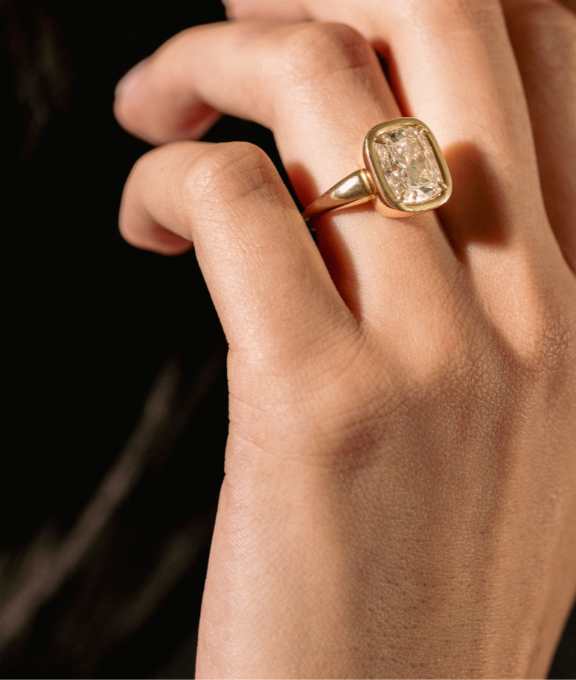

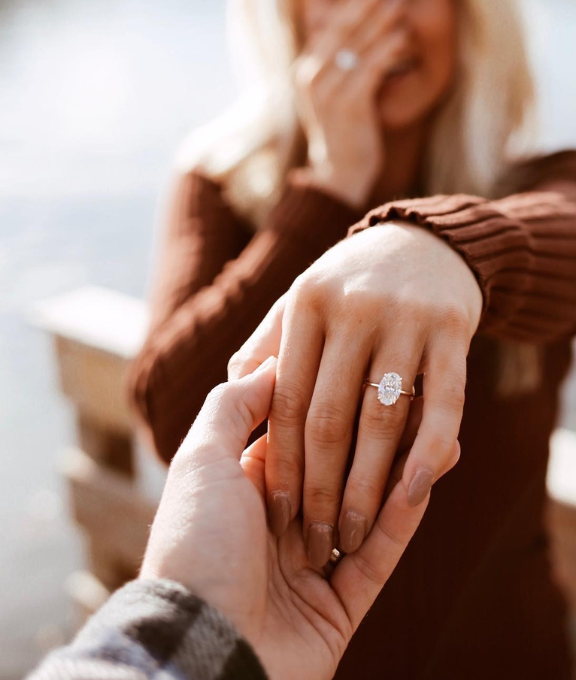


What Is the Bow-Tie Effect in Elongated Diamonds?
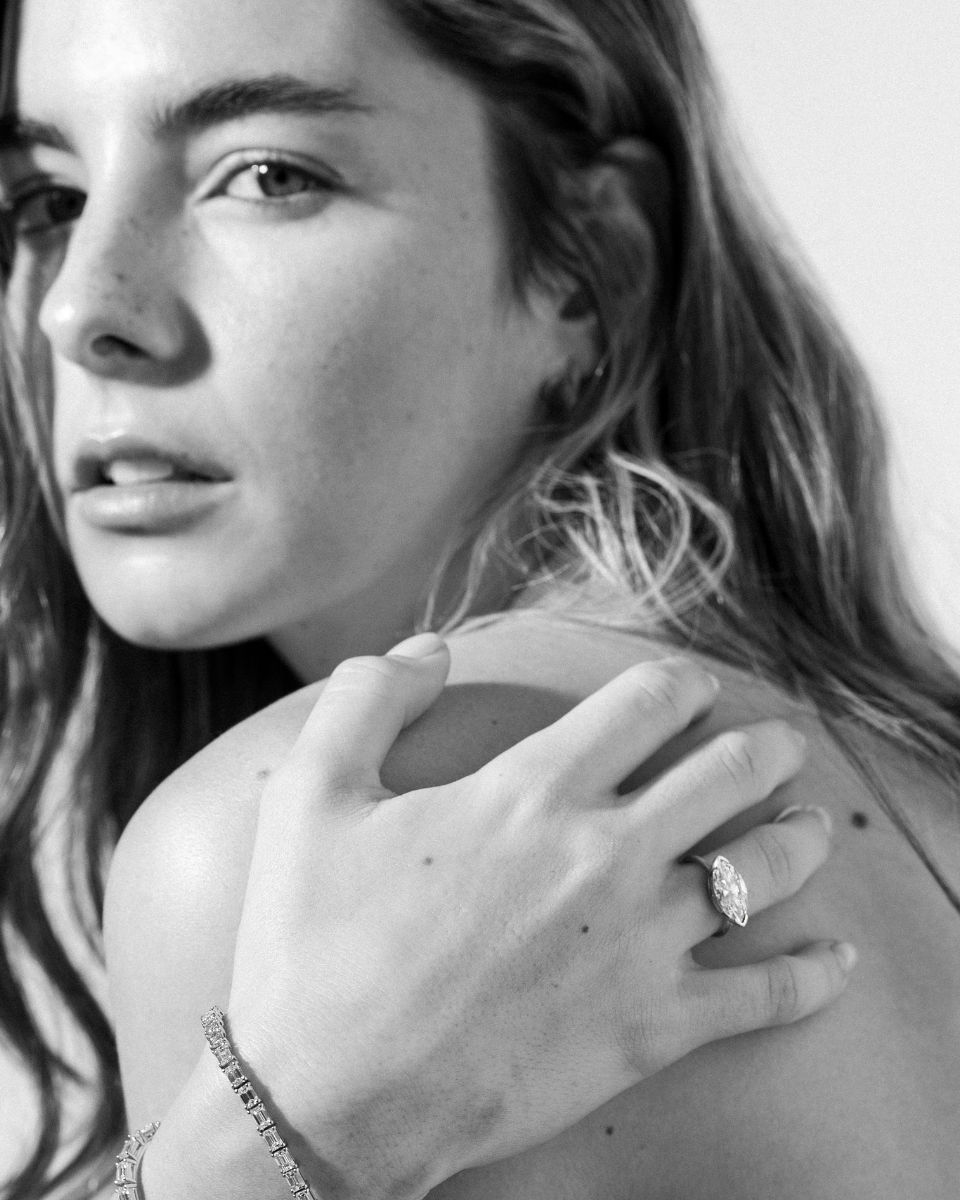
Looking closely at an oval or marquise diamond, a dark band running across the center is often visible. This is known as the bow-tie effect. At first glance, some may think there is an inclusion or a problem with the diamond, but the cause is different.
The bow-tie is a shadow caused by how light interacts with the diamond’s facets and the viewer’s position. When someone examines the stone, their head can block some of the light that would otherwise reflect back, resulting in a strip of darkness that varies in visibility.
Every elongated diamond has some version of this, and how much it bothers you depends on how well the diamond was cut and how you evaluate it before buying.

That dark band running across the center of an oval or marquise diamond isn't a flaw — it's a optical phenomenon known as the bow-tie effect.
How the Bow-Tie Forms
A diamond’s facets work like small mirrors. They pick up light from the area around the stone and bounce it back toward whoever is looking at it. When you lean in close to an elongated diamond, your head and shoulders block part of the incoming light.
The facets that would have reflected that blocked light instead produce dark patches, and because of the stone’s elongated geometry, those patches tend to line up horizontally across the center in a shape that looks like a bow tie.
This is not an internal flaw; there is no crack, clouding, or impurity causing it. The effect is an obstruction of light, a shadow created outside the diamond and projected inward by the facets. The shadow becomes more visible when examined closely and less so from a distance.

A diamond's facets act like small mirrors, and when you lean in to examine an elongated stone, your head blocks some of the incoming light those facets would otherwise reflect back.
Which Diamond Shapes Show a Bow-Tie?
The bow-tie effect is most noticeable in elongated brilliant-cut diamond shapes, such as ovals, marquise, and pears.
|
Diamond Shape |
Bow-Tie Effect Likelihood |
|
Oval |
Common |
|
Marquise |
Very common |
|
Pear |
Common |
|
Heart |
Sometimes visible |
|
Radiant |
Possible but often diffused |
|
Round |
Does not occur |
|
Princess |
|
|
Emerald |
|
|
Asscher |
Why Cut Precision Matters So Much
The intensity of the bow-tie effect relates to the quality of the diamond’s cut.
Several factors influence how visible the bow-tie becomes:
-
Facet alignment: When facets are misaligned or poorly polished, certain areas become darker, making the bow-tie more pronounced.
-
Depth percentage: Shallow-cut diamonds let excess light escape from the bottom. Deep-cut diamonds trap light, creating darker areas.
-
Length-to-width ratio: As the gap between length and width increases, the bow-tie often darkens due to more challenging pavilion angle control.
GIA educational materials indicate that a depth range of 58% to 63% can help balance light reflection and reduce bow-tie intensity.
Proportion Guidelines for Ovals
For oval diamonds, gemological sources suggest a depth of 57% to 62%, a table of 53% to 64%, and a length-to-width ratio of 1.40 to 1.50. GOODSTONE’s diamond cuts guide recommends a depth of 62% to 66% for optimal brilliance while minimizing the bow-tie effect.
Ovals with depths below 60% often have low pavilion angles that produce more visible bow ties. Going above 68% in depth can reduce the bow-tie but tends to compromise the stone’s overall optical performance.
-
Length-to-width ratios: 1.30:1 to 1.40:1 offer gentle elongation, while 1.41:1 to 1.50:1 create a slimmer profile. Ratios above 1.50:1 are rare and may display a stronger bow-tie effect.
-
Symmetry grading: GIA evaluates symmetry from Excellent to Poor. For ovals, Excellent or Very Good symmetry contributes to a balanced appearance.
Why Certificates Alone Won’t Tell You
GIA assigns a formal cut grade only to round brilliant diamonds. Fancy shapes, such as ovals, receive polish and symmetry grades but not an overall cut grade due to variations in proportions and facet styles. The bow-tie effect is not mentioned on GIA certificates.
In September 2022, IGI began including a cut grade on reports for loose fancy-shaped diamonds. This system incorporates shape-specific considerations, including the bow-tie for ovals, marquise, and pear shapes. However, IGI does not grade bow-tie severity as a standalone metric.
GIA published a paper in the fall 2024 issue of Gems & Gemology that represents 10 years of research on the face-up appearance and outline appeal of oval, pear, and marquise diamonds.
The study provides groundwork for a future fancy-cut grading system, though none has been formalized. Researchers found that variability in fancy shapes would require predictive grading systems to rely on 3D representations rather than just traditional proportions.

GIA does not assign an overall cut grade to fancy-shaped diamonds, and the bow-tie effect doesn't appear on any grading certificate.
Is a Bow-Tie Always Bad?
Not necessarily. A faint bow-tie can actually work in your favor because it creates contrast within the stone and improves scintillation, that play of light and dark you see when the diamond moves. A subtle shadow adds dimension to the stone, preventing it from looking flat.
A strong bow-tie can disrupt brilliance and draw attention to the center in an unflattering way. It may also indicate less precise cutting and can affect resale value.

A faint bow-tie isn't necessarily a problem, a subtle shadow can actually add contrast and dimension, enhancing the stone's scintillation and preventing it from looking flat.
How to Evaluate Before You Buy
Since no certificate notes the bow-tie effect, direct evaluation of the diamond is recommended.
When assessing bow-tie visibility, consider the following:
-
View the diamond in motion, either in person or through high-quality video.
-
Compare stones with similar length-to-width ratios and proportions.
-
Examine the diamond under natural daylight when possible.
-
Do not rely solely on grading reports; proportions that seem appropriate on paper may still produce a visible bow-tie.
How Your Setting Affects the Bow-Tie
Your ring setting affects how the bow-tie reads once the diamond is mounted. A hidden halo adds light return from the sides, which can soften the shadow. Raised settings allow more light to enter from below. Thoughtful prong placement helps distribute light more evenly.
On the other hand, full bezel settings cover the entire perimeter and limit the amount of light reaching the diamond. Too much metal beneath the stone can intensify the bow-tie effect, so it is worth thinking about your setting choice as part of the overall evaluation.
How to Evaluate the Bow-Tie Effect in a Diamond
The bow-tie effect can seem concerning, but understanding its mechanics helps clarify it. All elongated diamonds exhibit some degree of this effect, and a small amount of contrast enhances visual appeal.
Aim to find a diamond where the bow-tie effect remains subtle, and the cutting allows light to move through the stone evenly, producing a soft shadow.
Evaluate the stone in person, pay attention to depth and symmetry grades, and select a setting that complements the diamond.



Deja un comentario (todos los campos son obligatorios)