


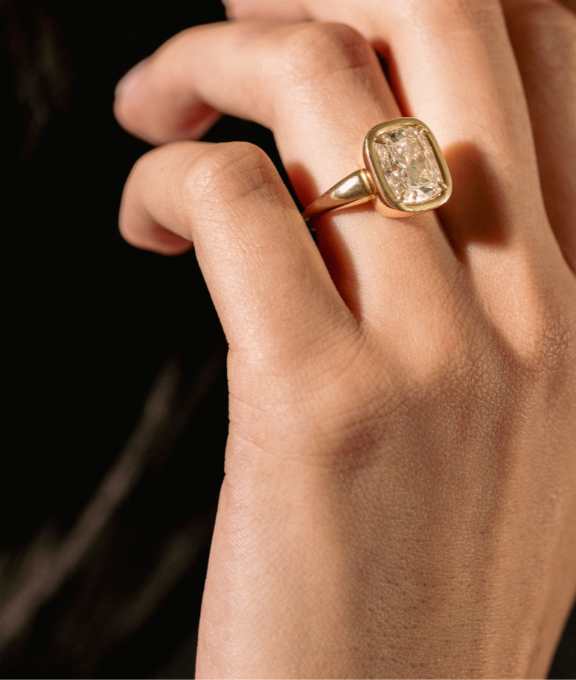




What Is a Hidden Halo Engagement Ring?
A hidden halo engagement ring sets a circle of small diamonds beneath its center stone, worked into the side of the mounting where only a side view reveals them. From above, the ring looks like a plain solitaire.
That placement surprises many first-time buyers, who expect the extra diamonds to show from the top. They never do. The added sparkle shows only in the profile view, so judging the ring means looking at it the way the wearer does all day, from the side.

A hidden halo keeps the clean look of a solitaire from above while revealing an unexpected layer of sparkle from the side. It's a subtle detail designed primarily for the person wearing the ring to enjoy.
How Is a Hidden Halo Constructed?
The hidden halo belongs to the halo family, but it repositions the accent stones. A row of pave melee is set into the vertical face of the mounting, directly below the girdle of the center diamond or around the base of the prongs. Because the accents occupy the underside of the mounting, they add no width to the ring's face. Jewelers also call the style an under-halo or a secret halo, and both names describe the same construction.
A solitaire goes dark at certain angles because its sparkle depends on light entering and returning through the top of the stone. With a hidden halo, light entering from the side catches the small diamonds beneath the center stone. The ring keeps returning light at angles where a solitaire produces little. The effect is strongest when the hand turns and the under-row catches light in flashes rather than as a constant glow.
Lifting the center stone slightly above its base adds a second effect. The diamond appears to hover over a lit gallery, and jewelers describe this as a floating look. It is part of what buyers notice when they tilt the ring for the first time.
A hidden halo does not make the center diamond sparkle more, and it does not change the stone's cut or light performance. What it adds is separate scintillation from below and beside the center stone. Buyers who expect a bigger-looking diamond from above are describing the classic halo's job, and they will be disappointed if nobody tells them the difference before they buy.

A hidden halo places a delicate row of diamonds beneath the center stone rather than around it. The result adds dimension and side-view sparkle without changing the center diamond's silhouette from above.
What's the Difference Between a Hidden Halo and a Classic Halo?
The two styles place similar ingredients on different planes. A classic halo surrounds the center stone on the same horizontal plane, visible from directly above, and it adds obvious face-up width. Depending on the accent stones, a classic halo can make the center diamond appear up to roughly half a carat larger. A hidden halo adds no face-up width at all. Its accents lie below the girdle, where the top view cannot reach them.
A buyer who wants maximum presence from across a room wants the classic halo. A buyer who wants a clean solitaire outline with a private detail wants the hidden version. The person who sees a ring's side profile most often is the wearer, whose own view of the hand comes at an angle. Owners consistently describe that private view as the point of the purchase.
Price and age differ as well. Halo-style settings generally run 10-20% above a comparable solitaire setting, with hidden halos falling at the cheaper end because they use fewer and smaller accent stones. The hidden version is also the younger style by roughly a century of halo history. It emerged during the 2010s and went mainstream around 2020-2021, and some buyers worry the look will date their ring to this decade.

A classic halo is designed to create visible presence around the center stone, while a hidden halo keeps its sparkle tucked beneath it. Our Bezel Set Halo Engagement Ring With Pear Cut Diamond has a stunning halo that surrounds the pear cut diamond.
What Types of Hidden Halo Settings Exist?
The category has split into several constructions, and the differences are structural. Accent placement governs the ring's height and side appearance, along with how it accepts a wedding band. Each construction also wears differently against the neighboring fingers, which buyers with close-set fingers notice on the first day.
The Single Hidden Halo That Rings the Prong Base
One row of small diamonds circles the base of the prongs or the basket beneath the center stone. The row usually follows the girdle line of the center stone, so a round center takes a circular row and an oval takes an elliptical one. This is the standard form and the least obtrusive, adding minimal height while producing the side glow the style is known for. Most ready-to-ship hidden halo rings use this construction.

A single hidden halo creates a fine line of sparkle beneath the center stone without overwhelming the setting. Its restrained profile makes it the most subtle interpretation of the design, as you can see on our beautiful Compass Solitaire Engagement Ring with Round Cut Diamond.
Outside Hidden Halos and Wraps That Use More Melee
In an outside hidden halo, the accent stones are set on the outer face of the prongs, which makes the sparkle slightly more visible from casual angles. The wrap variant extends the pave further around the basket, sometimes decking the entire gallery in small stones, and a double hidden halo stacks two full rows beneath the center stone. Both versions use more metal and more melee, and both raise the price above the single-row form. They also add more surface area for the upkeep discussed below.
Profile Halos and Colored-Stone Halos That Personalize the Side View
A profile halo places diamonds along the prongs themselves or along the visible side structure of the mounting, blending the hidden-halo idea into the ring's full side design. Custom shops also set the hidden row in sapphires, amethyst, or birthstones. Since the accent row is concealed from the top anyway, a colored halo works as a private personalization that never competes with the center stone. Three-stone and cathedral designs can include a hidden halo as well, a request custom jewelers report receiving regularly. Profile halos suit buyers who want the detail worked into the prongs themselves, and the line of stones stays most distinct in white metals.

The hidden position of a profile halo creates an opportunity for details meant primarily for the wearer.
Which Diamond Cuts and Metals Suit a Hidden Halo?
Round brilliant and oval diamonds account for most hidden halo requests. Pear, cushion, radiant, princess, and marquise follow, and each produces a slightly different side profile under the same construction.
Step cuts call for a specific mention. Emerald and Asscher cuts have clean architectural lines that a classic halo can crowd. A hidden halo adds sparkle around them without disturbing those lines from above. For buyers drawn to step cuts, this is the version of the halo that preserves what they chose the cut for.
Metal choice changes what the hidden row does. Platinum and white gold let the accent stones blend with the center diamond, so the hidden diamonds appear to float without a visible boundary. Yellow and rose gold take the opposite direction, making the under-gallery read as a deliberate band of light in a second tone. Two-tone builds, usually a yellow or rose gold shank under a white metal head, pick up the underside detail in both metals and show the construction most clearly.
The decision between a blending metal and a contrasting one comes down to how visible the detail should be. White metals suit buyers who want the sparkle without advertising the construction. Yellow and rose gold suit buyers who want the under-gallery read as part of the design. Confirm the metal pairing against a side-view photo of the ring itself before ordering, since product renders frequently merge the two tones into one.

A hidden halo can complement everything from brilliant cuts to architectural emerald and Asscher diamonds.
How Does a Hidden Halo Affect Height and Wedding Band Fit?
Making room for stones beneath a center diamond has a physical cost, and it usually gets paid in height. The structure supporting the halo raises the center stone in most executions, producing a taller profile that can catch on clothing and gloves. Low-profile hidden halos exist, but they are engineered exceptions. Buyers should treat a standard hidden halo as a higher-set ring until they confirm otherwise.
No part of this topic generates more contradictory advice than wedding band fit. The conflicting advice reconciles once the variables are distinguished. Fit is a matter of head geometry. Many hidden halos stack nearly flush, because the accents lie below the center stone and leave room for the band. A center head that juts wider than the shank creates a gap regardless of the halo. Genuinely low-profile versions create the opposite problem, and at least one bespoke maker discloses on its own product page that a straight wedding band will not fit flush against its ultra-low hidden halo design.
A contoured band resolves most of these cases, since it is made to follow the ring's profile. The contour must be cut for the specific ring, because a generic curved band rarely matches a head it was not built against. Buyers committed to a straight band should confirm the fit before purchase, with the ring in hand and not a stock photo. Asking the jeweler for the head height in millimeters gives a concrete number to plan around, and a higher head shows more of the center stone from the side even as it complicates the stack.
There is one more hazard that rarely gets mentioned until after the purchase. The side-set diamonds of a hidden halo lie exactly where a wedding band presses against the engagement ring, and diamond scratches both diamond and gold. Rings stacked flush without clearance can abrade each other for years before anyone notices. A millimeter of clearance between the two rings prevents the contact entirely.
Custom design houses treat all of this as solvable geometry at the design stage. GOODSTONE, for instance, builds each custom engagement ring through a one-on-one process with a designer, so basket height and the wedding band's curve are settled on the same sketch. Buyers shopping ready-made rings can reach a similar result by testing the intended band against the ring and ignoring category-level promises.
What Maintenance Does a Hidden Halo Need?
The under-gallery that makes the setting attractive also makes it harder to maintain. Lotion and soap film collect beneath the center stone faster than they do on a plain solitaire, joined by skin oils. A standard toothbrush cannot always reach the space between the girdle and the basket. Owners on diamond forums describe a grey film that dulls the tilt-view sparkle until the ring is properly cleaned, with remedies ranging from an electric toothbrush with a jewelry head to professional steam cleaning, and some owners finish with an alcohol rinse. Small pave stones anywhere on a ring can loosen with wear, and the hidden halo's melee is no exception. A professional inspection roughly every six months catches loose accents before they drop. Every couple of weeks, a gentle brush in warm soapy water keeps the under-gallery free of buildup between visits.

The same tucked-away details that make a hidden halo special need a little extra attention. Regular cleaning and occasional prong inspections keep the under-gallery bright and its delicate accent diamonds secure.
Frequently Asked Questions
What is the difference between a halo and a hidden halo?
A classic halo surrounds the center stone on the same horizontal plane and shows from the top, where everyone who looks at the wearer's hand will see it. A hidden halo lies below the girdle and shows only from the side, the angle the wearer sees most often.
Does a hidden halo make the diamond look bigger?
A 1.00-carat round center in a hidden halo still measures about 6.5mm across from above, the same as in a plain solitaire, so the added size is not face-up.
Is a hidden halo more expensive than a solitaire?
Setting-only retail examples run about $1,080 to $1,895, a modest premium over a plain solitaire mounting, with the accent melee and setting labor accounting for the difference.
Are hidden halo rings hard to resize?
The halo itself rarely blocks resizing because it is built into the head, away from the shank. Designs that pair the halo with a full pave band are harder to resize, as with any pave-heavy ring.
Can you wear a wedding band with a hidden halo ring?
Because the accents lie below the center stone and leave room for the band, most hidden halos accept one. The exceptions, heads wider than the shank or ultra-low designs, pair with a contoured band made to follow the ring's profile.
Can a hidden halo scratch your wedding band?
A hidden halo can scratch a wedding band when the two rings stack without clearance, because diamond abrades gold and other diamonds. Jewelers recommend confirming clearance between the rings or choosing a higher-set halo for stacking.
How do you clean a hidden halo engagement ring?
A soft brush in warm soapy water every couple of weeks handles routine film, and stubborn residue calls for an electric toothbrush with a jewelry head or a professional steam cleaning. Some owners finish with an alcohol rinse. Ultrasonic cleaners are best left to a jeweler, since strong vibration can loosen pave.
Do the small diamonds in a hidden halo fall out?
Pave melee anywhere on a ring can loosen with wear, and the hidden row is no exception, so an occasional lost stone is expected. Replacing it is routine and inexpensive, and twice-yearly inspections usually catch loosening before a stone drops.
Is a hidden halo a trend or a classic?
The style emerged in the 2010s and went mainstream around 2020-2021. The halo family is roughly a century old, and each dominant version has dated as the next refinement arrived.
Can you add a hidden halo to an existing ring?
A retrofit means fabricating a new head or remounting the center stone in a new setting, because the halo is part of the mounting itself and there is no bolt-on version.




Deja un comentario (todos los campos son obligatorios)