

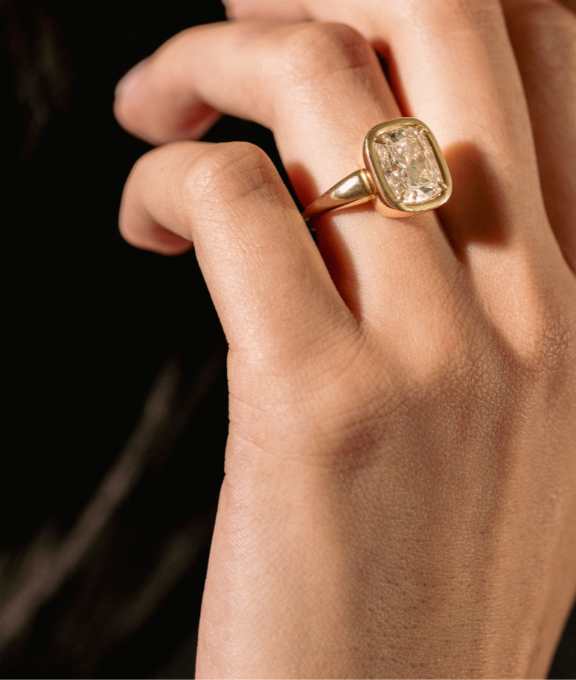



Four prongs at the cardinal points keep your diamond firmly in place, and a hidden halo beneath adds soft light from every angle. Our Compass collection is waiting for you.
Can't find the perfect diamond?
talk to an expert


Very happy with the service and customer care. This was a pleasant easy experience and they stuck with me throughout the entire process.

The Compass Solitaire Engagement Ring redefines timeless elegance with a modern twist. Featuring a breathtaking hidden halo, this design offers an understated brilliance that elevates the traditional solitaire. A delicate row of diamonds is artfully placed beneath the center stone, creating a mesmerizing sparkle visible from every angle. This innovative design not only adds depth and dimension but also highlights the central diamond, ensuring it remains the star of the design.
What truly sets the Compass Solitaire apart is its signature prong design, inspired by the four cardinal directions: North, South, East, and West. This unique detail not only secures the center stone but also symbolizes guidance, direction, and steadfastness, making it a meaningful choice for couples embarking on life’s journey together.
A compass setting is a solitaire whose four prongs stand at the north, south, east, and west points of the stone instead of the usual diagonal corners. Pointing straight outward, they make a cross or plus across the stone. That rotated placement exposes more of the diamond’s outline.
Compass prongs are the four prongs of a compass setting, positioned like the cardinal directions on a compass. A standard four-prong solitaire places its prongs on the diagonals at the corners instead. The name comes from those four compass points.
The setting rotates the four prongs to the top, bottom, and sides of the stone, while a standard four-prong solitaire holds it at the diagonal corners. Both use four prongs and grip the diamond the same way. The difference is the orientation, which moves where the metal crosses the stone and changes the face-up look.
Yes. Four points of contact spaced evenly around the stone hold it as securely as diagonal prongs do. The grip depends on the size and craftsmanship of the prongs rather than their orientation, and a compass layout secures the stone the same way a corner layout does, along a rotated axis.
Moving the prongs off the corners can let a touch more light reach certain parts of the stone. The effect is subtle, and sparkle depends far more on the diamond’s cut. The rotated prongs mainly change the look rather than the brightness.
The layout does not make the diamond larger, though pointing the prongs to the outer edges can leave more of the stone’s outline open at the corners. That open outline can give some stones a slightly airier look. Any size impression comes from the exposed edges rather than a real change in carat.
Round diamonds pair naturally with compass-point prongs, and elongated stones like ovals, pears, and marquises gain a distinctive look when the prongs mark their tips and sides. That placement suits outlines with defined points or a long axis. If you are weighing a particular stone, it helps to see how it reads with the prongs marking those points.
These prongs snag about as much as standard prongs, since the number and height of the prongs matter more than where they fall around the stone. Any four-prong solitaire can catch on knits if a prong lifts. Keeping the prongs checked and secure limits snagging, whatever the orientation.
A compass-set solitaire can be resized in most cases because resizing is done on the band below the setting, leaving the four prongs and the stone untouched. A jeweler adjusts metal at the base of the band. GOODSTONE can confirm the resizing range for the chosen metal and design.
A straight wedding band pairs easily with a compass solitaire, since the setting rests centered on the band with nothing curving away underneath. With the head rising straight up from the shank, a plain band settles in against its base with no shaped cut needed. A jeweler can match a band to the ring so the two lie together side by side.
For an active life, a compass setting holds up about as well as any four-prong solitaire, since four points of contact spread the grip evenly and hold firm through the knocks of a busy day. What it lacks is a metal frame around the stone, so the diamond stays more exposed than it would in a bezel. If your work often roughens up your hands, a full bezel would better protect the edges.
Let the ring rest for a few minutes in a bowl of lukewarm water with mild detergent, which loosens the film that forms under the stone. Then run a soft toothbrush around the four prongs and beneath the diamond, rinse, and pat it dry with a lint-free cloth. This prong layout cleans the same way as any four-prong solitaire, with a periodic professional check to keep the prongs tight.
Expect about the same price as a traditional prong solitaire, since the compass version uses four prongs and the same basic construction, with the prongs rotated. Any price difference comes from the metal, the stone, and the finishing rather than the orientation. The rotated prongs on their own do not carry a premium.
Orienting the prongs east and west places the metal at the sides of an elongated stone and leaves the tips open, which can lengthen the look of an oval, pear, or marquise. The exposed points draw the eye along the long axis. This placement gives the stone a slightly different character from that of corner prongs.
We elevate your jewelry journey with our personal concierge service. From understanding your unique preferences to guiding you through our exquisite collections.


