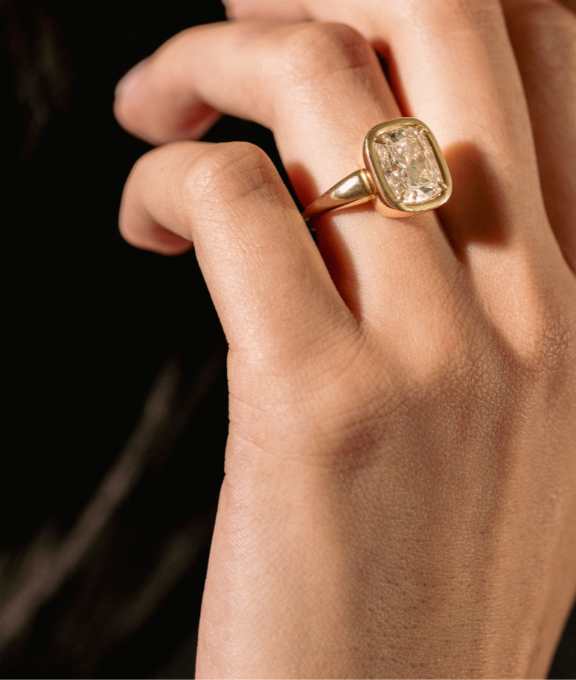
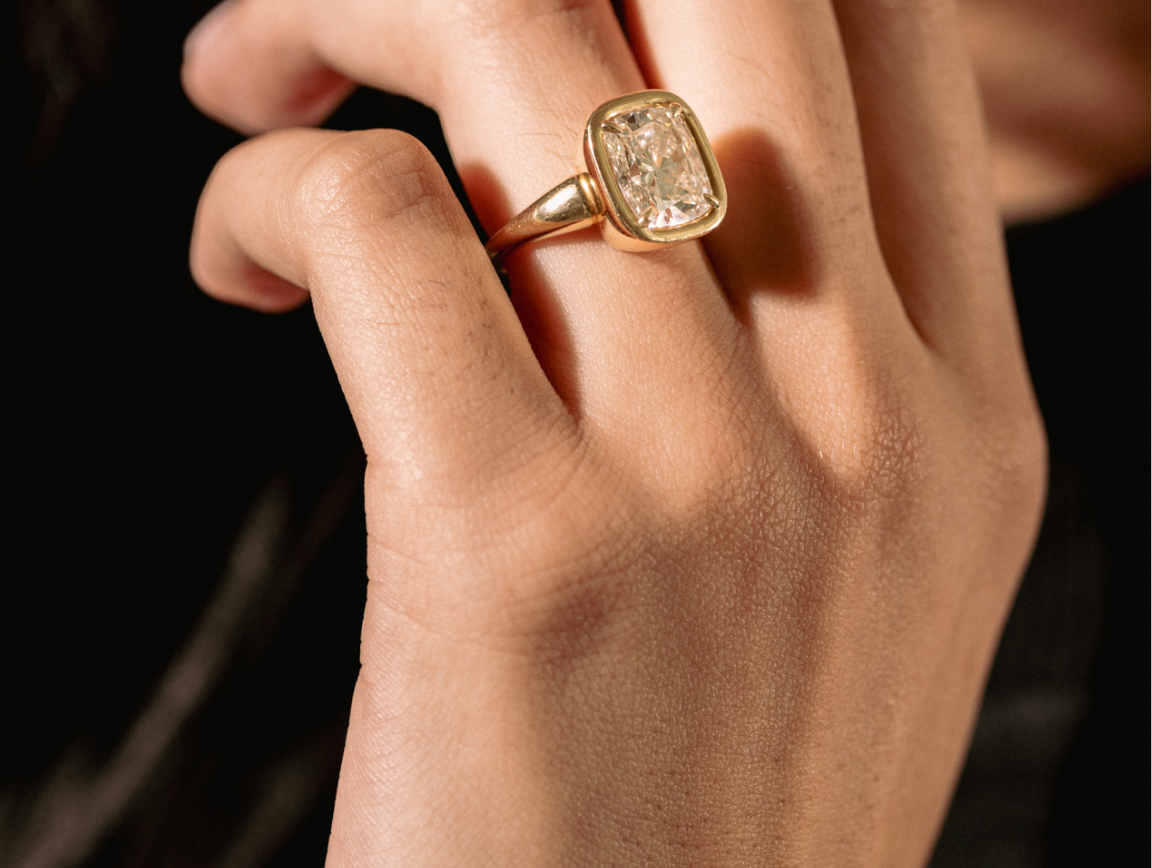
Every radiant is reviewed against our internal cut quality standards. Depth, table, and facet pattern are reviewed before the stone is set into any ring shown here.
Bracelets
By Style
Solitaire Series
MODERN SHAPES
Custom Processes
Learn how GOODSTONE's Diamond & Design experts work with you to craft your dream piece
GOODSTONE GUIDES
A GOODSTONE resource to enrich your knowledge on all things diamonds, gems, & jewelry
Commitment
Dive into GOODSTONE's ethos, where integrity, passion, and sustainability intertwine
Get in Touch
Connect with us through our dedicated contact portal for refined assistance and guidance
Visit Our Showroom
Experience our personalized service in Austin, TX.
By appointment only
Radiant-cut diamonds feature bold lines and bright sparkle, with a modern, structured look that feels refined and timeless. Explore our collection and find a ring that feels right.
Can't find the perfect diamond?
talk to an expert
Get a bespoke design from
GOODSTONE that'll last a lifetime.
The website was very easy to browse and offered a wealth of information for the process. Once I had settled on the design, Goodstone team helped to put everything together and assured me it would arrive on time.
JOHN L
Radiant cut engagement rings have a silhouette reminiscent of an emerald but with clipped edges, and dazzling facets like a round cut diamond. This unique combination results in a diamond that exhibits an effervescent and captivating sparkle, entrancing anyone who beholds its brilliance. Their versatility extends to a wide spectrum of grades, encompassing cut, color, clarity, and carat weight – providing a plethora of choices. Learn more about radiant cut diamonds here.
The Versatility of Radiant Cut Diamonds in Jewelry Design
The radiant cut diamond hybrid of rectangular and square shape results in an extremely versatile diamond shape. This versatility extends across various carat weights and proportions, making the radiant cut an ideal choice for those seeking a distinctive and personalized diamond ring that seamlessly combines the elegance of emerald cuts with the dazzling brilliance of round cuts.
Every radiant is reviewed against our internal cut quality standards. Depth, table, and facet pattern are reviewed before the stone is set into any ring shown here.
We offer radiant rings in solitaire, half-bezel, hidden halo, three-stone, and east-west settings in 14k gold, 18k gold, and platinum, giving buyers a range of styles and price points.
Each ring is crafted at our Los Angeles workshop using recycled gold. Overnight insured shipping is provided in a plain FedEx box, and an adult’s signature is required upon delivery.
Ready-to-ship rings qualify for free returns within 30 days. A lifetime warranty covers resizing, polishing, prong tightening, and replacement of small stones at no additional charge.
A radiant combines the elongated outline of an emerald cut with the scintillation of a round, making it suitable for buyers who want visible fire in a rectangular shape. An Asscher offers a different look with conservative step facets and cropped corners. A radiant prioritizes sparkle, while an Asscher draws attention to its geometric pattern.
The radiant appeals to buyers who want a rectangular shape with strong sparkle. Its cropped corners and brilliant faceting help create an elongated appearance while maintaining a lively return of light. A cushion cut offers a softer outline with rounded corners and broader curves. Buyers deciding between the two are choosing between sharper geometry and gentler silhouette.
The radiant comes in square or rectangular outlines with cropped corners. The rectangular version lengthens the finger in a way the emerald only approximates because the brilliant faceting adds visual lift. It matches the late-1990s-style vocabulary, serves as a brilliant-cut answer to the emerald, and suits a wearer who wants the silhouette of a step cut without giving up the sparkle of a round.
A radiant brings its late-’90s styling into the present without much fuss. Its cropped corners make it more durable than a marquise while maintaining strong sparkle. A marquise emphasizes length and shape, with pointed tips that draw attention and require more care around clothing. The choice is between a rectangular outline and a more dramatic silhouette.
The old European cut comes from an earlier era of diamond cutting, with broader facets and a round outline that produce larger, softer flashes of light. A radiant takes a more modern approach, combining brilliant faceting with a cropped square or rectangular shape to maximize brightness. Buyers choosing between the two are deciding between antique character and modern brilliance.
Buyers drawn to late-’90s glamour often gravitate toward the radiant, with its cropped corners, rectangular or square outline, and brilliant faceting. The old mine cut comes from an earlier era of diamond cutting, when stones were hand-shaped rather than optimized for modern proportions. Its broader facets and less uniform outline create an antique appearance. The choice is often between contemporary sparkle and antique character.
With its squarish proportions, a radiant sits squarely on the finger or stretches it slightly if elongated. The cropped corners soften the geometry. The pear’s asymmetrical outline ends in a point that requires protection from the setting. Choosing between the two centers on symmetry or asymmetry.
Available in both square and rectangular formats, the radiant offers more shape flexibility, with elongated versions creating a slight lengthening effect on the finger. The princess cut is firmly square, with sharp corners and brilliant faceting, popularized in the late ’90s. The decision comes down to preference over a square outline or a more elongated style.
Late-’90s engagement ring design helped popularize the radiant, with its cropped corners, brilliant faceting, and geometric outline. The round’s circular silhouette has remained popular across generations. The choice focuses on whether a buyer prefers a traditional round shape or a more angular profile.
Blake Asaad, founder
Discover More DiamondsA radiant cut is a square or rectangular brilliant-cut diamond with cropped, beveled corners and around 70 facets arranged across the crown and pavilion. Introduced by Henry Grossbard in New York City in 1977, it merges the silhouette of an emerald cut with the light return of a round brilliant. It was the first square or rectangular diamond to feature a complete brilliant-cut facet pattern on the top and the bottom. The shape appears modern, with straight sides and angular geometry softened by the cropped corners.
Neither is better. A square radiant has a length-to-width ratio close to 1.00, creating a compact, balanced look. An elongated radiant typically measures 1.20 to 1.50, with 1.25 to 1.35 considered the classic rectangular range, and creates more visual length on the finger. Square radiants emphasize symmetry, while elongated radiants focus on length.
A round brilliant has the highest light return because its proportions were developed to maximize it. A radiant’s roughly 70 facets create a crushed-ice scintillation pattern that returns more light than a princess but less than a round. A princess cut concentrates sparkle into a central X pattern visible through the table. A radiant produces broader flashes across the face, while a princess appears tighter and more geometric. The round is the brightest and most uniform of the three.
Yes. The broken, non-uniform facet pattern scatters light across the table, giving inclusions and faint color more places to disappear. SI1 and SI2 grades appear eye-clean in radiants, especially in elongated stones where light moves across more surface area. Color grades down to H and I face up white in most settings, particularly in yellow or rose gold mountings where the warm metal masks tint. Step cuts cannot do this, but radiants mask clarity and color better than emerald or Asscher cuts.
Most buyers settle on 1.20 and 1.35 for an elongated radiant-cut engagement ring. The 1.25 to 1.35 range is the classic rectangular look, appearing balanced and clean on the finger. Ratios closer to 1.20 look square, while 1.35 to 1.45 are longer. Above 1.50, the stone’s silhouette resembles an emerald. Compare two ratios side by side in our product page videos before deciding which version looks best on your hand.
Usually not. The cropped, beveled corners of a radiant are less vulnerable to chipping than the sharp 90-degree corners of a princess cut because they distribute impact more effectively. In a four-prong solitaire, the prongs cover those corners while securing the stone. Buyers who want additional protection can choose a six-prong setting or a bezel.
Radiants typically cost 10 to 30% less per carat than a round brilliant with similar color, clarity, and overall quality. Part of the difference comes from the cutting process. Radiants preserve more of the original crystal, while rounds can lose roughly 60% of the material during cutting and polishing. Demand for round brilliants is also higher, which contributes to the price gap. The same pattern applies to lab-grown radiants and rounds with comparable grades and certifications.
Platinum and white gold flatter colorless and near-colorless radiants in the D-to-G range because the cool metal enhances the stone’s white appearance. Yellow gold suits warmer radiants in the H to J range, since it warms the look and absorbs faint color. Rose gold looks romantic and matches with H-to-K stones for a softer tone. A mixed-metal ring, such as a white-gold head on a yellow-gold band, holds the stone’s whiteness and warmth on the finger.
It offers a contemporary look. The Art Deco era favored step cuts like the emerald and Asscher. A radiant can sit in a vintage-inspired mounting and pair with milgrain details or filigree, making the ring look softer and more traditional. The cut itself is the most modern of today’s mainstream diamond shapes.
SI1 and SI2 are usually eye-clean in radiant-cut diamonds because the broken facet pattern scatters light through and around inclusions. VS2 is the conservative ceiling for buyers who want certainty without paying for VVS. Inclusion location matters, as a dark inclusion at the center of the table can appear in lower-SI stones, whereas a tiny mark near the corners almost always hides under the prongs. SI1 is the most frequent value sweet spot for radiants, with VS clarity for those who want zero guesswork at a modest premium.
G is the conservative choice for buyers seeking an icy face-up appearance in a platinum or white-gold setting. H is often considered the value sweet spot for radiants and typically faces up white in white metals. I can also appear white in yellow or rose gold, where the warmer metal helps mask faint color. Below J, warmth becomes more noticeable even in warm-metal settings. A radiant’s crushed-ice scintillation can also soften the appearance of color compared with a step-cut diamond of the same grade.
A square radiant appears closer to a round of the same carat weight face-up, sometimes a fraction smaller in diameter but with a similar visual presence. An elongated radiant at a length-to-width ratio of 1.30 or higher is larger than a round of the same carat, since the long axis spreads more surface across the finger. Millimeter measurements matter more than carat weight when comparing shapes. A 3-carat elongated radiant typically measures about 9.1 by 9.3 millimeters and is wider than a round diamond of similar carat weight.
Trapezoid side stones suit three-stone radiant rings, with brilliant-cut trapezoids for sparkle continuity and step-cut trapezoids for contrast. Tapered baguettes are a classic step-cut option that elongates the ring along the finger, while round side stones soften the geometry and add brilliance. Pear- and shield-side stones offer a more modern look. The choice depends on whether the wearer wants the side stones to match or contrast with the radiant.
A straight wedding band sits flush against most radiant-cut solitaires and bezel-set rings, since the rectangular silhouette pairs cleanly with a straight band. A contoured band helps when the engagement ring has a cathedral profile, a halo, or a low-set stone where a straight band cannot reach. East-west radiants pair nicely with a straight band because the long axis lies across the finger. Pavé eternity bands are another option, adding subtle sparkle alongside the center stone on the finger.
GIA does not issue cut grades for fancy shapes like the radiant cut. Buyers instead evaluate proportions, finish, shape, and light return. Depths between 61 and 67% and tables between 61 and 69% are frequently cited ranges, with the 65-by-65 rule used as a quick guideline. Polish and symmetry should be graded Excellent or Very Good. The length-to-width ratio should match the intended shape, and a 360-degree video should show even light return.
Yes. GOODSTONE offers lab-grown stones above 2 carats, with 3- and 4-carat stones routinely in stock. Lab-grown pricing for a 3-carat radiant commonly runs in the low- to mid-thousands, depending on color and clarity, allowing buyers to purchase larger stones within the same budget. Elongated and square lab-grown radiants are produced with the same chemistry, light return, and certification as a natural diamond of similar grade.
A round brilliant generally holds the best resale value because it has the highest demand and deepest secondary market. Ovals also perform well, while radiants have less resale value because they account for a smaller share of diamond sales. Lab-grown radiants typically retain less value as the secondary market develops. Buyers focused on long-term wear often choose radiants for their lower purchase price over their resale potential.
Get in touch with our concierge team to book a one-on-one call with us to discuss about your Engagement Ring. We will walk through the process from diamond sourcing to choosing the perfect setting.